Industrial Seal Investment Insights: Where Margin Pressure Is Rising
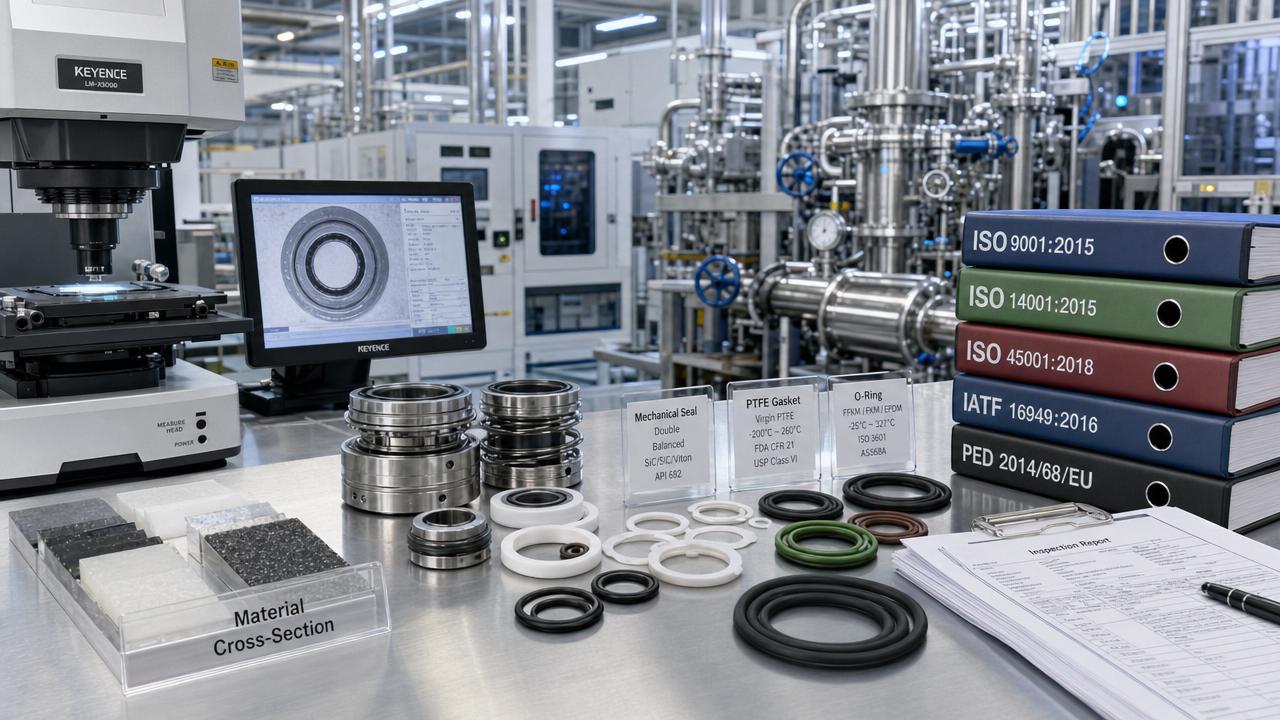
Industrial seal investment insights are becoming essential as margin pressure spreads across multiple layers of industrial supply chains. In sealing markets tied to energy, semiconductor processing, chemical handling, aerospace systems, and high-reliability automation, cost increases are no longer driven by raw materials alone. Compliance burdens, qualification cycles, application-specific engineering, and after-sales liability are all reshaping profitability. For companies evaluating extreme-environment mechanical seals, polymer gaskets, or custom containment components, the key question is not simply which segment is growing, but where value is still defendable. This article examines where margin pressure is rising, what the trend means for industrial decision-making, and how to interpret industrial seal investment insights with greater precision.
What do industrial seal investment insights actually reveal about margin pressure?
At a basic level, industrial seal investment insights help explain the gap between revenue growth and profit quality. A seal manufacturer may report increasing orders, yet still experience declining margins if the business mix shifts toward lower-differentiation products, frequent customizations, or contracts with fixed pricing under volatile material conditions. In industrial sealing, this problem is especially visible because many products appear simple on the surface but carry hidden engineering and validation costs.
Margin pressure often rises when three forces converge. First, input inflation affects elastomers, PTFE blends, graphite, specialty metals, and energy-intensive processing. Second, customers demand higher traceability, tighter leakage performance, and longer documented service life. Third, competition intensifies in standardized categories such as general-purpose gaskets, O-ring kits, and replacement seals, where price comparison is easy and switching barriers are limited.
Strong industrial seal investment insights therefore separate high-volume activity from durable pricing power. The most useful interpretation asks whether margin is being protected by certified materials, application know-how, installed-base dependence, and failure-risk sensitivity. When those factors weaken, gross profit usually comes under pressure even if shipments remain stable.
Which industrial seal segments are seeing the sharpest profitability squeeze?
The sharpest squeeze is usually found in segments caught between commoditization and rising technical expectations. Standard flange gaskets, molded seals for non-critical equipment, and maintenance-replacement parts in price-driven channels are common examples. These categories face aggressive bidding while still absorbing increased costs for compound consistency, dimensional inspection, and logistics resilience.
Another vulnerable area is mid-tier custom sealing. These products require engineering support, but not always enough performance differentiation to justify premium pricing. A supplier may invest in drawing reviews, prototype iterations, tooling changes, and short-run production, only to face annual price-down demands once the part is qualified. Industrial seal investment insights frequently show this as a margin trap: high effort, moderate risk exposure, and limited ability to scale efficiently.
By contrast, some specialized categories remain more resilient. Mechanical seals for corrosive fluids, high-purity semiconductor environments, hydrogen systems, or vacuum-critical applications can still preserve margin when failure consequences are severe and qualification barriers are high. However, even here, profitability is not automatic. Longer validation periods, documentation requirements, and field reliability commitments can offset premium pricing if engineering resources are stretched too thin.
- Highest pressure: standardized gaskets, low-complexity replacement seals, broad catalog products
- Hidden pressure: custom mid-spec seals with frequent revisions and low repeat volume
- Conditional resilience: extreme-environment mechanical seals and high-purity specialty sealing
Why are material, compliance, and qualification costs changing the economics?
Industrial seal investment insights increasingly point to non-material cost expansion as a central issue. Material volatility still matters, especially for FFKM, fluoropolymers, engineered fillers, and corrosion-resistant alloys, but compliance and qualification now shape economics just as strongly. In high-specification industries, the cost to prove performance can rival the cost to manufacture the part itself.
For example, a sealing product used in semiconductor tools, high-pressure gas systems, or regulated processing lines may require batch traceability, outgassing control, media-compatibility evidence, particulate limits, and alignment with ISO, API, SEMI, or application-specific internal standards. Those requirements create overhead in testing, document management, audits, and change control. If the commercial model does not recover these costs, reported growth may conceal shrinking returns.
Qualification cycles also delay revenue realization. A technically superior seal can take months or even longer to gain acceptance in a critical system. During that period, engineering labor accumulates, samples are revised, and production planning remains uncertain. Industrial seal investment insights are most valuable when they account for this timing mismatch between upfront technical investment and downstream profit capture.
How should industrial seal investment insights be used to compare suppliers or product strategies?
A useful comparison starts with profit architecture, not headline scale. Two suppliers may serve similar sectors, yet one depends on engineered, recurring, specification-bound business while the other relies on transactional replacement demand. Industrial seal investment insights become far more meaningful when combined with questions about mix quality, validation barriers, and technical substitution risk.
Several indicators help distinguish stronger positioning. One is application criticality: seals used in failure-sensitive systems usually carry better margin durability than parts installed in easily replaceable assemblies. Another is material specialization. A supplier with proven expertise in aggressive media, ultra-clean environments, thermal cycling, or high-pressure containment may defend price through performance evidence rather than sales effort alone.
It is also important to examine the engineering-to-revenue ratio. High technical support is not automatically positive. If custom design requests are frequent but repeat volumes remain low, engineering becomes a margin drain. Better industrial seal investment insights come from asking whether technical input creates long-term lock-in, qualification stickiness, or cross-platform reuse.
- Check how much revenue comes from regulated, validated, or mission-critical applications
- Measure exposure to commodity distribution channels versus engineered direct programs
- Review how often product changes trigger requalification, scrap, or non-billable engineering work
- Look for evidence of material science depth, not just catalog breadth
What common mistakes lead to poor interpretation of industrial seal investment insights?
One common mistake is assuming that higher technical complexity always produces better margins. In reality, complexity without standardization can destroy profitability. A seal program with dozens of slight geometry variants, inconsistent order patterns, and customer-specific testing may consume disproportionate resources. Unless pricing reflects that burden, complexity becomes dilution rather than strength.
Another mistake is focusing only on material cost pass-through. Many industrial seal investment insights are misread because analysts track resin or alloy pricing but ignore less visible expenses such as cleanroom handling, validation documentation, warranty reserves, and field-failure exposure. In critical containment applications, these soft costs can materially change return profiles.
A third error is treating all end markets as equally attractive. Growth in a cyclical sector can temporarily inflate demand, but if the product is easily substituted or overexposed to project-based bidding, margins may remain unstable. Better judgment comes from assessing whether the sealing product is embedded in a long-life platform, protected by operating history, or linked to a broader service ecosystem.
What actions help reduce risk when margin pressure is rising?
When industrial seal investment insights indicate rising pressure, the response should focus on selective depth rather than broad expansion. Concentrating on applications where containment failure has measurable operational, safety, or regulatory consequences usually improves pricing discipline. This is especially true in high-pressure flow control, corrosive media transfer, advanced fabrication environments, and thermal or vacuum extremes.
Portfolio discipline matters as well. Reducing low-repeat custom variants, tightening qualification filters, and standardizing material platforms can preserve engineering capacity for programs with better lifetime value. In many cases, the path to stronger margins is not more products, but fewer products with stronger technical defensibility.
Operationally, resilient players often improve quoting logic, link pricing to documentation scope, and treat traceability as a monetizable feature rather than a hidden overhead. They also use industrial seal investment insights to identify where premium positioning is justified by lower leakage risk, better chemical compatibility, or lower total cost of failure.
Industrial seal investment insights are most valuable when they move beyond simple market-growth narratives and reveal where technical value is truly monetized. Rising margin pressure is concentrated in areas where sealing products are increasingly expected to perform like critical engineered components while still being purchased like interchangeable parts. The strongest opportunities tend to remain in segments where validation depth, application severity, and failure cost create real barriers to substitution.
The next step is to evaluate seal portfolios, suppliers, or target segments through a sharper lens: technical defensibility, qualification economics, compliance load, and lifecycle pricing power. Using industrial seal investment insights in this way supports better capital allocation, lower sourcing risk, and more reliable performance across the systems where containment and flow cannot fail.
Industry Briefing
Get the top 5 industry headlines delivered to your inbox every morning.