How high tech supply chain sourcing reduces contamination risk
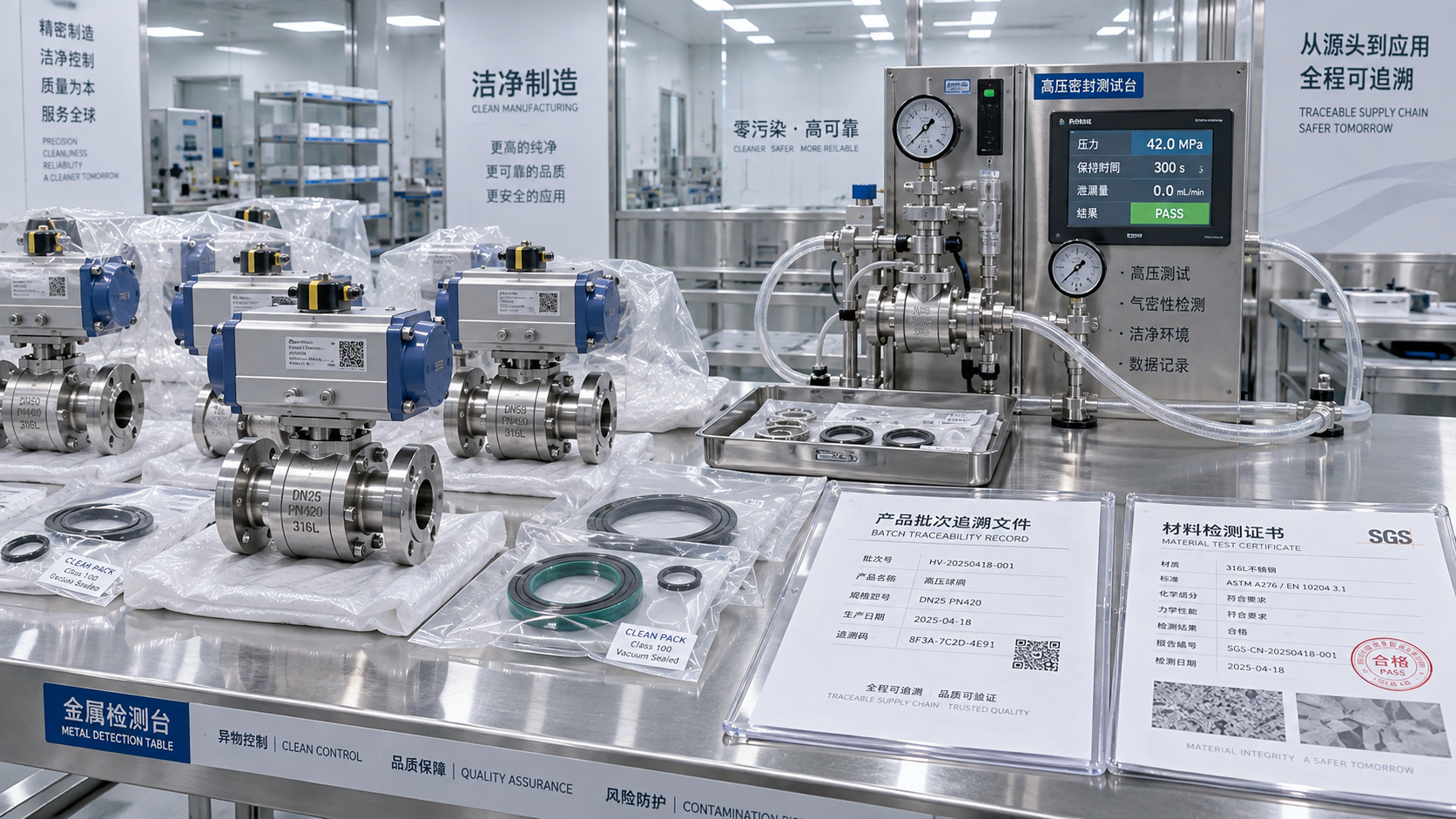
How High Tech Supply Chain Sourcing Reduces Contamination Risk
High tech supply chain sourcing is a critical safeguard against contamination in precision-driven operations. For quality control and safety managers, selecting validated suppliers for valves, seals, actuators, and specialized materials helps maintain clean-process integrity, traceability, and regulatory compliance. By applying rigorous technical benchmarks and supplier qualification standards, organizations can reduce particulate, chemical, and cross-contamination risks across sensitive manufacturing and energy systems.
The issue is often misunderstood as a housekeeping problem. It is not. A cleanroom may be well managed, and a process may be carefully documented, yet contamination can still enter through a seemingly minor component: an elastomer with unsuitable extractables, a valve assembled with the wrong lubricant, a pneumatic actuator that sheds particles during cycling, or a replacement gasket supplied without material traceability. In high-consequence environments, the supply chain becomes part of the contamination-control system.
That changes how procurement decisions should be made. The lowest unit price may appear attractive on a purchase order, but it does not reflect the cost of incoming inspection, process interruption, cleaning, requalification, field replacement, rejected product, or an investigation into an unexplained contamination event. Effective sourcing is therefore not simply a buying function. It is a disciplined method for controlling uncertainty before components enter production or service.
Contamination Begins Long Before Installation
In complex manufacturing and energy systems, contamination pathways are rarely limited to visible debris. Particles, residual oils, moisture, cleaning-agent residues, outgassing compounds, corrosion products, fibers, and incompatible chemicals can all affect performance. The relevant risk depends on the process. Semiconductor-adjacent equipment may be highly sensitive to particles and molecular contamination. Hydrogen, chemical-processing, aerospace, medical, RF, and vacuum applications may place more emphasis on leakage, material compatibility, pressure integrity, thermal stability, or degradation under cycling.
A component can meet its basic dimensional drawing and still be unsuitable for the actual environment. A seal may fit correctly but swell in contact with the medium. A valve may be pressure-rated but retain residues incompatible with a high-purity gas line. A polymer gasket may survive normal service temperatures while releasing compounds that are unacceptable in a vacuum or sensitive analytical process. These are sourcing failures because the required operating context was not translated into supplier requirements.
The practical lesson is that contamination control starts with the specification package. It should define more than size, pressure class, and delivery date. Where relevant, it should state permitted materials, cleaning expectations, packaging conditions, storage limitations, documentation needs, traceability level, and change-notification requirements. Ambiguous specifications invite substitutions, and substitutions are a common route by which hidden risk reaches the site.
Why Supplier Qualification Has a Direct Safety and Quality Effect
A qualified supplier is not merely a supplier with a certificate on file. Qualification should establish whether the supplier can repeatedly produce, handle, inspect, package, and document a component in a manner consistent with the intended process. For contamination-sensitive procurement, this means asking how materials are controlled, how lots are identified, whether cleaning is defined and repeatable, how nonconforming product is segregated, and what happens when a sub-tier source changes.
Certificates can support this assessment, but they do not replace it. ISO-based quality systems, SEMI-related requirements, API expectations, MIL-SPEC references, and customer-specific control plans each apply differently depending on the equipment and market. A standard cited in a brochure is not proof that a particular component, lot, cleaning method, or configuration meets the requirement needed for a project. Procurement and quality teams need to connect the stated standard to the exact supplied item and its documented condition.
This is especially important when the component is safety-critical or difficult to replace. A 700 bar hydrogen-compatible valve, for example, demands a different review from a general industrial valve. The buyer may need to examine pressure capability, medium compatibility, sealing architecture, material provenance, test documentation, and the supplier’s approach to configuration control. The same principle applies to perfluoroelastomer (FFKM) sealing elements, industrial magnetrons, piezoelectric positioners, and precision pneumatic assemblies: performance cannot be separated from cleanliness, material discipline, and repeatability.
The questions that reveal sourcing maturity
The most useful supplier discussions are specific. Rather than asking whether a supplier “has quality control,” buyers should ask what prevents contamination or unapproved variation from reaching shipment. Can the supplier identify the production lot and raw-material batch? Is the final cleaning process documented where cleanliness is required? Are lubricants, mold-release agents, adhesives, and processing aids controlled? Is packaging selected to preserve the required condition through transport and storage? Can the supplier notify the customer before changing a resin grade, compound formulation, coating, subcomponent, or manufacturing location?
Clear answers do more than reduce quality risk. They reduce the time consumed by incoming inspection and problem containment. When traceability is weak, even a small deviation can trigger a broad review of stock, installed equipment, prior deliveries, and production lots. When records are complete and the supply route is controlled, the scope of an investigation is easier to define.
The Cost Case: Unit Price Is Not the Cost of Contamination
Cost pressure is real, particularly for recurring maintenance parts and high-volume assemblies. Yet a comparison based only on purchase price tends to hide the expense transferred to operations. A lower-cost component with inconsistent documentation may require additional receiving checks. A seal with uncertain compound control may force more frequent replacement or cause avoidable downtime. An incorrectly cleaned valve can create a process issue that takes far longer to investigate than the original sourcing decision took to make.
A more useful commercial comparison considers total exposure across the component life cycle. This does not require speculative financial models. It requires asking where a low-cost offer creates additional work or uncertainty.
The goal is not to specify the most expensive component in every situation. It is to buy the level of assurance the process actually needs. A noncritical utility application may accept a broader supplier base and simpler documentation. A high-purity fluid system, precision positioning platform, or high-frequency energy assembly may justify tighter controls because the cost of uncertainty is disproportionately high.
Match the Control Level to the Failure Mode
Different component families introduce contamination risk in different ways. Seals and gaskets require attention to compound identity, storage condition, compression set, media exposure, and the possibility of particulate shedding or chemical migration. Valves require review of internal surface condition, dead-leg geometry where applicable, assembly lubricants, leak testing, and cleaning compatibility. Actuators can introduce wear particles, lubricant migration, or inconsistent motion that compromises a controlled process. Microwave and RF systems may involve materials, thermal interfaces, enclosure integrity, and maintenance practices that are not obvious in a conventional procurement checklist.
This is where generic approved-vendor lists often fall short. A supplier may be appropriate for standard industrial service but not for a process with strict cleanliness, vacuum, pressure, electromagnetic, or extreme-environment requirements. Supplier approval should be tied to the application category, not treated as a permanent pass for every component and every operating condition.
The Global Precision-Control & Specialized-Sealing (G-PCS) approaches this challenge through the “Logic of Containment and Flow”: the recognition that material choice, sealing performance, pressure control, energy delivery, actuation precision, and documentation discipline interact. Its technical intelligence repository spans Ultra-High Pressure control and valves, industrial microwave and RF energy systems, extreme-environment mechanical seals, high-precision pneumatic and piezoelectric actuators, and specialized polymer and composite gaskets. That cross-disciplinary view is useful because contamination problems frequently arise at the boundaries between these systems rather than within a single component category.
Benchmarking against relevant ISO, SEMI, API, and MIL-SPEC frameworks can help organizations build a more defensible sourcing baseline. It should not be used as a shortcut or a claim that one standard automatically solves every risk. The relevant question remains practical: which requirements apply to this medium, environment, installation method, cleanliness target, and failure consequence?
Build Contamination Controls Into the Procurement Workflow
The strongest programs avoid placing all responsibility on final inspection. By the time an incoming inspector discovers an unsuitable material or questionable package condition, the organization may already be facing a shortage. A better approach introduces control points before the order is released and maintains them through receipt.
- Define the process exposure: medium, pressure, temperature, cleanliness sensitivity, cycling profile, and consequences of leakage or material degradation.
- Translate exposure into purchase requirements, including approved materials, documentation, cleaning, packaging, and prohibited substitutions.
- Review suppliers by criticality. High-risk components need deeper technical and quality review than standard consumables.
- Require change notification for characteristics that could affect containment, cleanliness, compatibility, or validation status.
- Set receiving checks that verify the risks most likely to escape supplier controls, rather than repeating every supplier test.
This workflow also improves communication between procurement, engineering, quality, safety, and maintenance. Purchasing teams are not expected to become material scientists, but they do need a usable escalation path when an offer differs from the approved specification. Engineering teams, in turn, need to describe requirements in a way that can be placed on an order, audited, and checked at receipt.
Avoid the Common “Equivalent” Trap
“Equivalent” is one of the most costly words in contamination-sensitive sourcing when it is not defined. Two seals can share nominal dimensions but use different polymer formulations. Two valves can have similar flow ratings but differ in wetted materials, internal finishes, cleaning history, or assembly practices. Two actuators can meet a force requirement while producing different particle loads or requiring different lubricants. Dimensional interchangeability is not functional equivalence.
When alternatives are necessary because of lead time, obsolescence, or cost, they should be evaluated against the original failure mode. Does the alternative preserve material compatibility? Does it change the fluid-contact path, sealing behavior, particle-generation potential, temperature margin, or documentation availability? Is requalification required by internal procedure, customer commitment, or applicable standards? The answer may be simple for a low-risk item and demanding for a critical one, but the decision should be visible and controlled.
A More Defensible Purchasing Decision
High tech supply chain sourcing reduces contamination risk when it treats component provenance, material behavior, cleaning, handling, and configuration control as part of the delivered product. It does not require excessive documentation for every bolt or gasket. It requires proportionate rigor where process integrity depends on what enters the system.
Before approving a lower-cost source or an alternative part, confirm the application conditions, the contamination pathways that matter, the exact evidence available for the proposed item, and the operational cost of being wrong. For critical containment and flow applications, that review is often the difference between a purchase saving on paper and a controlled, reliable supply decision in practice.
Industry Briefing
Get the top 5 industry headlines delivered to your inbox every morning.