Environmental equipment news and updates shaping cleanroom gas systems
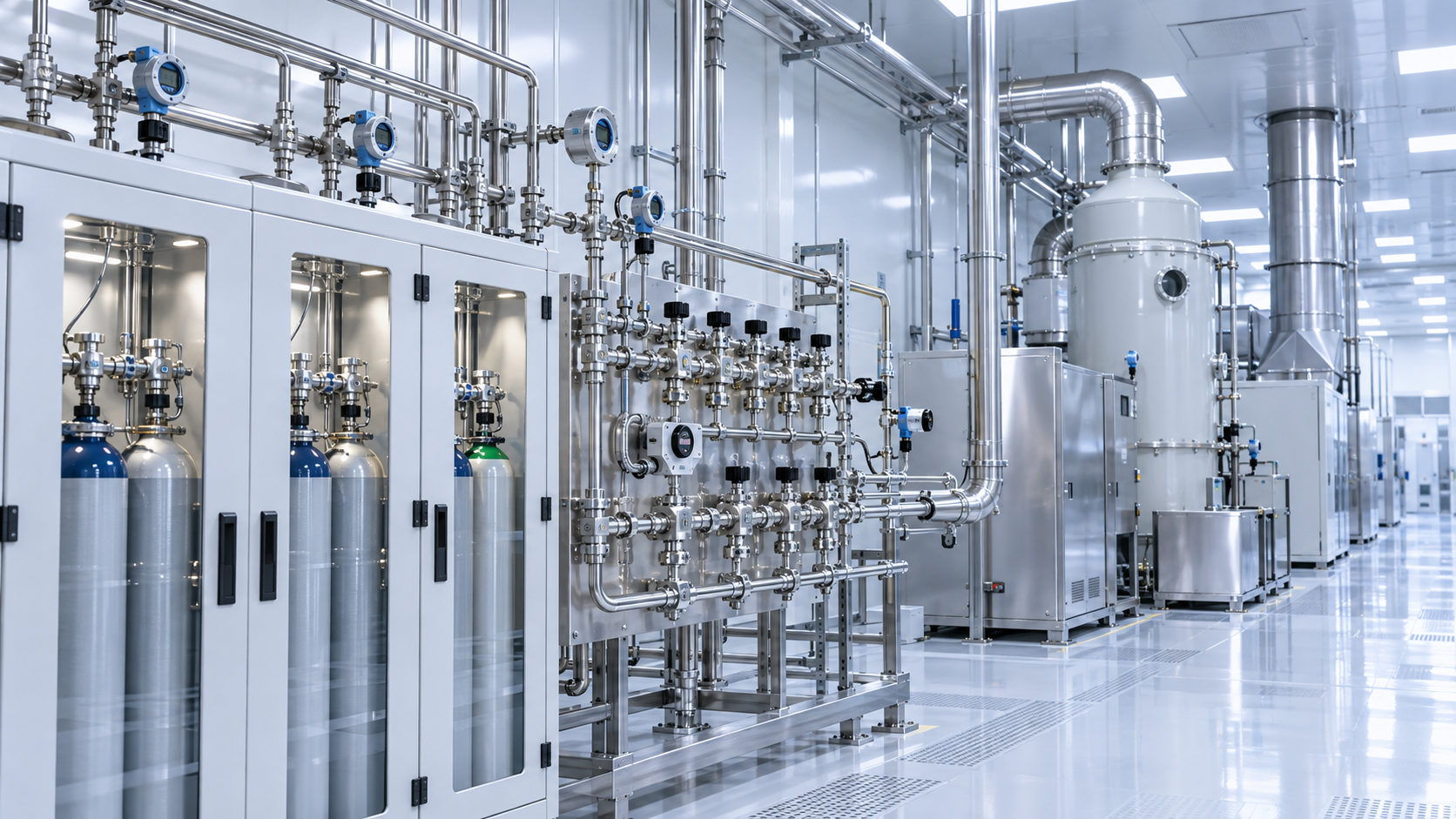
Why cleanroom gas systems are moving into the environmental-equipment conversation
Environmental equipment news and updates matter to cleanroom gas-system evaluators because the boundary between “process utility” and “environmental control” is becoming less useful. A gas cabinet, valve manifold, abatement connection, purge circuit, or exhaust interface can influence personnel exposure, emissions management, contamination risk, uptime, and product yield at the same time. For semiconductor, aerospace, advanced-energy, and other high-sensitivity facilities, that overlap changes how equipment should be specified and reviewed.
The immediate implication is practical: a gas delivery system should no longer be assessed only by nominal flow range, pressure rating, or whether it can connect to a given cylinder or bulk source. Technical teams need to understand how the system behaves during changeover, purge, upset, maintenance, and shutdown. Those events are where containment, emissions handling, and cleanroom integrity meet.
This does not mean every cleanroom gas installation requires the most complex environmental-control architecture available. It does mean that procurement decisions based solely on component datasheets can miss the conditions that determine real operating risk. The useful market signals are the ones that reveal how suppliers, facilities, and regulators are treating gas containment as a system-level responsibility.
Containment performance is becoming a lifecycle issue
Historically, technical reviews often separated process performance from environmental performance. A valve was selected for compatibility and cycle life; an enclosure was reviewed for ventilation; an exhaust line was assigned to a separate facilities package. That division can work for stable, low-hazard utilities, but it becomes fragile when gases are toxic, pyrophoric, corrosive, high purity, greenhouse-active, or costly enough that losses have material operational consequences.
Recent environmental-equipment discussions increasingly focus on what happens beyond normal steady-state delivery. That focus is justified. A cleanroom gas system may operate within specification for long periods while still carrying unresolved weaknesses in its purge design, trapped-volume management, relief routing, leak-detection coverage, or serviceability. A small dead leg may not be visible in a high-level piping diagram, yet it can lengthen purge cycles, retain reactive residues, complicate maintenance, and increase the consequences of an intervention.
For technical evaluators, the relevant question is not simply whether a component is leak-tight when new. It is whether the assembled system preserves containment after repeated cycling, thermal variation, cylinder replacement, cleaning, actuator wear, and seal exposure. This shifts attention toward several engineering details that are easy to underweight during early specification:
- the number and location of mechanical joints, particularly in areas requiring recurring service;
- seal material compatibility with the full gas stream, cleaning media, temperature envelope, and expected maintenance practices;
- internal volumes that cannot be effectively purged or monitored;
- the response of valves and actuators during loss of power, loss of pneumatic supply, or emergency shutdown;
- how vent, purge, and relief paths connect to the site’s treatment or exhaust infrastructure;
- the ability to identify a leak source without opening multiple sections of the system.
Specialized sealing is central to this assessment. The correct material cannot be chosen by chemical compatibility tables alone. Perfluoroelastomer, metal, fluoropolymer, and composite sealing approaches each involve tradeoffs involving permeation, compression behavior, particle generation, temperature cycling, extractables, installation sensitivity, and replacement intervals. A seal that appears chemically robust may still be a poor fit for a high-cycle valve or an application where particulate control is as important as gas containment.
Environmental scrutiny tends to expose these tradeoffs earlier. When a facility seeks to reduce emissions, improve incident readiness, or document more reliable abatement performance, it must look upstream at how gases are isolated and routed. Better treatment equipment cannot fully compensate for a delivery design that creates uncontrolled residual volumes or makes routine service a containment event.
The useful updates are about interfaces, not isolated equipment categories
Environmental equipment coverage can be misleading when it treats abatement units, scrubbers, monitoring instruments, gas cabinets, and cleanroom exhaust as independent product categories. In a critical facility, their performance is connected by pressure balance, flow stability, materials compatibility, controls logic, and maintenance sequencing.
Consider the interface between a high-purity gas panel and downstream process equipment. A pressure disturbance during switching or purge can affect more than delivery consistency. It can alter the performance of point-of-use treatment, change dilution conditions in an exhaust line, or create backflow risk if the system has not been engineered around credible fault states. The gas panel may comply with its own specification while the complete installation remains difficult to operate safely or consistently.
The same issue appears at the boundary between gas cabinets and facility exhaust. Exhaust capacity alone is not an adequate design conclusion. Evaluators need to understand the expected flow profile, cabinet pressure control approach, alarm behavior, effects of filter loading or duct changes, and how the design performs when multiple connected systems are operating under non-routine conditions. A change to facility ventilation can alter the assumptions behind a cabinet installation without any modification to the cabinet itself.
Control architecture is therefore becoming a more important part of environmental performance. Technical teams should examine whether alarms, valve states, ventilation signals, gas detection, and abatement interlocks are coordinated in a way operators can understand during an upset. A system with many sensors is not automatically more resilient. Poorly prioritized alarms can obscure the initiating condition, while overly aggressive automatic shutdown can introduce contamination, pressure, or recovery problems elsewhere in the process.
A disciplined review asks for cause-and-effect logic rather than a generic statement that the system is “fully interlocked.” It should identify what occurs when a detector enters alarm, when exhaust flow falls outside its permitted range, when a valve does not reach commanded position, when abatement availability is lost, and when communications between subsystems fail. The desired response may differ by gas chemistry and process criticality. The important point is that it has been deliberately defined, tested, and documented.
Purity and sustainability can reinforce each other, but they do not always align
Cleanroom gas systems are frequently discussed in terms of purity because contamination can affect deposition, etch, epitaxy, analytical accuracy, or material performance. Environmental initiatives add another set of priorities: reduced gas consumption, lower fugitive losses, better treatment of hazardous streams, and more complete documentation of emissions pathways.
In many cases, these goals support one another. Reducing leaks improves both purity protection and emissions control. A well-designed purge sequence can limit air or moisture ingress while reducing the amount of high-value process gas discarded during maintenance. Better valve repeatability can help prevent both process variability and unnecessary venting. High-integrity connections can reduce contamination opportunities while simplifying leak-management programs.
There are also situations where the objectives need to be balanced rather than assumed to be identical. Longer purge cycles may improve confidence before returning a line to sensitive service, while increasing inert-gas use and exhaust load. More frequent preventive replacement of wetted components can reduce the probability of in-service failure but generate additional waste and interruption. A more elaborate containment architecture may reduce release risk but add fittings, controls, and maintenance points.
Technical evaluators should avoid treating any single metric as a proxy for environmental quality. Low gas consumption does not necessarily prove low emissions if recovery or treatment conditions are unclear. A tight component specification does not demonstrate cleanroom suitability without considering particle control and purgeability. A high-efficiency treatment claim says little about total performance unless the incoming stream, bypass conditions, maintenance state, and measurement boundary are defined.
For this reason, a useful evaluation framework considers the complete gas path:
Standards should frame the review, not replace engineering judgment
Standards and customer specifications remain essential in this market. Requirements associated with semiconductor equipment, pressure systems, industrial safety, materials performance, and environmental management help establish a common language between equipment makers, integrators, and facility owners. They are particularly valuable when defining documentation, inspection, test methods, traceability, and responsibilities at interfaces.
However, compliance language can create false confidence when it is used as a substitute for application-specific evaluation. A component may be qualified to a recognized standard while still being poorly matched to a particular gas chemistry, duty cycle, installation geometry, or contamination budget. Likewise, a system may be assembled from compliant parts but lack a coherent plan for fault handling or maintenance isolation.
The most productive use of standards is to turn broad obligations into reviewable evidence. For a cleanroom gas system, that evidence may include material certificates where appropriate, pressure-test and leak-test records, weld or assembly records, cleaning and packaging controls, valve functional testing, alarm matrices, maintenance instructions, and clear boundaries of responsibility for exhaust and abatement connections. The formality required will vary, but ambiguity at the handoff between supplier and facility should be treated as a technical concern rather than a contractual detail.
Environmental requirements also evolve differently across locations and end markets. A procurement team should resist copying a specification from one site to another without checking local permitting assumptions, facility exhaust arrangements, process-gas inventories, and customer-imposed reporting obligations. The equipment itself may travel well; the operating context often does not.
What to watch in the next round of equipment decisions
The most consequential changes are likely to be less visible than a new cabinet design or a higher-capacity abatement unit. They will appear in how systems generate evidence about their own condition. Demand for more traceable maintenance, better event records, valve-state confirmation, gas-use reconciliation, and fault diagnostics is likely to influence both equipment architecture and supplier qualification.
This does not require turning every gas line into an over-instrumented data project. The aim is to make important failure modes observable. A pressure trend that identifies a developing restriction, a confirmed valve position that distinguishes command failure from mechanical failure, or a monitored exhaust condition that explains an interlock can be more useful than a large volume of disconnected data.
There is also growing pressure on suppliers to demonstrate repeatability across component engineering and field installation. For high-performance UHP valves, pneumatic actuators, and specialized gaskets, nominal capability matters less than controlled manufacturing, material traceability, installation guidance, and a credible method for managing configuration changes. A redesigned seal, alternative actuator, or different surface treatment can alter the behavior of an otherwise familiar assembly.
For technical evaluators, the practical response is to review cleanroom gas projects as containment-and-flow systems with environmental consequences, rather than as a collection of catalog components. Ask where gas can remain, where it can escape, where it can carry contaminants, how the system behaves when its assumptions fail, and whether the resulting evidence is sufficient for operations to act on. Those questions are where environmental equipment news becomes relevant to procurement decisions long before a facility is forced to respond to an incident or compliance gap.
Industry Briefing
Get the top 5 industry headlines delivered to your inbox every morning.