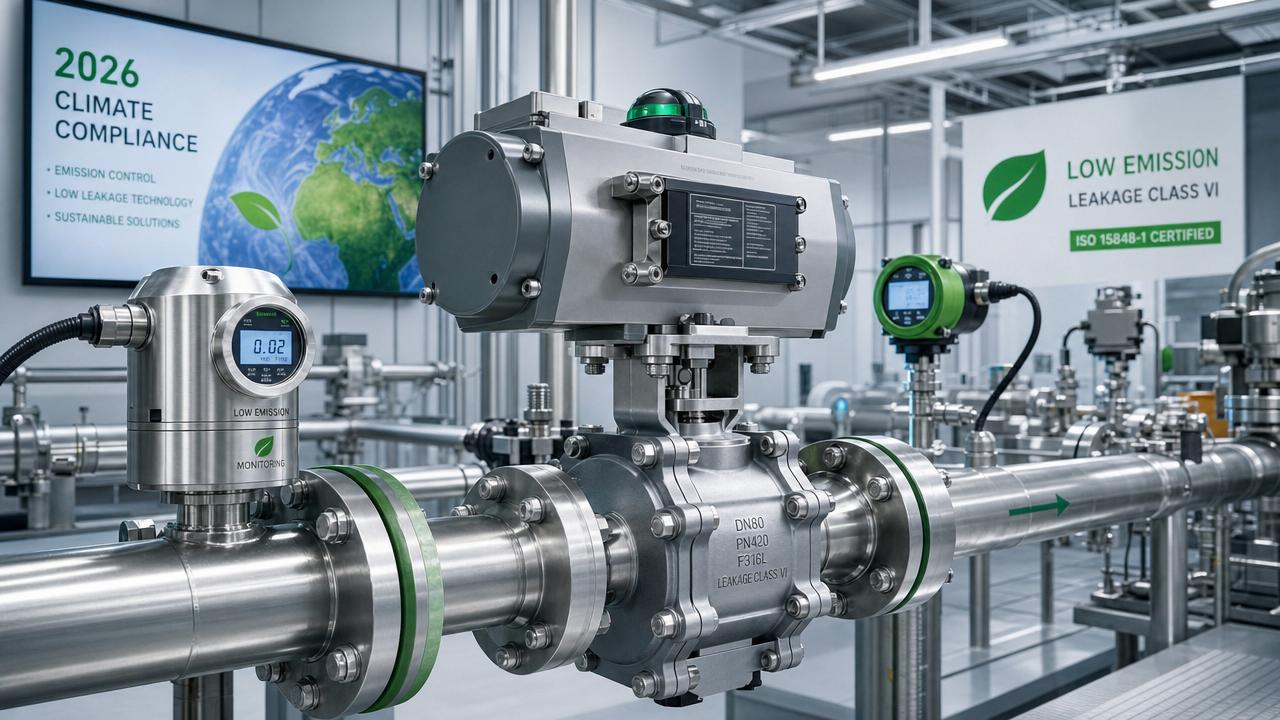
In 2026, environmental equipment news for climate change is no longer just a sustainability update.
It is a strategic signal for compliance, procurement, and operational resilience across high-value industrial systems.
As regulators tighten emissions, containment, and efficiency requirements, decision-makers must evaluate advanced valves, seals, actuators, and control technologies.
This article explains the developments shaping climate compliance across precision-control and specialized-sealing applications.
Search Intent and Editorial Focus
Executives searching this topic usually want to know which equipment changes will affect compliance, capital planning, and supplier qualification.
They are less interested in broad climate commentary and more concerned with leakage risk, emissions reporting, reliability, certification, and lifecycle cost.
The most valuable guidance connects regulatory pressure with practical component decisions in valves, seals, gaskets, actuators, and monitoring systems.
This article therefore emphasizes business impact, technical evaluation criteria, procurement signals, and risk controls rather than generic sustainability language.
Why 2026 Is a Turning Point for Environmental Equipment Decisions
The most important 2026 shift is that climate compliance is moving from corporate reporting into equipment-level engineering requirements.
Facilities are increasingly expected to prove that containment, pressure control, and energy systems support measurable emissions reduction.
For enterprise leaders, this changes environmental equipment news for climate change from background information into procurement intelligence.
Equipment specifications now influence permitting, insurance, customer audits, and the ability to enter regulated international supply chains.
High-performance industries face particular scrutiny because small leaks, unstable flow, or seal degradation can create disproportionate compliance exposure.
Semiconductor fabs, hydrogen infrastructure, aerospace test systems, pharmaceutical plants, and RF energy platforms all depend on environmental integrity.
In these sectors, climate compliance is not only about carbon accounting but also about verified containment and process stability.
The Compliance Questions Executives Should Ask First
Decision-makers should begin with one question: does the equipment reduce measurable environmental risk under real operating conditions?
A low-emission claim has limited value unless it is supported by test data, standards alignment, and documented application boundaries.
The second question is whether the equipment helps the organization pass future audits without expensive redesign.
Climate-related rules are evolving quickly, so short-term compliance can become a stranded investment if specifications are too narrow.
The third question is whether suppliers can provide traceability, materials documentation, performance curves, and maintenance assumptions.
For precision-control and specialized-sealing systems, missing documentation can create procurement delays and operational risk during regulatory reviews.
Executives should also ask how failure modes affect emissions, safety, uptime, and total cost of ownership.
Low-Leakage Valves Are Becoming Climate Compliance Assets
Valves are moving from mechanical commodities to compliance-critical assets, especially in hydrogen, specialty gases, refrigerants, and chemical processing.
In 2026, buyers should expect stronger attention to fugitive emissions, stem sealing performance, and cycle durability.
For ultra-high pressure applications, a valve’s environmental value depends on leakage rate, pressure stability, materials compatibility, and fail-safe behavior.
Hydrogen systems are a clear example, because small molecules challenge sealing surfaces and accelerate qualification complexity.
Procurement teams should evaluate valves against relevant ISO, API, and application-specific requirements rather than relying on catalog pressure ratings.
They should also compare maintenance intervals, actuation response, and performance under temperature cycling or vibration.
The business case is strongest where low-leakage valves reduce reporting uncertainty, downtime, gas losses, and inspection frequency.
Advanced Sealing Systems Are Central to Emissions Control
Sealing technology is one of the most underestimated areas in climate compliance planning.
A high-value system can fail environmental expectations if seals degrade, swell, crack, or lose compression under process stress.
Extreme-environment mechanical seals, FFKM elastomers, PTFE-based components, and composite gaskets are receiving greater attention in 2026.
The reason is simple: containment performance directly affects emissions, contamination control, and equipment reliability.
Decision-makers should verify chemical compatibility, compression set resistance, thermal limits, and documented performance in aggressive operating environments.
They should also examine whether seal selection supports fewer interventions and less unplanned equipment exposure.
For climate compliance, the best seal is not always the lowest-cost item but the one that prevents measurable risk.
Actuators and Controls Will Shape Efficiency and Response Precision
Environmental compliance increasingly depends on how fast and accurately equipment responds to changing process conditions.
High-precision pneumatic and piezoelectric actuators can reduce overshoot, stabilize flow, and improve repeatability in sensitive applications.
This matters because unstable control often leads to energy waste, excess venting, product loss, or inconsistent treatment performance.
In 2026, procurement evaluations should include response time, positioning resolution, drift, power demand, and control integration.
For mission-critical systems, micro-second response precision can improve both quality outcomes and environmental performance.
Executives should also consider whether actuator data can support predictive maintenance and compliance evidence.
When controls generate reliable operating data, environmental reporting becomes less dependent on estimates and manual inspection.
Industrial Microwave and RF Systems Face Efficiency Scrutiny
Industrial microwave and RF energy systems are becoming relevant in climate discussions because they influence energy conversion efficiency.
Applications in drying, plasma processing, heating, materials treatment, and chemical synthesis can offer significant process advantages.
However, decision-makers must evaluate magnetron performance, RF containment, thermal management, and system-level energy use.
Climate compliance will increasingly reward equipment that delivers controlled energy precisely where the process requires it.
That means efficiency claims should be validated against throughput, quality yield, shielding integrity, and maintenance stability.
For enterprise buyers, the key question is whether RF equipment reduces total energy intensity without adding operational complexity.
Systems with strong monitoring, safety interlocks, and predictable replacement cycles will be easier to justify in regulated environments.
Data, Traceability, and Verification Are Now Procurement Requirements
The strongest trend in environmental equipment news for climate change is the growing demand for proof.
Enterprises can no longer rely only on supplier claims, especially when equipment affects emissions or hazardous containment.
Procurement teams should request certificates, test conditions, material declarations, maintenance assumptions, and standards cross-references.
For critical components, digital records should connect serial numbers, batch data, inspection results, and operating history.
This traceability helps organizations respond faster to audits, customer inquiries, insurance reviews, and internal risk assessments.
It also improves supplier accountability when performance failures create environmental or operational consequences.
In 2026, a supplier’s documentation discipline may be as important as its engineering capability.
How to Evaluate ROI Beyond the Purchase Price
Climate-compliant equipment often appears more expensive when buyers only compare acquisition cost.
A better assessment includes avoided downtime, reduced leakage losses, fewer inspections, lower energy consumption, and longer maintenance intervals.
Executives should model the financial impact of noncompliance, including penalties, delayed permits, customer disqualification, and reputational damage.
They should also consider the value of operational flexibility when regulations change or customers impose stricter environmental requirements.
In many cases, premium components protect revenue continuity more effectively than they reduce direct operating expense.
This is especially true for semiconductor, aerospace, hydrogen, and pharmaceutical operations where disruption costs are extremely high.
The strongest ROI case combines measurable environmental improvement with reliability gains and easier compliance documentation.
Supplier Selection: What Separates Strategic Partners from Commodity Vendors
In 2026, supplier selection should prioritize engineering transparency, qualification depth, and lifecycle support.
A strategic supplier can explain why a valve, seal, gasket, or actuator fits specific environmental and operating conditions.
Commodity vendors often provide specifications without clarifying test boundaries, aging behavior, or failure implications.
Decision-makers should favor partners familiar with ISO, SEMI, API, MIL-SPEC, and industry-specific validation frameworks.
They should also assess whether suppliers can support design reviews, failure analysis, replacement planning, and regulatory documentation.
For Global Top 500 technology leaders, supplier reliability directly affects product integrity and market access.
The best supplier relationship reduces uncertainty before equipment is installed, not after problems appear.
Where Enterprises Should Prioritize Investment First
Not every environmental equipment upgrade deserves the same urgency, so leaders need a risk-based prioritization model.
Start with assets handling high-pressure gases, volatile substances, toxic media, refrigerants, or energy-intensive thermal processes.
Next, examine components with frequent maintenance, known leakage history, unstable control performance, or limited documentation.
Facilities preparing for expansion, new permits, or customer audits should prioritize systems that influence approval timelines.
Enterprises should also invest where improved equipment data can reduce reporting uncertainty and manual verification effort.
This prioritization approach helps avoid scattered spending and connects capital allocation with measurable compliance outcomes.
The goal is not to modernize everything immediately, but to remove the highest environmental and operational vulnerabilities first.
Practical 2026 Action Plan for Decision-Makers
First, map climate-related compliance obligations to specific equipment categories, not only to facility-level targets.
This creates a direct link between regulations, technical specifications, procurement decisions, and maintenance programs.
Second, build a critical-component register covering valves, seals, gaskets, actuators, RF systems, and monitoring devices.
Each item should include application conditions, environmental risk, replacement history, documentation status, and supplier qualification notes.
Third, update procurement templates to require leakage data, material traceability, lifecycle assumptions, and standards alignment.
Fourth, involve engineering, sustainability, operations, and finance teams before approving major equipment investments.
This cross-functional process prevents climate compliance from becoming either a technical afterthought or a disconnected reporting exercise.
Conclusion: Climate Compliance Is Becoming an Engineering Discipline
The 2026 environmental equipment news for climate change points to a clear conclusion.
Climate compliance is becoming an engineering discipline shaped by containment integrity, control precision, efficiency, and verifiable documentation.
For enterprise decision-makers, the winning strategy is to evaluate equipment through both regulatory and operational lenses.
Advanced valves, seals, actuators, gaskets, and RF systems can reduce emissions exposure while improving reliability and resilience.
The most prepared organizations will not wait for regulations to force reactive upgrades.
They will use 2026 as a planning window to strengthen specifications, suppliers, and lifecycle evidence.
In high-stakes industries, environmental integrity is no longer separate from performance; it is becoming a core measure of competitiveness.