Industrial Equipment Manufacturers Facing 2026 Supply Chain Shifts
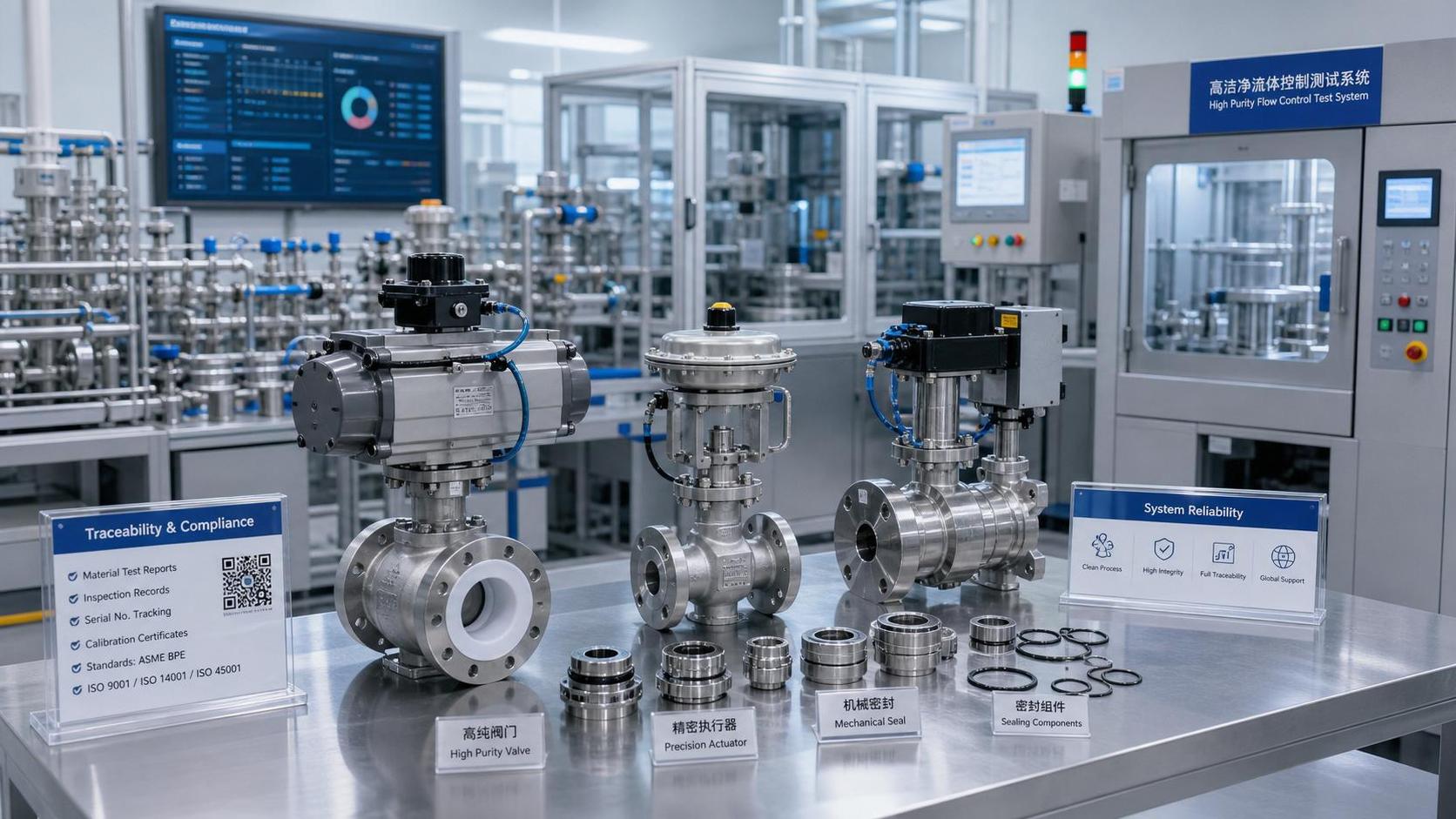
Industrial equipment manufacturers are entering 2026 with a supply chain environment that looks less volatile than 2021, yet far more complex. Availability has improved in some categories, but predictability has not.
Lead times, export controls, material traceability, and qualification standards now intersect more directly with uptime, warranty exposure, and market access. In practical terms, supply chain strategy is no longer separate from engineering risk.
That shift matters across general industry, especially where systems depend on containment, flow control, sealing integrity, precision actuation, and regulated energy performance. A delayed part is often manageable. A delayed qualified part is a different problem entirely.
Why 2026 looks different from earlier disruptions
Earlier disruptions were defined by shortage and transport shock. The 2026 cycle is more structural. Industrial equipment manufacturers now face slower-moving pressures that reshape sourcing decisions over multiple quarters.
Several forces are converging at once. Regionalization policies are changing supplier footprints. Compliance expectations are tightening. Critical component makers are also prioritizing sectors with higher margins and stronger long-term contracts.
This creates a new operating reality. The question is no longer only whether a component can be purchased. The question is whether it can be sourced, certified, integrated, and supported without weakening system performance.
The difference between supply continuity and technical continuity
Many organizations still measure resilience in terms of inventory cover and supplier count. That is necessary, but insufficient for industrial equipment manufacturers serving demanding operating environments.
Technical continuity means more than keeping a line running. It means preserving validated pressure ratings, chemical compatibility, sealing life, response speed, and regulatory documentation after supplier changes or specification updates.
The components attracting the most attention
Not every purchased part carries the same risk. In 2026, concern is rising around components that combine long qualification cycles with strict performance tolerances and limited global supply depth.
This is where a technical intelligence model such as G-PCS becomes useful. Its focus on the logic of containment and flow reflects a basic industrial truth: small component changes can trigger system-level consequences.
That is especially clear in five areas linked to advanced manufacturing and mission-critical equipment.
Why compliance is now tied to sourcing decisions
Industrial equipment manufacturers are under greater pressure to prove not just what a system does, but what it contains, where it came from, and whether it still meets the correct standard set.
In sectors influenced by ISO, API, SEMI, or MIL-SPEC requirements, alternate sourcing cannot be treated as a purchasing shortcut. A substitute that matches dimensions may still fail on outgassing, purity, fatigue life, or documentation quality.
This is one reason industrial equipment manufacturers are investing more time in approved vendor structures, validation records, and controlled change processes. Compliance drift often begins with an apparently minor supply decision.
Traceability has become a commercial issue
Traceability used to sit mainly inside quality functions. It now affects delivery confidence, customer acceptance, and after-sales liability. That shift is visible in sealing materials, alloys, ceramics, and high-response actuation components.
When documentation trails are incomplete, commercial friction rises fast. Site approval may stall. Warranty reserves may increase. Internal teams may delay release because engineering, procurement, and compliance no longer share the same evidence base.
What this means for system reliability
For industrial equipment manufacturers, supply chain resilience is ultimately measured at the equipment level. The key issue is whether the delivered machine performs consistently under expected load, media, temperature, and duty cycle.
A lower-tier substitution can remain invisible during factory acceptance testing, then fail under sustained field conditions. This is common where sealing chemistry, actuator repeatability, or valve response timing interacts with real process variability.
That is why component intelligence matters. G-PCS, for example, frames sourcing through benchmarked performance and international standards, not through catalog similarity alone. That approach supports better judgment when replacement decisions carry operational risk.
- A seal is not equivalent because the dimensions match.
- A valve is not equivalent because the pressure rating appears similar.
- An actuator is not equivalent because the stroke length aligns.
- A microwave source is not equivalent because output power looks close on paper.
The gap between nominal similarity and application equivalence is where many 2026 problems will surface.
Operating scenarios where risk is highest
Some environments amplify supply chain mistakes more than others. Industrial equipment manufacturers should pay special attention where failure carries safety, contamination, precision, or uptime consequences.
High-purity and contamination-sensitive processes
Semiconductor, advanced coating, and certain pharmaceutical-adjacent systems depend on material cleanliness and stable sealing behavior. Here, one unqualified substitution can compromise yield far beyond the cost of the part itself.
Pressure-intensive energy and fluid systems
Hydrogen, specialty gas, and UHP fluid control applications place unusual stress on valves, fittings, and sealing interfaces. Industrial equipment manufacturers in these areas need deeper visibility into certification and life-cycle performance.
Precision motion and fast-response control
Positioning systems, automated inspection tools, and high-speed assembly platforms depend on repeatable actuation. Component drift in these systems often appears first as reduced consistency, not immediate failure.
How industrial equipment manufacturers can respond
The most effective response is not broad supplier expansion by itself. It is structured decision-making that combines engineering criticality, compliance relevance, and sourcing optionality.
In practice, that means ranking components by consequence, not just spend. A low-cost gasket may deserve more attention than a costly frame assembly if it can stop the system, fail audit review, or degrade field reliability.
- Map single-source exposure at the component and material level.
- Separate commercial substitutes from technically validated alternatives.
- Review standards exposure before approving any engineering change.
- Build traceability requirements into sourcing and supplier onboarding.
- Use field performance data to confirm whether alternates are truly equivalent.
Industrial equipment manufacturers that treat these actions as an ongoing governance routine will be better positioned than those relying on reactive expedites.
What to evaluate over the next planning cycle
The next step is not to assume every category faces equal disruption. The better approach is to identify where technical sensitivity and supply uncertainty overlap.
That review should cover qualification lead time, approved-source depth, material traceability, standard dependency, and field failure impact. These factors usually reveal which categories deserve early intervention.
For industrial equipment manufacturers operating in high-spec environments, a benchmark-driven reference point is increasingly valuable. It helps compare options through performance logic, not just vendor claims or short-term availability.
As 2026 supply chain shifts continue to unfold, the strongest position will come from linking sourcing choices with reliability evidence, compliance discipline, and realistic application context. That is where more durable decisions begin.
Industry Briefing
Get the top 5 industry headlines delivered to your inbox every morning.