Spring Compression Force Data: What Values Matter Most
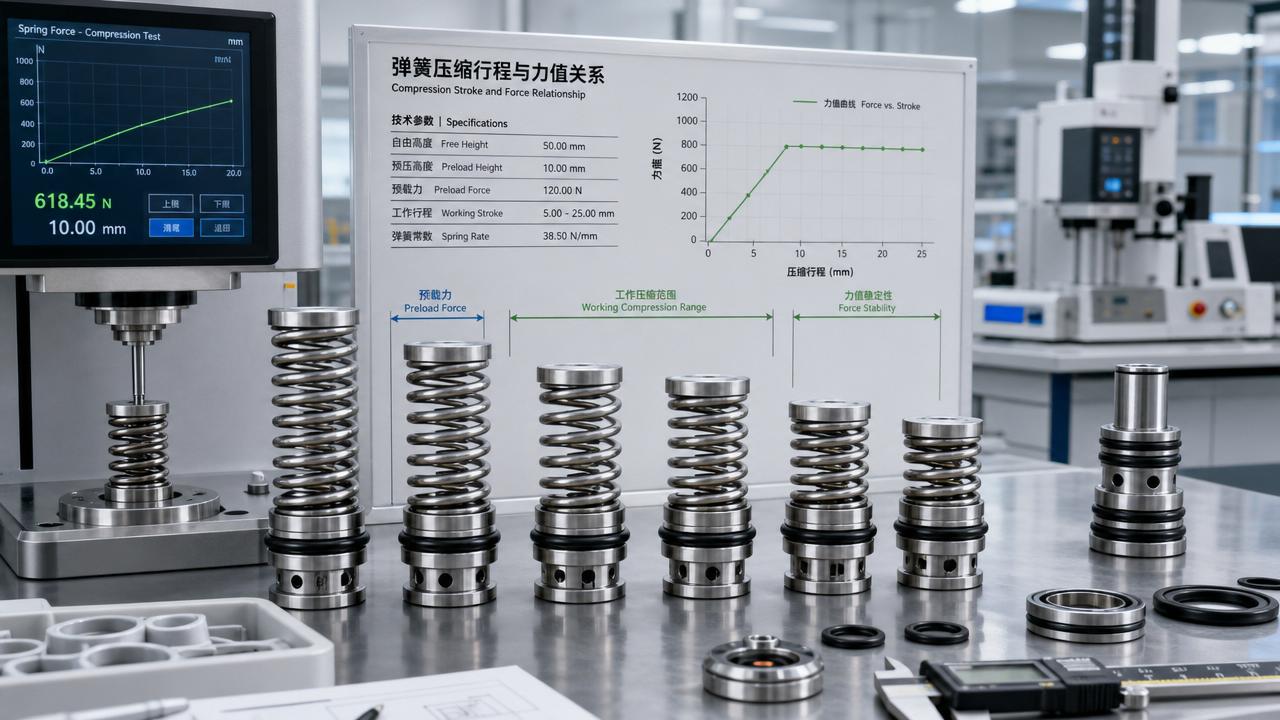
For technical evaluators, spring compression force data is more than a specification—it is a decision-critical indicator of stability, response accuracy, load consistency, and service life. In high-performance systems where sealing integrity and motion precision cannot fail, knowing which force values matter most helps reduce risk, improve component selection, and support reliable engineering validation.
Why spring compression force data is gaining strategic importance
A clear shift is underway across industrial supply chains: spring selection is no longer treated as a low-level mechanical detail. In sectors tied to precision sealing, controlled flow, actuation, microwave assemblies, valve systems, and harsh-environment equipment, spring compression force data has become part of a broader reliability conversation. Technical evaluators are increasingly asked to justify not only whether a spring fits, but whether its force profile remains stable under temperature variation, repeated cycling, media exposure, vibration, and assembly tolerances.
This change is being driven by tighter performance windows in advanced equipment. As systems become smaller, faster, cleaner, and more regulated, the acceptable range for spring force drift narrows. A marginal mismatch between required load and delivered force can now affect seal compression, contact pressure, positional repeatability, valve response timing, and fatigue behavior. That is why spring compression force data is moving upstream in design reviews and procurement qualification.
For organizations operating in high-consequence environments, the key question is no longer “What is the nominal spring force?” It is “Which force values actually predict system performance, and under what conditions do those values remain valid?”
The market signal: force values are being evaluated across the full operating window
One of the strongest trend signals is that evaluation practices are becoming more dynamic. Historically, many specifications focused on one or two point values such as free length, solid height, and force at a single compressed length. Today, technical teams are more likely to assess spring compression force data across a working range, because real applications rarely operate at only one static position.
This matters especially in applications involving seals, calibrated valves, pneumatic positioning, or high-cycle mechanical interfaces. In these environments, a spring may need to deliver different but predictable loads at preload, working compression, peak travel, and end-of-life conditions. A spring that looks acceptable at one checkpoint may still fail functionally if its rate curve, residual set, or load loss behavior is poorly matched to the application.
Which spring compression force data values matter most now
For technical evaluators, not every value has equal decision weight. The most useful spring compression force data usually falls into five practical categories that support trend-aware validation.
1. Preload force at installed height
Installed-height force is often the first truly critical number. It determines whether the spring can establish sufficient contact pressure or sealing load immediately after assembly. In precision systems, preload that is too low can cause leakage, chatter, or unstable engagement. Preload that is too high can increase wear, drag, insertion load, or deformation of adjacent components. As designs become more compact, this value is receiving more scrutiny than basic free-length data.
2. Force at working compression range
The second high-value metric is force across the actual travel window. This is where spring compression force data connects directly to operating stability. Evaluators want to know whether the spring maintains the intended load while the system cycles through its normal motion band. For valves, actuators, and seal-loading interfaces, force consistency here often matters more than peak load capability.
3. Spring rate and linearity behavior
The slope of the force-deflection curve is increasingly important because modern systems demand predictable response. A nominal force value without rate information is incomplete. If the spring rate is too steep, small dimensional variation can create large force differences. If the rate is too soft, the system may become sensitive to dynamic loads or lose functional control. In trend terms, engineering teams are shifting from “force value acceptance” to “force curve acceptance.”
4. Set, relaxation, and force retention after cycling
Initial laboratory values can be misleading if the spring loses force after compression dwell or repeated actuation. This is especially relevant in thermal systems, chemically exposed assemblies, and high-duty-cycle applications. Evaluators increasingly request spring compression force data before and after endurance testing because retained force is often the real determinant of service life.
5. Maximum safe compression and reserve margin
The usable safety margin between working compression and solid height has become more important as designers push miniaturization. Technical reviewers need confidence that transient overloads, tolerance shifts, or thermal expansion will not drive the spring into damaging stress conditions. In other words, the data set must show not just normal behavior, but resilience under edge conditions.
What is driving this change in evaluation priorities
Several forces are pushing spring compression force data toward the center of qualification decisions. First, system integration has become tighter. Springs are often paired with engineered polymers, composite gaskets, metal seals, precision plungers, or piezo-assisted positioning mechanisms. In these assemblies, force is not isolated; it interacts with compression set, friction, thermal growth, and contact geometry.
Second, operating environments are becoming more extreme. Exposure to pressure cycling, aggressive media, vacuum, RF heat, cryogenic transitions, or elevated temperature changes how force values should be interpreted. A spring that performs well in general-purpose industrial equipment may not hold its load in a contamination-sensitive or extreme-environment system.
Third, procurement expectations are rising. Buyers increasingly require traceable technical data that supports cross-functional approval by engineering, quality, and sourcing teams. That means spring compression force data is being used not only for design selection but also for supplier comparison, deviation management, and lifecycle risk assessment.
Who is affected most by the shift
The impact is not limited to spring manufacturers. It extends across technical evaluation, product design, quality assurance, and strategic sourcing.
How technical evaluators should interpret spring compression force data today
A practical change in approach is needed. Instead of accepting a spring data sheet at face value, evaluators should read spring compression force data as a contextual data package. The first question should be whether the reported values align with the actual installation condition. Force numbers taken at arbitrary test lengths are less useful if they do not match the compressed heights inside the final assembly.
The second question is whether the force values are tied to clear environmental assumptions. Temperature, lubrication state, corrosion risk, and cycle count all influence the real-world meaning of the data. If conditions are missing, comparison across suppliers becomes unreliable.
The third question is whether the force data supports failure-mode thinking. Strong evaluation now connects force loss or excessive force variation to system consequences such as leakage, delayed actuation, misalignment, material creep, noise, or shortened maintenance intervals. This is where spring compression force data becomes a decision tool rather than a passive specification item.
Signals that deserve ongoing attention over the next evaluation cycle
Looking ahead, several signals are worth monitoring. One is the increasing use of application-specific force validation rather than catalog-based selection. Another is the growing expectation that force data be paired with life and environment testing. A third is the rise of smaller, faster systems where tolerance sensitivity magnifies the impact of even modest force deviation.
In advanced supply chains, spring compression force data is also becoming more relevant to digital qualification workflows. More teams want measurable acceptance criteria that can be tracked through design revisions, supplier changes, and field feedback. This creates demand for cleaner documentation, repeatable test methods, and better comparability across vendors.
Recommended actions for better decision quality
For companies evaluating critical components, the most effective response is not to request more data indiscriminately, but to request the right spring compression force data in the right format. A structured review process should include:
- Force values at installed height, minimum working height, and maximum working height
- Defined tolerances for force and dimensional variables
- Spring rate information and, when relevant, force-deflection curves
- Data after cycling, thermal exposure, or compression dwell
- Clarity on test conditions, measurement method, and sample basis
These actions help translate raw specifications into usable engineering judgment. They also support better communication between evaluators, design authorities, and procurement teams, especially when reliability expectations are high and qualification windows are short.
FAQ: the most common decision questions
Is nominal force the most important item in spring compression force data?
No. Nominal force is useful, but installed-height force, working-range behavior, and retained force after use often have greater decision value.
Why does force retention matter so much?
Because many failures are not caused by incorrect initial load, but by gradual load loss. If the spring cannot hold force over time, system stability and sealing reliability decline.
When should evaluators ask for multi-point force data?
Whenever the component operates over a travel range, faces variable loads, or interacts with sensitive sealing or positioning elements. In these cases, single-point data is usually insufficient.
Final judgment: focus on the values that predict behavior, not just compliance
The broader trend is clear: spring compression force data is evolving from a simple catalog reference into a validation signal for system reliability. The values that matter most are the ones that explain how the spring behaves when installed, when cycled, when exposed to real operating conditions, and when tolerances begin to stack. For technical evaluators, that shift has direct implications for risk control, supplier comparison, and long-term asset reliability.
If your organization needs to judge how these trends affect current projects, the most useful next step is to confirm four issues: which force points match real assembly heights, how much load variation the application can tolerate, what retention data exists after environmental stress, and whether supplier data is comparable enough to support a defensible decision. That is where spring compression force data becomes actionable—and where stronger evaluations begin.
Industry Briefing
Get the top 5 industry headlines delivered to your inbox every morning.