Industrial Microwave Systems for Medical Sterilization: Key Specs
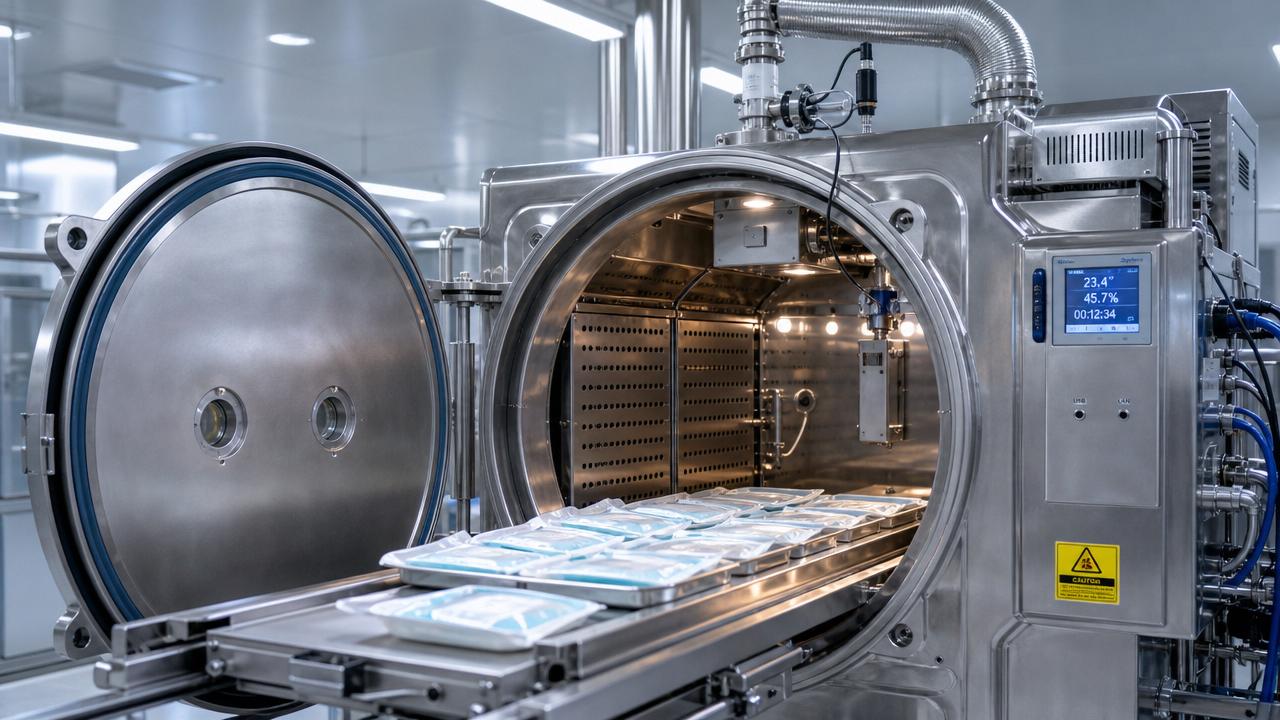
Why medical sterilization is looking beyond conventional heat
Industrial microwave systems for medical sterilization are gaining attention because medical manufacturing now needs faster cycles without compromising validated microbial lethality.
The decision is not simply about replacing steam, ethylene oxide, or dry heat. It is about matching energy delivery to device risk.
Microwave energy can heat certain loads rapidly and volumetrically. That advantage becomes valuable when packaging, polymers, fluids, or hybrid assemblies limit traditional approaches.
Yet speed alone is never enough. Medical sterilization depends on repeatability, documentation, process control, and proof that every critical zone receives adequate exposure.
This is where industrial microwave systems for medical sterilization require careful technical review. The platform must control RF behavior, temperature gradients, airflow, moisture, and containment.
In high-reliability environments, G-PCS frames this evaluation around containment and flow logic. Energy, heat, vapor, pressure, and materials must behave predictably.
What a microwave sterilization platform actually controls
Industrial microwave systems for medical sterilization use electromagnetic energy, commonly at regulated ISM frequencies, to generate heat within compatible materials.
The system is not only a chamber with a generator. It includes RF sources, waveguides, tuners, sensors, shielding, controls, and validation interfaces.
A well-specified system manages how energy enters the load. It also manages how heat moves, how vapor escapes, and how exposure is documented.
For medical use, the sterilization claim must be tied to measurable conditions. Temperature, time, humidity, power stability, and load geometry all matter.
Industrial microwave systems for medical sterilization therefore sit between RF engineering and regulated process validation. Both disciplines need to align before production use.
Core subsystems that shape performance
The RF generator defines available energy. Magnetron-based designs remain common, while solid-state sources offer finer control and faster modulation.
The applicator or chamber determines field distribution. Mode stirrers, rotating fixtures, and load spacing help reduce cold spots.
The control architecture links process variables to alarms, recipes, batch records, and access permissions. That connection becomes critical during validation.
Key specifications that deserve close comparison
Industrial microwave systems for medical sterilization should be compared through process capability, not isolated catalog numbers.
Rated power, for example, does not guarantee useful power absorption. Reflected power, coupling efficiency, and load sensitivity often reveal more.
The following specifications provide a practical starting point for structured evaluation.
This table is not a final specification. It is a way to separate process capability from attractive but incomplete performance claims.
RF uniformity is often the first technical risk
The most difficult question for industrial microwave systems for medical sterilization is whether energy reaches every relevant location consistently.
Microwave fields can form hot and cold regions. Product shape, dielectric properties, packaging density, and moisture content influence that pattern.
A chamber that works for one load may fail with another. This is why load definition belongs inside the sterilization strategy.
Uniformity should be demonstrated with mapping, biological indicators when applicable, thermal sensors, and worst-case configurations.
For industrial microwave systems for medical sterilization, cold-spot identification is more important than average chamber temperature.
Average temperature can look acceptable while a shielded interface remains below the required exposure condition.
Design features that support uniformity
- Mode stirrers or multi-mode cavities that reduce standing-wave dependence.
- Rotating carriers that expose each product side to changing field patterns.
- Adaptive tuning that reduces reflected power during changing load conditions.
- Recipe limits that stop the cycle when sensor signals drift.
- Fixture designs that avoid metallic shadowing and trapped moisture pockets.
These features do not automatically prove sterility. They make validation more achievable and reduce unexplained batch variation.
Temperature, moisture, and lethality cannot be separated
Industrial microwave systems for medical sterilization must translate RF exposure into a validated microbial kill process.
That translation depends on temperature history, moisture availability, microbial resistance, packaging barriers, and product bioburden assumptions.
Microwave heating can be rapid, but rapid heating may create steep gradients. Control loops must respond before local overheating occurs.
Infrared sensors may read surfaces. Fiber-optic probes may capture internal temperatures. Both methods require calibration and clear placement logic.
Moisture control is also central. Dry materials may heat differently, while excess vapor can affect packaging, seals, and chamber pressure.
In practice, industrial microwave systems for medical sterilization often need integrated humidity, airflow, or vacuum management.
The process window should define acceptable ramp time, hold time, maximum temperature, pressure condition, and post-cycle cooling behavior.
Material compatibility affects both product quality and safety
Medical devices may contain polymers, adhesives, coatings, elastomers, metals, glass, electronics, or absorbent materials.
Each material interacts with microwave energy differently. Some absorb strongly, some remain transparent, and some create localized heating risks.
Industrial microwave systems for medical sterilization should be assessed against real product constructions, not idealized samples.
Packaging also deserves attention. Tyvek, films, trays, labels, and barrier seals may respond differently under heat and humidity.
A sterilization cycle that preserves microbial safety but weakens a seal is not production-ready.
This connects directly with specialized sealing knowledge. Door gaskets, chamber seals, and packaging interfaces all influence containment integrity.
Materials such as FFKM, high-performance silicones, fluoropolymers, and composites may be considered where heat, vapor, and cleaning chemicals converge.
Compatibility checks that should not be skipped
- Dimensional stability after full-cycle exposure and cooling.
- Seal strength and package integrity after aging studies.
- Adhesive performance at interfaces with dissimilar materials.
- Discoloration, embrittlement, odor, or extractables concerns.
- Interaction between metallic features and RF field behavior.
Regulatory documentation is part of the specification
Industrial microwave systems for medical sterilization cannot be evaluated only by equipment performance. Documentation quality is part of system readiness.
Medical sterilization normally requires a defined validation lifecycle. Installation, operation, and performance qualification must be planned before routine use.
Relevant references may include ISO 14937 for general sterilization process characterization and ISO 13485 for quality management context.
Electrical safety, electromagnetic compatibility, RF leakage, and workplace exposure requirements also need local regulatory review.
The strongest suppliers provide traceable calibration records, alarm descriptions, software controls, service procedures, and change-control expectations.
For industrial microwave systems for medical sterilization, batch records should show more than cycle start and end time.
Useful records include recipe version, load identification, power profile, temperature trends, deviations, interlock events, and operator actions.
Where microwave sterilization can make practical sense
Industrial microwave systems for medical sterilization are not universal solutions. They fit best when product design and process physics support the method.
They may be considered for certain polymer devices, laboratory consumables, packaged components, fluid-contact parts, or controlled decontamination steps.
They can also support specialized production where lower chemical residue, shorter cycles, or compact equipment footprints are strategic priorities.
However, devices with complex metallic assemblies, deep shielding, sensitive electronics, or narrow thermal margins require more caution.
The application case should start with product risk, not equipment availability.
How to build a practical evaluation path
A sound selection process begins with a defined load family. Product size, packaging, material stack, and microbial target should be documented.
Next, candidate industrial microwave systems for medical sterilization should be tested with representative and worst-case loads.
Pilot studies should capture temperature maps, RF behavior, biological response, material changes, and packaging effects.
Cycle development should then define control limits. These limits need to be measurable during every production batch.
A useful checklist includes several non-negotiable questions.
- Can the system identify and control the slowest-heating location?
- Does the chamber maintain RF leakage within required limits?
- Are sensors accurate during RF exposure and moisture changes?
- Can the recipe be locked, versioned, and audited?
- Does maintenance affect field uniformity or calibration status?
- Can deviations be investigated using complete process data?
These questions help determine whether the system is merely functional or genuinely controllable.
The value of a broader containment and flow perspective
Industrial microwave systems for medical sterilization do not operate in isolation. They interact with utilities, ventilation, pressure control, cleaning, and sealing systems.
A weak door seal can create leakage risk. Poor vapor control can destabilize heating. Inconsistent airflow can shift cooling profiles.
This is why G-PCS treats RF energy, containment, actuation, valves, and specialized materials as connected technical domains.
For sensitive industrial systems, the reliability of one component often depends on the behavior of adjacent components.
Benchmarking against ISO, SEMI, API, MIL-SPEC, and related practices can reveal hidden weaknesses before scale-up.
The result is a more realistic view of equipment readiness, lifecycle cost, and validation burden.
Moving from specification review to confident selection
Industrial microwave systems for medical sterilization should be judged by their ability to create repeatable, documented, and product-safe lethality.
The strongest evaluation looks beyond chamber volume and rated power. It tests RF uniformity, sensor confidence, material response, and validation support.
Before moving forward, define the load family, establish acceptance criteria, and request data from representative process trials.
Compare each platform using the same cycle objectives, documentation expectations, and maintenance assumptions.
That approach makes industrial microwave systems for medical sterilization easier to evaluate as controlled process assets, not experimental heating equipment.
The next step is to build a requirement matrix around product risk, throughput, compliance, containment, and long-term serviceability.
With that structure, shortlisting becomes more objective, and the final choice can better support validated medical manufacturing.
Industry Briefing
Get the top 5 industry headlines delivered to your inbox every morning.