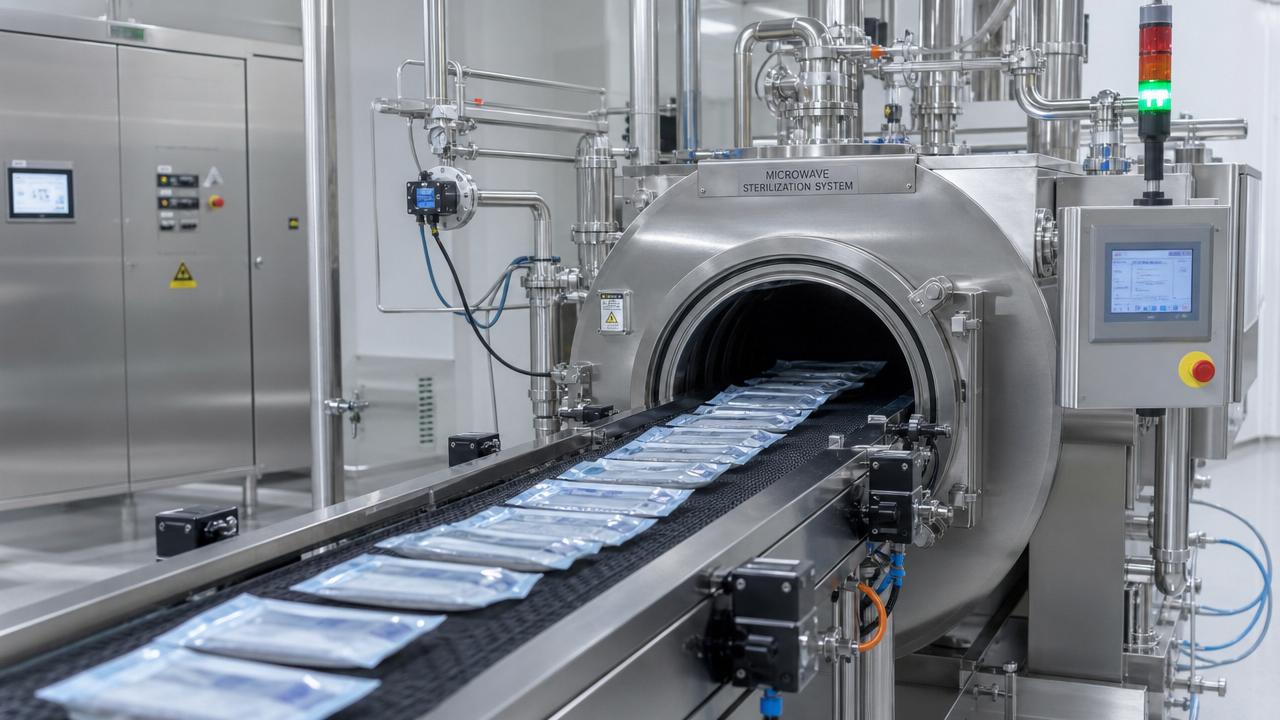
Selecting industrial microwave systems for medical sterilization requires more than comparing power ratings or chamber size. Technical evaluators must verify how reliably the system delivers uniform energy, controls temperature and pressure, validates microbial reduction, and maintains compliance with medical-device quality frameworks.
This guide highlights the key checks that matter most—process repeatability, RF containment, material compatibility, sensor accuracy, documentation readiness, and lifecycle support—so engineering, QA, and procurement teams can assess whether a microwave sterilization platform is truly fit for regulated, high-integrity medical applications.
Search Intent: What Evaluators Are Really Trying to Confirm
Most searches for industrial microwave systems for medical sterilization are not casual technology research. They usually indicate a serious feasibility, vendor-screening, or process-development decision.
The core question is whether microwave energy can deliver validated sterilization outcomes without damaging devices, packaging, sensors, adhesives, or sensitive polymer components.
Technical evaluators also want to know whether a supplier understands regulated manufacturing, not only microwave generators, cavities, conveyors, or heating efficiency.
The most useful content therefore compares system architecture, validation evidence, risk controls, and documentation readiness, rather than repeating general microwave heating advantages.
First Check: Is the Sterilization Claim Technically Defined?
Before assessing equipment, define what “sterilization” means for the intended product, load, packaging, and regulatory pathway. Ambiguous claims create validation risk.
For medical devices, evaluators should ask whether the process targets terminal sterilization, bioburden reduction, decontamination, drying assistance, or a hybrid treatment step.
True sterilization normally requires validated microbial inactivation and a defensible sterility assurance level, often discussed around SAL 10-6.
Microwave platforms may perform differently across organisms, moisture levels, materials, and load geometries. A vendor should not generalize from food or laboratory applications.
Request organism-specific data, D-values where applicable, biological indicator strategy, worst-case load mapping, and justification for selected process parameters.
Energy Uniformity Matters More Than Nameplate Power
Nameplate power is only a starting point. The critical issue is how uniformly electromagnetic energy couples into the product and load configuration.
Non-uniform fields can produce hot spots that damage materials and cold spots that fail microbial reduction. Both outcomes are unacceptable in regulated production.
Evaluate cavity design, mode stirring, conveyor motion, turntables, applicator geometry, and load spacing. These features determine practical repeatability more than generator size.
Ask for field-mapping studies, thermal distribution data, and evidence from representative device families. Laboratory beakers or water loads are insufficient proxies.
For continuous systems, verify dwell-time control, belt speed accuracy, edge effects, and transition behavior at start-up, shutdown, and product gaps.
Temperature, Moisture, and Pressure Control Must Be Closed-Loop
Microwave sterilization performance depends on coupled thermal and non-thermal mechanisms, but validation still requires measurable, controlled, and repeatable process variables.
Temperature measurement is challenging because metallic probes can disturb RF fields. Infrared sensing may miss internal temperatures or shielded regions.
Strong systems combine fiber-optic probes, calibrated IR sensors, pressure transducers, humidity monitoring, and recipe-based control logic with alarm limits.
If the process uses steam, vacuum, controlled humidity, or pressurized chambers, sealing integrity and condensate management become essential engineering concerns.
Evaluators should examine sensor placement rationale, calibration intervals, drift monitoring, data sampling frequency, and how deviations trigger hold, reject, or reprocess decisions.
Material Compatibility Is a Go-or-No-Go Criterion
Medical devices often include polymers, elastomers, adhesives, lubricants, coatings, electronics, hydrogels, or drug-contact surfaces that respond unpredictably to microwave exposure.
Compatibility testing should include dimensional stability, tensile properties, seal strength, extractables, leachables, discoloration, embrittlement, and functional performance after processing.
Packaging must also be evaluated. Tyvek, films, trays, labels, inks, and barrier systems may heat unevenly or lose sterile barrier performance.
Metallic components are not automatically impossible, but they require careful RF design, spacing rules, arc detection, and application-specific validation.
A credible supplier should request material bills, product drawings, packaging formats, and load patterns before making performance or throughput commitments.
RF Containment and Operator Safety Require Hard Evidence
Industrial microwave systems for medical sterilization operate at energy levels that demand robust shielding, interlocks, leakage monitoring, and maintenance discipline.
Evaluators should verify compliance with applicable RF exposure limits, local workplace safety rules, and electromagnetic compatibility requirements for the installation environment.
Important checks include door seals, waveguide gaskets, viewing windows, choke structures, interlock redundancy, emergency stops, and leakage test procedures.
For automated lines, also evaluate access panels, guarding, lockout-tagout provisions, arc detection, reflected-power shutdown, and fault recovery behavior.
Safety validation should not rely only on factory statements. Request leakage maps, commissioning test records, maintenance instructions, and operator training materials.
Validation Readiness Separates Industrial Equipment from Medical-Grade Platforms
A sterilization platform must fit within medical-device quality systems, including design controls, process validation, change control, and traceable documentation.
For novel or alternative sterilization methods, ISO 14937 is frequently relevant because it addresses characterization, development, validation, and routine control.
Depending on device type and market, evaluators may also consider ISO 13485, ISO 11138 indicators, ISO 11737 bioburden methods, and regulatory expectations.
The supplier should provide installation qualification, operational qualification, and performance qualification support, with clear acceptance criteria and test responsibilities.
Look for audit-ready records, software version control, user access levels, electronic data integrity, calibration certificates, and documented parameter release logic.
Process Repeatability Must Be Demonstrated Across Real Loads
Repeatability cannot be proven by one successful demonstration run. It requires statistically meaningful evidence across batches, operators, environmental conditions, and product variability.
Evaluators should define worst-case loads, including maximum mass, minimum mass, densest packing, shadowed regions, and lowest expected initial temperature.
Challenge studies should capture both microbial outcomes and product performance. Sterility without preserved device function is not a viable process.
For multi-product facilities, recipe management becomes critical. Each device family may require separate parameters, limits, validation files, and change assessments.
The strongest proposals include a process development plan, not only equipment specifications. This plan should define samples, methods, responsibilities, and decision gates.
Chamber, Conveyor, and Sealing Design Affect Containment Integrity
Medical sterilization environments require controlled containment, cleanability, and predictable flow of air, steam, vapor, condensate, or exhaust streams.
Evaluate chamber materials, surface finish, drainability, gasket selection, access-door alignment, and compatibility with cleaning agents or sterilant residues.
Specialized sealing components are especially important where vacuum, pressure cycling, RF leakage control, and high-temperature exposure occur simultaneously.
Conveyorized systems need attention to belt material, edge sealing, product tracking, particulate generation, and contamination risk at loading zones.
For batch systems, loading fixtures should be repeatable, documented, cleanable, and designed to minimize field distortion or product-to-product shielding.
Generator Architecture and Controls Influence Uptime
Technical evaluators should compare magnetron-based and solid-state RF architectures in terms of controllability, redundancy, maintenance, and lifecycle availability.
Magnetrons can deliver high power cost-effectively, but they may require scheduled replacement, tuning expertise, and careful reflected-power protection.
Solid-state systems may offer finer power modulation, frequency agility, diagnostics, and modular redundancy, although capital cost may be higher.
The right choice depends on process sensitivity, required control resolution, service model, spare-part strategy, and total cost of ownership.
Ask vendors to disclose control bandwidth, ramp rates, power stability, fault logging, cooling requirements, and expected component replacement intervals.
Data Integrity and Traceability Are Procurement Requirements
In regulated manufacturing, a batch is not complete because the machine finished a cycle. It is complete when evidence supports release.
The system should capture recipe ID, operator ID, time stamps, sensor values, alarms, deviations, calibration status, and cycle outcome.
Electronic records should support audit trails, controlled access, backup procedures, and integration with MES, SCADA, or quality management systems.
Data gaps are not minor inconveniences. They can lead to batch quarantine, investigation costs, delayed release, and regulatory exposure.
Procurement teams should include documentation, cybersecurity, data export, and record-retention requirements in the user requirement specification.
Throughput Claims Need Load-Based Verification
Microwave systems are often promoted for fast heating and reduced cycle time, but throughput must be evaluated using validated load conditions.
A useful throughput model includes loading time, preconditioning, energy exposure, hold time, cooling, unloading, documentation review, and rejected-cycle handling.
For packaged devices, cooling can become a bottleneck because excessive residual heat may compromise materials or handling safety.
Continuous systems may improve productivity, but they also introduce challenges around product spacing, traceability, segregation, and line clearance.
Request acceptance tests based on your real products, packaging, and quality release criteria, not idealized demonstration materials.
Lifecycle Support Should Be Scored Before Purchase
A sterilization system becomes a long-term validated asset. Any uncontrolled change to hardware, software, sensors, or components can affect compliance.
Assess supplier capability for preventive maintenance, spare parts, remote diagnostics, requalification support, training, and documented engineering changes.
Critical spare parts include RF generators, waveguide components, seals, sensors, power supplies, cooling elements, and safety interlock assemblies.
Ask whether the supplier provides service-level agreements, obsolescence planning, calibration support, and emergency response for production-critical installations.
The best vendor is not necessarily the lowest bidder. It is the one able to protect validated performance across the asset lifecycle.
Practical Vendor Questions for Technical Evaluators
Ask which medical-device applications the supplier has validated, and whether references involve similar materials, packaging, load density, and regulatory expectations.
Request examples of IQ, OQ, PQ protocols, deviation handling, calibration procedures, software documentation, and routine monitoring templates.
Challenge the supplier to explain cold-spot identification, biological indicator placement, sensor limitations, and how process drift is detected.
Ask how RF leakage is tested after maintenance, door adjustment, gasket replacement, or relocation of the system.
Finally, require a feasibility plan with measurable success criteria before committing to full-scale purchase or production validation.
When Microwave Sterilization Is a Strong Fit—and When It Is Not
Microwave sterilization may be attractive when rapid volumetric heating, reduced thermal exposure, or integration with controlled humidity offers measurable benefits.
It can also support applications where conventional steam, ethylene oxide, or radiation creates material, residue, cycle-time, or supply-chain constraints.
However, it may be unsuitable for highly variable loads, poorly characterized materials, complex metallic geometries, or products lacking validation resources.
Organizations should treat microwave sterilization as a process development project, not a plug-and-play replacement for established sterilization modalities.
The decision should combine microbiology, RF engineering, materials science, regulatory strategy, and production economics from the earliest evaluation stage.
Conclusion: The Right Decision Is Evidence-Based, Not Specification-Based
Industrial microwave systems for medical sterilization should be evaluated through repeatability, containment, material compatibility, validation support, and lifecycle control.
Power rating, chamber volume, and cycle speed matter, but they do not prove microbial reduction, product safety, or regulatory readiness.
Technical evaluators should demand representative testing, transparent documentation, calibrated controls, RF safety evidence, and supplier commitment beyond commissioning.
When these checks are satisfied, microwave technology can become a credible high-integrity sterilization platform for selected medical applications.
When they are not, the risk is not merely inefficient equipment. The risk is an unvalidated process inside a regulated product lifecycle.