Seal Industry Conference 2026 News: What Signals Matter Most
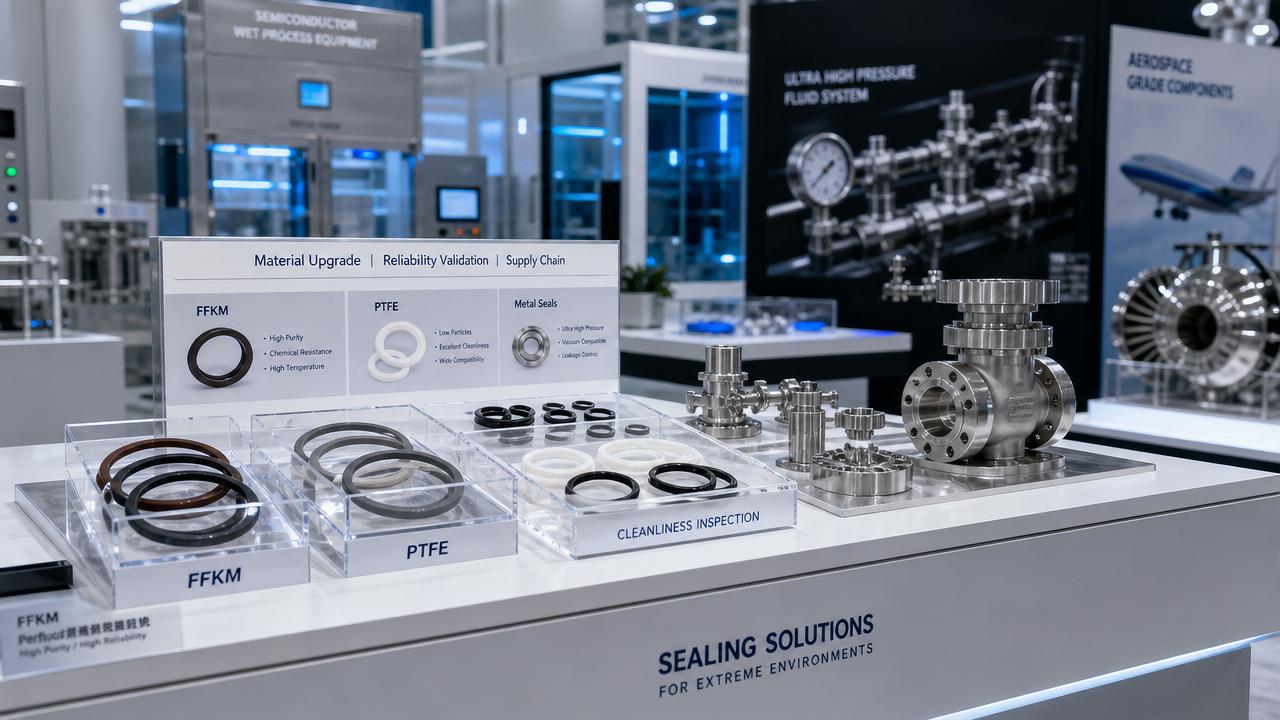
As seal industry conference 2026 news begins to surface, decision-makers are watching for more than event highlights—they need signals on materials, compliance, reliability, and supply-chain direction. For researchers and sourcing teams in advanced industries, the real value lies in identifying which announcements may reshape sealing performance, qualification standards, and future procurement priorities.
For information-led buyers, the conference cycle is rarely about headlines alone. It is often an early indicator of where qualification budgets will move over the next 12–24 months, which materials will gain traction in high-risk applications, and how suppliers will respond to tighter leakage, temperature, pressure, and contamination requirements.
This matters even more in sectors where containment failure is not a minor maintenance event but a system-level risk. In semiconductor fabrication, hydrogen handling, industrial RF systems, aerospace platforms, and ultra-clean flow control, even a small shift in seal chemistry, validation methods, or standards interpretation can affect sourcing strategy, lifecycle cost, and approval timelines.
For organizations tracking seal industry conference 2026 news through a technical intelligence lens, the most useful question is simple: which signals deserve action now, and which are only noise? The answer usually sits at the intersection of material science, test discipline, supply resilience, and application-specific reliability.
Why seal industry conference 2026 news matters beyond event coverage
In B2B industrial markets, conferences often compress 6–9 months of market movement into 2–4 days of presentations, product releases, and informal buyer-supplier discussions. That is why seal industry conference 2026 news can reveal future demand patterns earlier than standard product catalogs or routine sales updates.
For G-PCS-aligned audiences such as CTOs, R&D leads, and procurement directors, the value lies in connecting public announcements with deeper engineering implications. A new elastomer grade, a revised test method, or a packaging change for contamination control may directly affect approval cycles, spare strategy, or service intervals.
Four high-value signals to watch
- Material transition signals, especially in FFKM, PTFE blends, graphite composites, and engineered thermoplastics.
- Compliance signals tied to ISO, API, SEMI, MIL-SPEC, and customer-specific validation expectations.
- Reliability signals, including leakage thresholds, cycle-life benchmarks, and performance under thermal shock or pressure swings.
- Supply-chain signals such as lead-time compression, regionalization, dual-source qualification, and raw-material dependency.
Why advanced industries react quickly to these signals
In high-consequence systems, seal selection is rarely isolated. It is linked to valve dynamics, actuator precision, fluid compatibility, outgassing control, maintenance windows, and total system cleanliness. A specification update may therefore trigger 3 downstream actions: engineering review, supplier requalification, and inventory adjustment.
For example, a procurement team sourcing components for ultra-high pressure systems at 350–700 bar may not respond to conference news in the same way as a team managing microwave vacuum assemblies or extreme-environment mechanical seals above 250°C. The signal only becomes meaningful when mapped to duty cycle, media compatibility, and failure consequence.
The difference between headline news and decision-grade news
Not every announcement is actionable. Decision-grade seal industry conference 2026 news usually includes one or more of the following: a defined performance range, a stated qualification method, a disclosed application boundary, or a realistic production timeline such as 8–12 weeks instead of vague “commercial availability.”
That distinction helps research teams filter marketing language from engineering relevance. If a supplier cannot describe chemical compatibility limits, pressure classes, leakage expectations, or test conditions, the announcement may have low procurement value even if it receives broad event attention.
The table below summarizes how different types of conference announcements should be interpreted by technical sourcing teams in advanced sealing environments.
The key takeaway is that conference news becomes valuable when it is translated into sourcing actions. Teams that build a structured review process within 30 days of major industry events usually identify qualification opportunities earlier and reduce reactive procurement later.
The technical signals most likely to shape 2026 sealing decisions
Among all forms of seal industry conference 2026 news, technical signals usually have the strongest long-term impact. They affect not only component selection but also system architecture, maintenance planning, and compliance documentation across multiple industrial pillars.
1. Materials moving toward harsher operating windows
One likely trend is broader discussion around materials that can survive wider thermal and chemical ranges. Buyers should pay close attention to seals positioned for -60°C to 300°C windows, low-permeation hydrogen service, aggressive plasma exposure, or repeated rapid pressure cycling.
This is especially relevant for specialized polymer and composite gaskets, extreme-environment mechanical seals, and UHP control systems. If new compounds are introduced, teams should request data on compression set, outgassing behavior, swell resistance, and performance after 500, 1,000, or 5,000 cycles rather than relying on nominal material claims.
2. Qualification methods getting more application-specific
Another major signal is the shift from generic qualification language to more application-bound testing. In practice, this means buyers may see more emphasis on media-specific test protocols, particulate control checks, helium leak testing, or validation under combined stress rather than single-variable bench data.
For advanced manufacturing and aerospace-related programs, a seal that passes a static chemical test may still fail under vibration, rapid thermal ramping, or vacuum cycling. Conference sessions that discuss multi-factor testing often signal where customer expectations are heading over the next procurement cycle.
Questions buyers should ask after a technical launch
- What pressure, temperature, and media ranges were used in validation?
- Were the results measured in static, dynamic, or mixed-motion conditions?
- What was the failure criterion: leakage rate, dimensional change, torque drift, or visible wear?
- Can the supplier support pilot quantities within 4–8 weeks for internal testing?
3. Reliability becoming a total-cost metric
Reliability news should not be read only as an engineering issue. It is also a cost-control issue. If a new seal design extends maintenance intervals from 6 months to 12 months, or reduces unscheduled stoppages in high-value tools, the procurement case may be stronger even at a higher unit price.
This is why sourcing teams should compare cost per operating hour, replacement frequency, and failure impact rather than only price per part. In mission-critical systems, a lower-cost seal with unstable performance can create a much higher lifecycle burden across labor, downtime, contamination response, and audit exposure.
The next table outlines practical evaluation dimensions that can turn technical conference updates into a disciplined sourcing framework.
A useful reading of seal industry conference 2026 news is therefore not “Which product looks new?” but “Which supplier can support technical proof, stable delivery, and application-fit documentation at the same time?” That is the combination most likely to influence real purchasing decisions.
How procurement and research teams should interpret conference updates
The most effective teams do not wait for annual budgeting cycles to react. They create a short post-conference review model that turns market signals into internal action. In many organizations, that review can be completed in 5 steps and finalized within 2–3 weeks.
A practical 5-step review process
- Collect all relevant news items related to materials, standards, reliability claims, and delivery updates.
- Map each item to a real application, such as UHP hydrogen valves, RF sealing interfaces, vacuum systems, or high-cycle actuators.
- Score relevance across 4 dimensions: performance fit, qualification burden, supply risk, and cost impact.
- Shortlist 2–3 supplier or material changes that justify internal validation.
- Define next actions with engineering and procurement, including sample request, test plan, and commercial review.
Common mistakes when reading seal industry conference 2026 news
One common mistake is assuming that broad compatibility claims apply to every advanced environment. A material that performs well in static chemical sealing may still be unsuitable for fast actuation, abrasive particulates, vacuum exposure, or aggressive RF-adjacent thermal profiles.
Another mistake is ignoring documentation quality. In top-tier industrial supply chains, the absence of lot traceability, clean packaging controls, shelf-life clarity, or standardized acceptance records can delay adoption by 30–90 days even when technical performance looks promising.
What strong suppliers usually provide
- Defined operating windows for pressure, temperature, and media compatibility.
- Clear statements on whether the solution is intended for static, rotary, reciprocating, or vacuum service.
- Test documentation aligned with recognized industrial standards or customer protocols.
- Lead-time visibility for prototype, pilot, and production phases.
- Guidance on storage, handling, contamination control, and replacement intervals.
For organizations working across G-PCS industrial pillars, this structured approach creates a major advantage. It allows teams to compare a sealing update not as an isolated part change, but as a systems decision affecting containment integrity, actuator performance, process uptime, and regulatory readiness.
Where 2026 conference signals may have the biggest market impact
Not all application areas will respond equally to seal industry conference 2026 news. The strongest impact is likely in environments where tighter process margins, harsher media, or higher reliability expectations are already pushing legacy sealing solutions to their limits.
Hydrogen, UHP, and clean energy infrastructure
Hydrogen systems and ultra-high pressure equipment remain sensitive to permeation, embrittlement-related interface risk, and repeated pressure fluctuation. Any conference signal involving low-permeation materials, 350–700 bar service, or validated cycling behavior deserves close attention from energy and mobility supply chains.
Semiconductor and ultra-clean processing
In semiconductor and contamination-sensitive manufacturing, even minor shifts in particle control, extractables, outgassing, or cleanroom packaging can influence supplier approval. News related to FFKM refinement, plasma durability, or low-contamination sealing methods may therefore carry disproportionate procurement significance.
Aerospace, defense, and remote-service systems
Applications with long service intervals and difficult maintenance access will continue to prioritize durability over lowest initial cost. Sealing announcements tied to thermal shock, vacuum stability, or long-life reliability under cyclic load are more likely to matter in these sectors than purely price-driven updates.
Industrial RF and microwave energy systems
Microwave and RF-related environments introduce their own challenges through heat concentration, dielectric interaction, and mechanical alignment sensitivity. Conference news that links sealing materials with thermal management, chamber integrity, or stable performance near high-frequency energy systems should be screened carefully for system-level relevance.
As more seal industry conference 2026 news appears, the highest-value signals will likely come from updates that combine technical specificity, realistic production timing, and clear application boundaries. That is the combination researchers and sourcing teams can act on with confidence.
For companies managing critical flow and containment decisions, G-PCS provides the analytical framework needed to interpret those signals across UHP valves, RF energy systems, extreme-environment seals, precision actuators, and specialized gasket materials. If you need help turning industry news into a practical sourcing roadmap, risk review, or qualification plan, contact us to discuss your application details and explore tailored solutions.
Industry Briefing
Get the top 5 industry headlines delivered to your inbox every morning.