Where Diamond-Coated Seals Are Delivering Real Gains
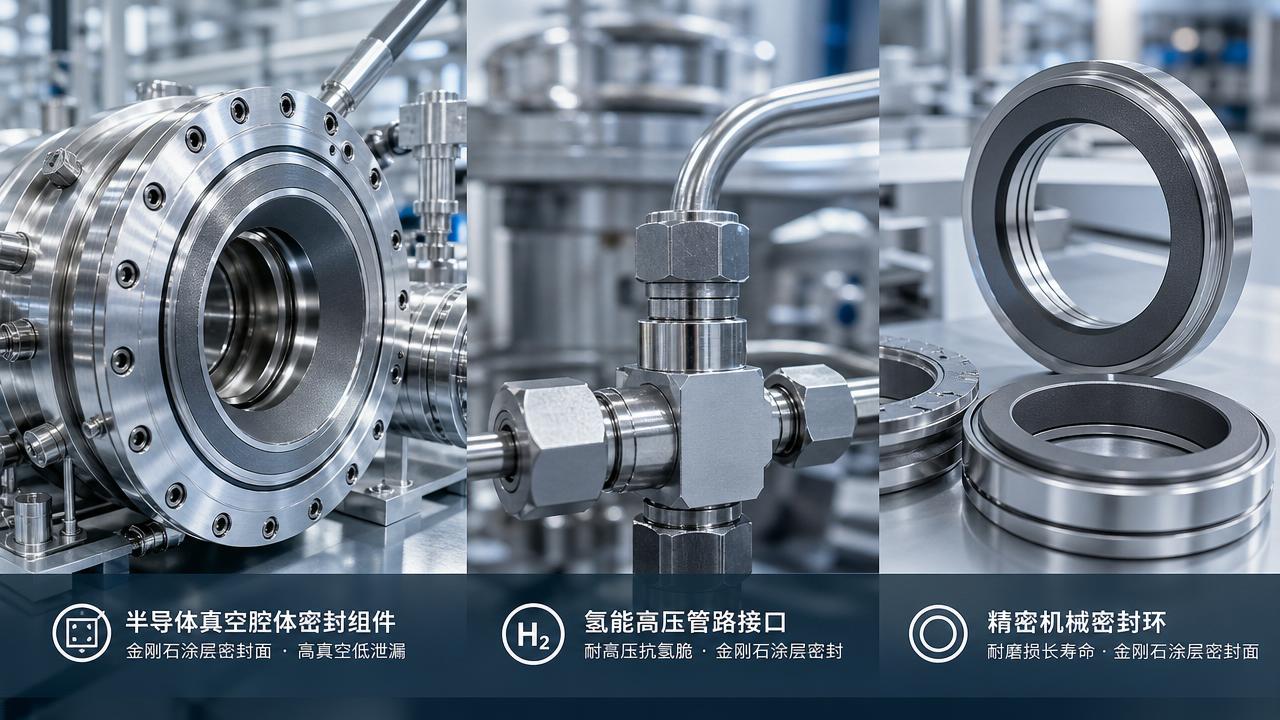
From semiconductor fabs to hydrogen systems and extreme-environment equipment, innovations in diamond-coated seals are delivering measurable gains in durability, leakage control, and lifecycle cost. For business decision-makers balancing performance, compliance, and supply-chain risk, understanding where these advanced sealing solutions create real operational value is now essential.
In high-consequence industrial environments, seal failure is rarely a minor maintenance event. A leak in a UHP gas line, RF vacuum chamber, cryogenic transfer interface, or corrosive process tool can trigger unplanned downtime, product scrap, compliance exposure, and multi-tier supplier disruption. That is why diamond-coated sealing surfaces are drawing attention well beyond niche engineering circles.
For CTOs, R&D leaders, and procurement directors, the question is not whether advanced coatings are technically impressive. The more relevant question is where they produce a defensible business return within 12–36 months. In many cases, the answer depends on operating pressure, media aggressiveness, temperature swing, motion profile, and the cost of even a 1-hour interruption.
Within the G-PCS perspective on containment and flow, innovations in diamond-coated seals matter because they connect material science to system-level reliability. They can reduce wear at sealing interfaces, stabilize friction behavior, limit particle generation, and extend maintenance intervals in applications where ISO, API, SEMI, or MIL-SPEC alignment is part of the buying decision.
Why Diamond-Coated Seals Are Moving from Specialty Use to Strategic Procurement
Diamond-coated seals are not a universal replacement for elastomeric, composite, or conventional mechanical sealing systems. Their value appears when operating conditions repeatedly exceed the comfort zone of standard materials: pressures above 100 bar, vacuum-sensitive processes, abrasive media, fast cycling, or thermal ranges that can span from cryogenic conditions to 300°C or more, depending on the substrate and mating pair.
The coating itself is typically applied as a thin hard layer designed to improve surface hardness, wear resistance, and chemical tolerance. In practice, procurement teams should not focus on hardness alone. Surface finish, adhesion quality, coating thickness consistency, and compatibility with the counterface often determine whether the seal extends service life by 20% or by 3x.
What decision-makers are actually buying
When buyers evaluate innovations in diamond-coated seals, they are usually buying one or more of four outcomes rather than a coating as such:
- Longer maintenance intervals, often shifting inspection cycles from every 3–6 months to 6–12 months in stable duty conditions
- Lower leakage risk in precision gas, vacuum, or hazardous media systems
- Reduced friction and wear in dynamic interfaces with high cycle counts, sometimes above 1 million cycles per year
- More predictable total cost of ownership in assets where downtime costs exceed component price by 10x–100x
Why adoption is accelerating in critical systems
Several cross-industry forces are pushing adoption. First, process windows are getting tighter. Semiconductor and advanced electronics production increasingly penalize particles, outgassing, and micro-leakage. Second, energy and hydrogen systems are operating at higher pressures, commonly 350 bar and 700 bar in storage and fueling architectures. Third, procurement teams are under pressure to cut lifecycle cost without increasing field risk.
These pressures make surface engineering more important than before. In many sealing assemblies, the difference between acceptable and unstable performance is no longer the bulk material alone. It is the interaction of coating, substrate, roughness, preload, and media chemistry over thousands of hours.
The table below shows where buyers typically see the strongest business case for diamond-coated sealing interfaces compared with standard uncoated solutions.
The main takeaway is straightforward: innovations in diamond-coated seals tend to create the most value where contamination, leakage, or downtime carries a disproportionate cost. In low-duty or noncritical systems, the premium may be difficult to justify. In mission-critical lines, the economics can shift quickly in favor of coated surfaces.
Where the Real Gains Are Being Delivered
Not all sectors benefit equally. The strongest returns usually appear in environments where sealing surfaces experience a combination of sliding wear, chemical attack, thermal cycling, or strict cleanliness requirements. That is why adoption maps closely to the five G-PCS industrial pillars and their adjacent supply chains.
Semiconductor and advanced electronics manufacturing
In semiconductor fabs, even minor seal degradation can affect yield through contamination, vacuum instability, or gas delivery inconsistency. Diamond-coated interfaces are especially relevant in subsystems exposed to aggressive cleaning cycles, repetitive actuation, or fine particle sensitivity below visible thresholds. When a process tool runs 24/7, extending component replacement from 8 weeks to 16 weeks can change maintenance planning across an entire line.
Why fabs value them
- Lower particle generation at sliding or contact surfaces
- Higher resistance to wear under high-frequency actuation
- Better fit for regulated maintenance planning in uptime-driven facilities
Hydrogen and ultra-high-pressure gas systems
Hydrogen systems introduce a difficult mix of high pressure, permeation risk, fast cycling, and demanding safety expectations. In valve trains, compression stages, and storage interfaces, innovations in diamond-coated seals can help reduce surface wear and maintain tighter sealing performance over repeated cycles. This becomes important when equipment is designed around 350 bar or 700 bar architectures and service interruptions affect fueling availability, safety reviews, and contractual uptime obligations.
Buyers should still assess the full material stack carefully. Hydrogen compatibility is never a coating-only question. It depends on the substrate, seal geometry, temperature envelope, mating material, and pressure transients. However, coated surfaces can be a meaningful reliability enhancer when integrated correctly.
Industrial microwave, RF, and vacuum-based energy systems
In microwave and RF energy systems, the cost of a leaking or unstable seal is often indirect but significant. It may appear as inconsistent process output, contamination, extended calibration downtime, or thermal drift. Diamond-coated surfaces are increasingly considered where vacuum integrity and clean operation must remain stable over repeated thermal cycles, often in duty patterns that include start-stop stress several times per shift.
Extreme-environment pumps, mixers, and rotating equipment
Mechanical seals in abrasive slurries, corrosive chemicals, or elevated-temperature service can fail from wear long before the broader asset reaches overhaul. In these cases, a diamond-coated face or contact surface may reduce frictional wear and maintain sealing geometry longer. For plants that currently replace seals every 2–4 months, even a moderate extension to 5–8 months can deliver measurable savings in labor, shutdown coordination, and spare inventory.
The next table outlines where business impact tends to be operationally visible, and where the decision should be validated by testing rather than assumed.
The pattern is clear: the biggest gains appear when the seal is part of a larger reliability bottleneck. If the root problem is poor alignment, incorrect preload, or incompatible fluid chemistry, coating alone will not solve it. But where surface wear and leakage are the limiting factors, the improvement can be substantial.
How to Evaluate Diamond-Coated Seals Before You Buy
For enterprise buyers, technical interest should quickly convert into a structured qualification process. A premium coating can fail commercially if it is introduced without a clear acceptance plan. The right approach is to compare baseline performance, define test windows, and establish measurable decision gates before scale-up.
Four technical checks that matter most
- Confirm substrate compatibility and coating adhesion under actual thermal and pressure cycles.
- Review surface roughness and mating-face compatibility, especially in dynamic sealing interfaces.
- Validate chemical resistance against process media, cleaning agents, and purge gases.
- Test leakage, wear, and friction behavior over a representative duty cycle, ideally 500,000 to 1,000,000 cycles where relevant.
Procurement questions beyond material performance
Decision-makers should also examine supply continuity, process repeatability, inspection capability, and change-control discipline. A technically strong supplier that cannot maintain coating consistency lot to lot may create more risk than value. For critical programs, incoming inspection and sample validation over 2–3 lots is often more informative than a single qualification batch.
Lead time is another practical issue. Depending on geometry, substrate, and finishing requirements, coated seal components may require 4–10 weeks rather than the 1–3 weeks typical of standard items. That difference matters when buyers are supporting uptime-sensitive assets or trying to reduce emergency expediting costs.
A practical qualification framework
A useful rollout model is to move through three stages: lab screening, pilot deployment, and controlled scale-up. In stage 1, screen 2–3 candidate designs against wear, leakage, and compatibility criteria. In stage 2, install the selected version on a limited number of assets, often 3–5 units, and compare maintenance, leakage events, and operating stability over one service interval. In stage 3, expand only after confirming repeatable gains.
Common buying mistakes
- Assuming harder always means better without checking counterface wear
- Comparing component price instead of lifecycle cost per operating hour
- Skipping media compatibility review for cleaning chemistries and transient conditions
- Overlooking standards alignment, documentation, and traceability requirements
Implementation, Risk Control, and the Business Case
The strongest business case for innovations in diamond-coated seals usually comes from avoided losses rather than raw component savings. If a coated seal costs 1.5x–3x more than a conventional alternative but doubles service life or reduces one shutdown per year, the financial logic can become compelling. This is especially true in high-value production environments where one stoppage may affect multiple downstream assets.
How to build the ROI view
A sound ROI model should include at least five elements: component cost, installation labor, replacement frequency, cost of downtime, and quality or compliance risk. In fabs, hydrogen handling systems, and regulated process lines, the final two factors often dominate. A seal that reduces leakage excursions or contamination events may justify itself even if direct maintenance savings are moderate.
Risk controls for enterprise deployment
To lower deployment risk, procurement and engineering teams should align on a documented control plan. For most critical systems, that plan should define 6 checkpoints: drawing review, material confirmation, coating-process review, incoming inspection, field validation, and service feedback capture. This creates traceability and helps teams identify whether any failure is driven by design, process variation, or operating conditions.
For globally distributed operations, dual-source strategy may also be worth considering. Not every coated sealing application is suitable for immediate multisourcing, but high-risk single-source exposure can be reduced through parallel qualification, shared inspection criteria, and stocking plans matched to lead times and failure criticality.
What leaders should ask suppliers
- What operating pressure, temperature, and media envelope has this seal concept been designed to support?
- How is coating consistency monitored across lots and complex geometries?
- What is the recommended mating material and surface finish range?
- What inspection data can be provided at incoming, in-process, and final release stages?
- What is the expected lead time under standard and expedited schedules?
What This Means for B2B Decision-Makers
For enterprise buyers, the opportunity is not simply to upgrade a component. It is to remove a recurring weakness from critical flow and containment systems. In the right applications, innovations in diamond-coated seals help stabilize uptime, reduce leakage-related interventions, and improve confidence in demanding operating envelopes. That makes them relevant not only to maintenance teams, but also to procurement, compliance, and technology leadership.
The best candidates are systems where seal performance directly influences yield, safety, contamination control, or service continuity. If your operation includes high-pressure hydrogen circuits, vacuum-sensitive process equipment, RF energy systems, or harsh-duty rotating assets, the case for a structured evaluation is strong. G-PCS supports this decision process by linking component
Industry Briefing
Get the top 5 industry headlines delivered to your inbox every morning.