High-Precision Pneumatic Actuators: What Affects Accuracy
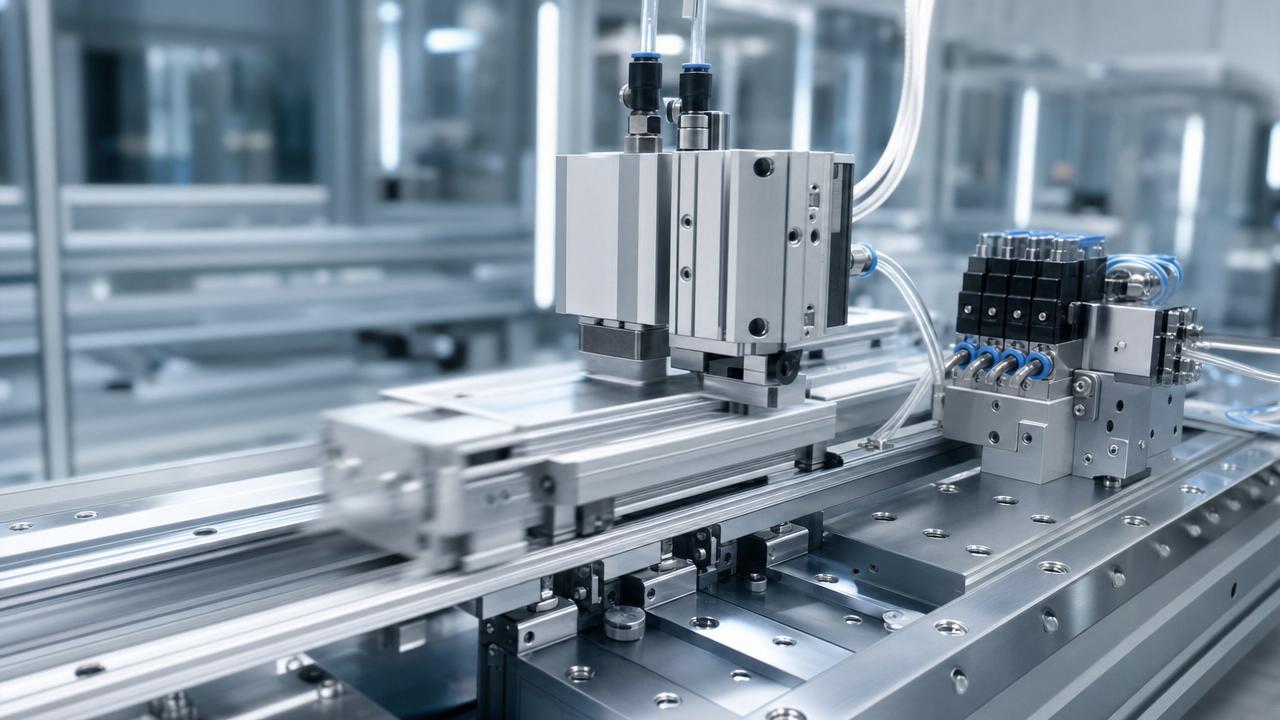
In systems where repeatability, speed, and micro-level motion control affect output quality, high-precision pneumatic actuators are a decisive link. Their actual accuracy depends on the full operating scene, not only the actuator body.
Air stability, seal condition, load changes, mounting rigidity, and control tuning all shape positioning behavior. When these factors are judged by application scenario, high-precision pneumatic actuators deliver more consistent and reliable motion.
Why accuracy changes across application scenarios
The same actuator can perform differently in semiconductor handling, test automation, packaging, or laboratory equipment. Each scene imposes different limits on speed, force, stroke stability, and environmental cleanliness.
This matters because accuracy is not a single number. It includes repeatability, settling time, backlash behavior, stop-point deviation, and response under varying loads.
For high-precision pneumatic actuators, a good technical decision starts with the operating context. The right question is not only “How accurate is the actuator?” but “How accurate is it in this exact duty cycle?”
Core factors that shift precision in real use
- Compressed air pressure stability and flow consistency
- Seal friction, leakage, and wear progression
- Load mass, inertia, and off-axis force
- Valve response speed and control loop tuning
- Mounting alignment and structural vibration
- Temperature variation and contamination exposure
Scenario 1: High-speed pick-and-place needs repeatability under rapid cycling
In electronics assembly and light automation, the priority is fast motion with narrow tolerance windows. Here, high-precision pneumatic actuators must repeat the same stop position across thousands of short cycles.
Accuracy often drifts when supply pressure pulses, valve timing varies, or the payload changes between cycles. Even small hose length differences can alter air delivery and change response.
Key judgment points in this scene
- Can the actuator maintain repeatability at peak cycle rate?
- Does the valve match the required response bandwidth?
- Are end-of-stroke impacts causing rebound or overshoot?
- Is air preparation adequate for stable friction behavior?
For this scenario, minimizing motion variability is often more important than maximizing theoretical force. High-precision pneumatic actuators perform better when the surrounding pneumatic circuit is simplified and balanced.
Scenario 2: Fine positioning systems depend on low friction and control resolution
Inspection stages, optical fixtures, and laboratory instruments need smaller travel corrections and smoother stopping. In these scenes, stick-slip friction becomes a major source of error.
High-precision pneumatic actuators can lose fine control when seals generate uneven breakaway force. Pressure may rise, but motion starts late, then jumps forward beyond the intended point.
What affects micro-level positioning most
- Seal material, surface finish, and lubrication regime
- High-resolution pressure regulation and valve modulation
- Load symmetry and guide precision
- Feedback sensor placement and signal noise
In such applications, the best result usually comes from viewing the actuator, valve, sensor, and guide as one motion system. Evaluating only the cylinder specification is rarely enough.
Scenario 3: Harsh environments challenge sealing, stability, and lifetime accuracy
Food processing, chemical units, dusty workshops, and outdoor automation place different stress on seals and moving parts. Accuracy may degrade slowly rather than fail suddenly.
Contamination increases drag, moisture changes friction, and thermal cycling shifts dimensional fit. For high-precision pneumatic actuators, long-term accuracy depends heavily on environmental compatibility.
Critical checks before deployment
- Seal resistance to chemicals, washdown, or fine particles
- Air dryness level and filtration grade
- Thermal expansion impact on alignment
- Maintenance interval versus acceptable drift
This is where specialized sealing knowledge becomes valuable. Low leakage and stable friction curves support both immediate performance and predictable lifecycle behavior.
Scenario 4: Heavy or uneven loads distort actuator accuracy
Material handling, clamping, and fixture movement often involve changing masses or off-center loads. In these cases, the actuator may be precise in theory but unstable in actual motion.
Side loading increases wear, raises friction, and changes the stop position over time. High-precision pneumatic actuators need rigid guidance when the load path is not perfectly axial.
Signals that load conditions are the real problem
- Accuracy worsens only at certain payload levels
- One direction of travel shows higher deviation
- Seal wear appears early on one side
- Guides and brackets show vibration marks
When these signs appear, resizing the actuator alone may not solve the issue. Load support, guide rail quality, and bracket stiffness often have greater influence.
How different scenarios change requirements for high-precision pneumatic actuators
Practical selection and tuning advice by scenario
The following actions improve the real-world performance of high-precision pneumatic actuators across mixed industrial settings.
- Stabilize supply pressure with proper regulation close to the motion point.
- Match valve flow and response speed to stroke length and cycle demand.
- Use seals designed for low friction and application-specific media exposure.
- Control side load through guides instead of relying on the actuator rod.
- Verify bracket rigidity and alignment during installation, not only at design stage.
- Measure repeatability under real payload changes, not empty-run conditions.
- Track drift over time to separate wear-related issues from tuning errors.
Common misjudgments that reduce accuracy
A frequent mistake is choosing high-precision pneumatic actuators based only on bore size, force, or catalog repeatability. Those values may not reflect the installed system.
Another mistake is ignoring air quality. Oil, water, and particles change friction behavior, then produce inconsistent motion that looks like a control problem.
Many systems also underestimate the effect of tubing layout. Long or uneven air paths delay pressure build-up and make synchronized motion difficult.
Finally, some applications demand better feedback architecture than standard end-position sensing can provide. Without suitable sensing, the control system reacts too late.
Turning accuracy requirements into a workable next step
Improving high-precision pneumatic actuators starts with a scene-based audit. Record pressure stability, cycle rate, load variation, stop accuracy, and environmental exposure in the actual installation.
Then rank the dominant error source. In one system, the issue may be seal friction. In another, it may be side load, valve lag, or contaminated compressed air.
A disciplined review of containment, flow control, sealing, and motion feedback reveals where accuracy is won or lost. That is the practical path to more dependable high-precision pneumatic actuators.
If a system must meet tighter tolerances, start with a measured baseline, compare scenarios, and refine the full motion chain. Precision improves fastest when the operating context guides every adjustment.
Industry Briefing
Get the top 5 industry headlines delivered to your inbox every morning.