Carbon Capture Equipment News: What Matters in 2026
In 2026, carbon capture headlines mean less if they stop at funding rounds and project scale. The more useful environmental equipment news for carbon capture now sits deeper in the system: containment quality, control stability, material durability, and compliance under uneven operating loads.
That shift matters across power, chemicals, refining, cement, gas processing, and advanced manufacturing. Capture units increasingly connect with compressed CO2 handling, purification loops, heat recovery, and digital monitoring, so equipment decisions affect both performance and long-term asset risk.
A technical reading of the market also changes. Instead of asking which project is biggest, the better question is which systems can hold purity, pressure, response time, and sealing integrity through real duty cycles.
Why 2026 looks different from earlier carbon capture coverage
Earlier reporting often centered on capacity targets, policy support, and capture percentages. Those points still matter, but they no longer explain whether installed equipment will remain stable after commissioning.
Environmental equipment news for carbon capture now reflects a more mature market. Buyers, plant owners, and technical reviewers want evidence of repeatable operation, lower leakage probability, faster control response, and defensible maintenance intervals.
This is where component-level intelligence becomes important. Carbon capture systems depend on valves, seals, actuators, gaskets, control loops, and separation hardware that must perform together, not just in isolated product tests.
The G-PCS perspective is useful here because it treats flow control and containment as a reliability logic, not a catalog exercise. That matters when CO2 service includes corrosive contaminants, frequent cycling, temperature variation, and strict emissions accountability.
What carbon capture equipment really includes
Carbon capture equipment is not a single machine category. It is a linked operating chain that starts at gas separation and continues through compression, drying, purification, storage preparation, and transfer control.
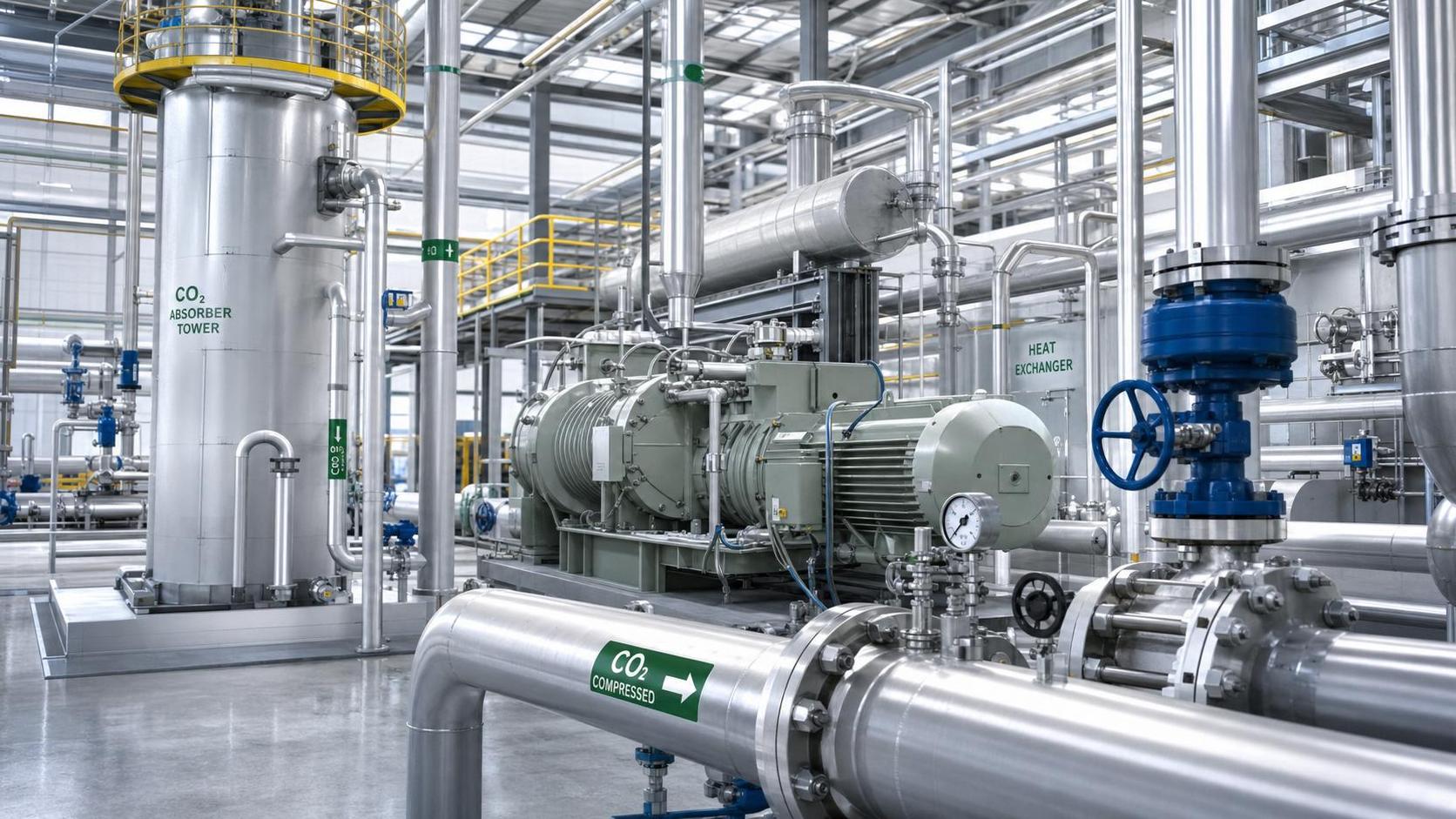
In practical terms, the most relevant equipment groups include absorber and stripper systems, compressors, heat exchangers, pressure regulators, shutoff valves, analytical instruments, sealing assemblies, and pipeline interface components.
For many facilities, the hidden constraints are not in the capture chemistry alone. They appear in elastomer compatibility, valve seat wear, actuator repeatability, pressure containment, and fugitive emissions control.
Core equipment signals worth tracking
- Seal and gasket performance in wet CO2 or impurity-rich streams
- Valve response consistency during start-stop operation
- Actuator precision in control-critical dosing and pressure regulation
- Material resistance to amines, trace sulfur compounds, and temperature swings
- Documented alignment with ISO, API, and plant-specific qualification standards
That is why serious environmental equipment news for carbon capture increasingly reads like operations intelligence. It connects performance data with service conditions instead of repeating launch announcements.
The reliability questions behind the headlines
A system can meet design capacity on paper and still create operational friction. In 2026, the strongest market signal is whether a supplier can explain failure modes before they appear in service.
For CO2 capture, leakage is not the only concern. Drift in pressure control, unstable valve timing, contamination at sealing surfaces, and material swelling can reduce capture efficiency or complicate downstream compression.
This is especially relevant where capture units link to high-pressure handling. A poorly matched valve or gasket can turn a promising decarbonization investment into a maintenance-intensive asset.
Five issues that deserve closer scrutiny
The most credible environmental equipment news for carbon capture usually contains this kind of detail. If it does not, the announcement may say more about financing than field readiness.
Where G-PCS logic becomes relevant
Carbon capture sits inside a broader industrial pattern: precision control plus reliable containment. That is the same logic seen in ultra-high pressure systems, extreme-environment sealing, and high-accuracy actuation.
G-PCS approaches this through benchmarked component intelligence. Instead of treating valves, gaskets, and actuators as standard accessories, it considers how each item behaves inside critical flow and energy systems.
This matters because many capture projects now operate closer to enterprise reliability expectations. They are no longer demonstration assets. They are expected to integrate with established industrial maintenance, audit, and compliance frameworks.
In that setting, specialized polymer and composite gaskets, extreme-environment mechanical seals, and precision actuator assemblies are not secondary details. They often determine whether control philosophy survives real operation.
How to read application differences across sectors
The phrase environmental equipment news for carbon capture covers several operating contexts. Each context changes what should be prioritized during technical review.
Power and energy assets
Load swings are common, so dynamic valve response and cycling endurance matter. Solvent management, emissions control, and downtime exposure often dominate equipment selection.
Cement, steel, and heavy process sites
Gas streams may carry dust, temperature variation, and contaminant complexity. Robust sealing surfaces and contamination-tolerant control hardware become more valuable than theoretical peak performance.
Chemicals and refining
Integration with existing process controls is critical. Compatibility with aggressive media, certification expectations, and maintenance planning shape equipment risk more directly than nameplate capacity.
Transport-ready CO2 handling
As capture projects tie into compression and transfer systems, pressure boundaries become stricter. UHP-style valve logic and sealing discipline start to influence equipment evaluation more strongly.
A practical filter for evaluating 2026 market claims
Not all market updates deserve equal weight. A useful filter is to separate symbolic progress from equipment evidence.
- Look for service-condition data, not only capture-rate claims
- Check whether sealing materials are named and qualified
- Ask how valve and actuator performance changes under cycling
- Review standards references with actual test context
- Compare maintenance assumptions with plant operating reality
- Treat lifecycle cost as part of technical fitness, not a separate topic
Usually, the best environmental equipment news for carbon capture is the news that helps narrow uncertainty. It clarifies operating envelopes, component assumptions, and known trade-offs.
What deserves attention next
The next phase of market evaluation should move toward structured comparison. That means mapping equipment claims against gas composition, pressure profile, control frequency, seal chemistry, and compliance obligations.
It also helps to follow carbon capture updates through a containment-and-flow lens. When a project announcement includes details on valve architecture, sealing systems, actuator precision, and qualification standards, it becomes more actionable.
For 2026, the most relevant environmental equipment news for carbon capture is not the loudest story. It is the one that explains how the system stays reliable after startup, during cycling, and across its maintenance life.
That is a useful place to begin any next review: define the service conditions clearly, rank containment risks early, and compare equipment on verifiable operating evidence rather than headline scale alone.
Industry Briefing
Get the top 5 industry headlines delivered to your inbox every morning.