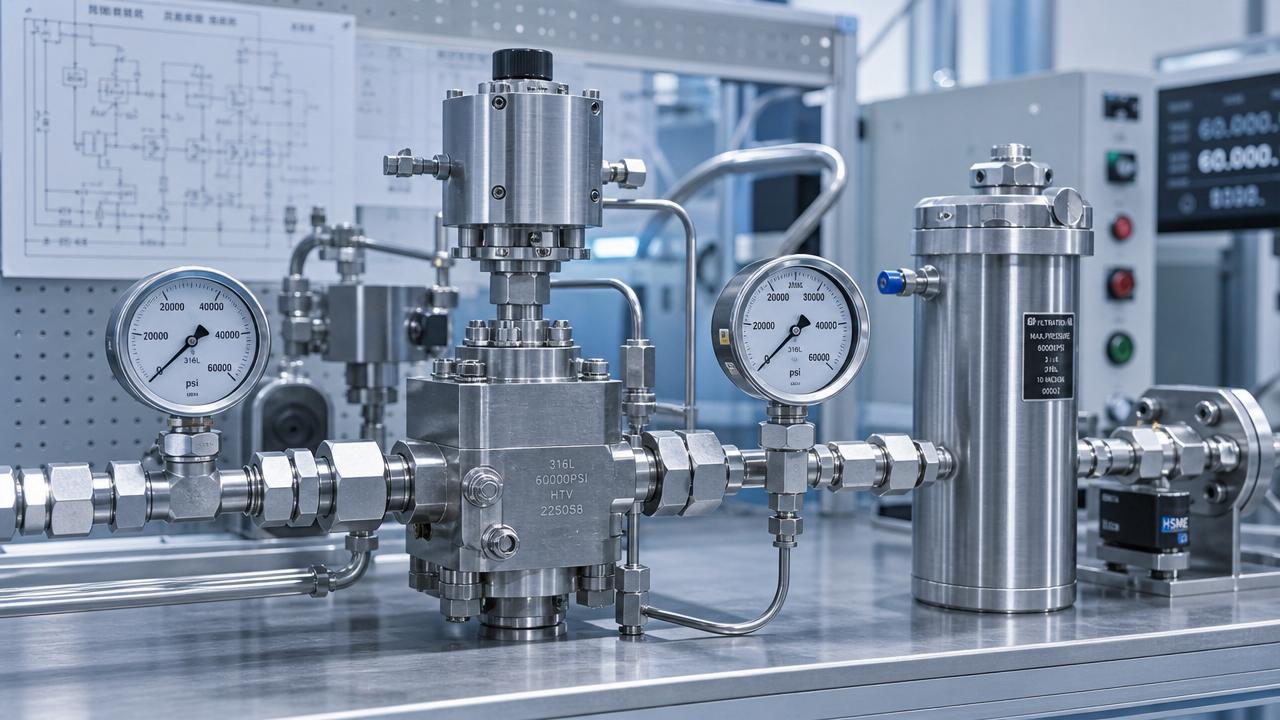
Ultra-High Pressure Control Valves: Failure Checks
When ultra-high pressure control valves begin to drift, leak, chatter, or respond slowly, the first minutes of troubleshooting can determine whether a system returns safely to service or moves toward costly downtime.
For after-sales maintenance teams, effective failure checks require more than replacing visible worn parts; they require a structured review of integrity, sealing, actuation, contamination, and signal stability.
What Maintenance Teams Usually Need to Confirm First
The main search intent behind this topic is practical fault identification, not general valve theory or broad product promotion.
Technicians usually want to know whether the valve can be safely isolated, inspected, repaired, recalibrated, or removed from service.
The most urgent questions are simple but critical: Is the valve leaking, sticking, over-cycling, misreading, or failing to close?
In ultra-high pressure service, small symptoms can indicate seat damage, seal extrusion, actuator weakness, particle contamination, or control-loop instability.
The best failure check is therefore not a single test, but a disciplined sequence that avoids unsafe assumptions.
Start With Safety, Isolation, and Operating History
Before touching ultra-high pressure control valves, confirm lockout, depressurization, venting, temperature stabilization, and stored-energy release according to site procedure.
Never assume a pressure gauge proves the system is safe, especially where blocked ports, trapped volumes, or failed transmitters are possible.
Review the last operating conditions before the failure appeared, including pressure spikes, rapid cycling, media changes, abnormal vibration, or maintenance events.
A valve that fails after a process upset should be checked differently from one that degrades slowly over months.
Slow degradation often points toward seat wear, seal aging, filter bypass, actuator fatigue, or calibration drift in the control system.
Sudden failure more often suggests debris impact, pressure shock, broken linkage, electrical fault, diaphragm rupture, or incorrect reassembly.
Check External Leakage Before Internal Performance
External leakage is the first visible warning because it directly affects safety, environmental compliance, and equipment availability.
Inspect body joints, bonnet interfaces, stem packing, actuator connections, threaded fittings, tube ends, and welded interfaces for wetting or residue.
For gas service, use approved leak detection methods suitable for the fluid, pressure class, and site safety requirements.
Do not tighten fasteners blindly under pressure, because uneven loading can damage sealing faces or worsen extrusion paths.
If leakage appears at packing or dynamic stem seals, check for stem scoring, side loading, misalignment, and excessive actuator thrust.
If leakage appears at static joints, suspect incorrect gasket compression, surface damage, thermal cycling, wrong material, or incompatible lubricant.
Evaluate Seat Leakage and Shutoff Integrity
Many failures in ultra-high pressure control valves are not visible externally, because the valve leaks internally across the seat.
Internal leakage can cause pressure creep, unstable downstream pressure, unexpected actuator cycling, and process contamination in sensitive systems.
Perform seat leakage tests only under approved procedures, with controlled pressure, known direction of flow, and verified downstream isolation.
Compare results with the valve specification, not with assumptions from lower-pressure valves or general-purpose control devices.
If leakage increases gradually, examine the seat, plug, ball, needle, or poppet for erosion, indentation, galling, or embedded particles.
If leakage appears immediately after maintenance, suspect incorrect orientation, damaged soft seat, wrong torque, contamination during assembly, or calibration error.
Identify Drift, Slow Response, and Poor Repeatability
Control drift is a common complaint because the valve may still move, yet no longer reaches the commanded position accurately.
Check whether the problem follows pressure load, temperature, command signal, actuator supply pressure, or a particular operating range.
Slow response may come from actuator friction, sticky seals, restricted pilot passages, weak solenoids, low supply pressure, or controller tuning problems.
Poor repeatability often indicates mechanical backlash, worn guiding surfaces, contaminated trim, unstable feedback, or excessive hysteresis in the actuator.
Record commanded position, actual position, upstream pressure, downstream pressure, and response time during several controlled steps.
This trend data helps separate a valve mechanical problem from an instrumentation or control-loop problem.
Listen for Chatter, Vibration, and Pressure Instability
Chatter should never be treated as normal noise in ultra-high pressure applications, especially near regulators, pumps, or fast-acting actuators.
Repeated impact can damage seats, stems, springs, guides, and sealing edges much faster than steady high-pressure operation.
Check for oversized valves, excessive pressure drop, insufficient downstream volume, unstable controller tuning, entrained gas, or cavitation-like conditions.
In gas systems, acoustic resonance and flow-induced vibration can amplify small control errors into severe mechanical fatigue.
In liquid systems, rapid closure can create pressure spikes that exceed normal operating limits and harm nearby components.
If chatter disappears during manual control but returns in automatic mode, investigate signal noise, tuning, feedback lag, or actuator overshoot.
Inspect Contamination Pathways and Filtration Condition
Contamination is one of the most common hidden causes of failure in ultra-high pressure control valves.
Particles can cut soft seats, hold sealing surfaces open, jam small passages, and create scratches that grow under cycling.
Check upstream filters, strainers, flushing records, tubing cleanliness, lubricant compatibility, and whether maintenance introduced fibers or metallic debris.
When disassembling the valve, collect debris carefully instead of wiping everything away before evidence is documented.
Particle shape and material can reveal whether contamination came from pump wear, tube cutting, seal breakdown, corrosion, or assembly tools.
For oxygen, hydrogen, semiconductor, or high-purity service, cleanliness control is not optional; it is part of functional reliability.
Examine Seals, Packing, and Material Compatibility
Seals in ultra-high pressure systems fail through extrusion, compression set, chemical attack, thermal aging, rapid decompression, and mechanical cutting.
Look for flattened profiles, spiral marks, nibbling, cracks, swelling, discoloration, hardening, or missing fragments around the sealing interface.
Elastomer damage should be interpreted with the service media, pressure cycle frequency, temperature, and decompression rate in mind.
Hydrogen service may require special attention to permeation, embrittlement risks in metals, and seal materials qualified for the duty.
High-purity or corrosive media may require FFKM, PTFE-based materials, metal seals, or other specialized sealing solutions.
Replacing a seal with the same size but wrong compound can restore assembly appearance while creating a repeat failure.
Verify Actuator Force, Travel, and Feedback
A valve can appear defective when the real problem is insufficient actuator force or unreliable feedback.
Check pneumatic supply pressure, hydraulic pressure, electrical power, solenoid operation, spring condition, travel stops, and linkage security.
Confirm full travel using calibrated indicators instead of relying only on controller display values or visual estimates.
For pneumatic actuators, inspect tubing restrictions, moisture, regulator drift, exhaust blockage, and air quality issues.
For electric or piezoelectric actuation, check connectors, grounding, driver output, thermal limits, and response under actual load.
If feedback disagrees with physical travel, the position sensor, linkage, or calibration procedure may be misleading the control system.
Review Control Signal Quality and Instrumentation
Many field failures are misdiagnosed because technicians focus on the valve body before checking the signal path.
Measure command signal stability, feedback stability, controller output, pressure transmitter accuracy, and any alarm history around the event.
Noise, grounding faults, loose terminals, water ingress, electromagnetic interference, or scaling errors can create apparent valve instability.
Compare local manual operation with remote automatic operation to determine whether the issue follows the control system.
If the valve behaves correctly on a bench test but fails in the process, instrumentation and system dynamics deserve deeper review.
Document the test conditions carefully, because bench pressure, media, temperature, and load may differ greatly from installed service.
Use a Failure Pattern Matrix Instead of Guesswork
A structured matrix helps maintenance teams connect symptoms to likely causes without replacing parts randomly.
External leakage points toward packing, gaskets, body joints, fitting integrity, stem damage, or incorrect assembly torque.
Internal leakage points toward seat damage, trapped particles, trim wear, incorrect closure force, or pressure-assisted deformation.
Slow response points toward actuator supply issues, sticky dynamic seals, blocked passages, controller settings, or excessive friction.
Chatter points toward unstable differential pressure, poor sizing, resonance, feedback lag, cavitation, or aggressive control tuning.
Unstable pressure readings may reflect transmitter issues, trapped gas, pulsation, blocked impulse lines, or a genuine valve control problem.
When to Repair, Rebuild, or Remove From Service
Not every valve with a symptom should be rebuilt immediately, but unsafe uncertainty should never be ignored.
Minor calibration drift may be corrected through adjustment if sealing surfaces, actuator response, and pressure integrity remain acceptable.
Repeated seat leakage, visible scoring, seal extrusion, cracked components, or unexplained pressure creep usually requires removal and detailed inspection.
If the valve is used in critical hydrogen, oxygen, toxic, or semiconductor service, the threshold for removal should be lower.
Consider lifecycle data, cycle count, operating severity, spares availability, and downtime cost before choosing repair over replacement.
A low-cost rebuild is not economical if it returns an unstable valve to a high-consequence system.
Documentation That Makes Future Troubleshooting Faster
Good after-sales maintenance depends on records that are specific enough to support future technical judgment.
Record valve model, serial number, pressure rating, media, temperature, cycle count, leakage test result, failure symptom, and corrective action.
Include photographs of damaged seats, seals, stems, debris, fittings, and actuator linkages before cleaning or replacement.
Capture pressure trends, controller logs, alarm timestamps, and maintenance history around the failure window.
This information helps distinguish isolated damage from recurring system issues such as contamination, oversizing, or pressure shock.
For global operations, standardized failure records also improve spare parts planning, supplier communication, and warranty evaluation.
Preventive Checks After the Valve Returns to Service
Failure checking does not end when the valve passes a single pressure or function test.
After installation, monitor startup behavior, leakage, control stability, response time, temperature effects, and abnormal sound during early operation.
Verify that filters are installed correctly, upstream lines are clean, and any flushing bypasses have been restored to normal configuration.
Recheck actuator settings, travel limits, position feedback, and controller parameters after the system reaches normal operating pressure.
Schedule follow-up inspection based on duty severity rather than using the same interval for every high-pressure valve.
The most reliable maintenance programs combine condition evidence, operating history, and manufacturer recommendations into one decision framework.
Conclusion: Reliable Failure Checks Protect More Than the Valve
Ultra-high pressure control valves fail in ways that can look similar at first but require very different corrective actions.
Effective troubleshooting begins with safe isolation, then moves through leakage, shutoff integrity, actuation, contamination, sealing, and signal verification.
For after-sales maintenance teams, the goal is not simply to make the valve move again.
The real goal is to understand why performance changed and whether the system can return safely to controlled operation.
By using structured failure checks, technicians reduce repeat repairs, protect critical assets, and improve confidence in high-pressure flow control systems.