How High Temperature Polymers Reduce Outgassing Risk
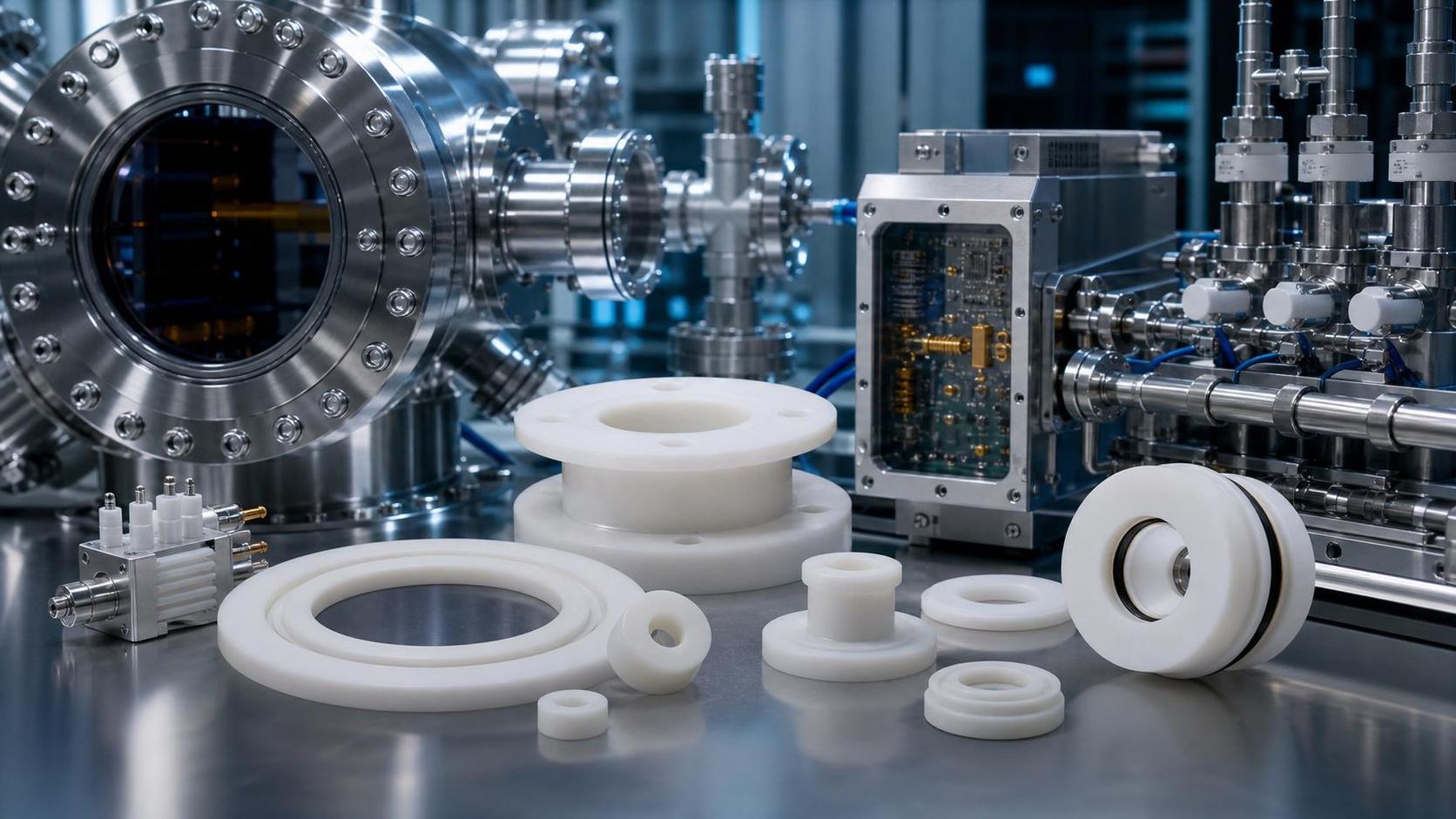
Why high temperature polymers low outgassing matters in real operating environments
In tightly controlled systems, material choice is rarely a background detail.
When heat, vacuum stability, and contamination limits intersect, polymer behavior starts shaping process reliability.
That is where high temperature polymers low outgassing performance becomes a practical engineering question, not a catalog phrase.
In semiconductor tools, microwave assemblies, high-pressure flow control, and space-grade sealing, outgassing can shift more than cleanliness.
It can alter dielectric behavior, fog optical surfaces, destabilize vacuum baselines, and shorten maintenance intervals.
The issue becomes sharper when operating temperatures stay elevated for long periods rather than peaking briefly.
In those conditions, material selection has to balance thermal endurance, sealing function, chemical compatibility, and low molecular release.
Across the G-PCS industrial context, that balance sits at the center of containment and flow integrity.
Actual performance depends on where the polymer sits in the system
Different applications ask different things from the same polymer family.
A gasket near a plasma chamber wall faces a very different risk profile than an insulator inside a microwave power path.
A valve seat in hydrogen service may tolerate minimal organic release, yet still fail if permeation control is overlooked.
The common mistake is assuming high temperature rating alone solves the contamination problem.
In practice, high temperature polymers low outgassing behavior depends on resin chemistry, filler system, cure quality, and post-processing history.
Geometry also matters.
Thin films, porous structures, and large exposed surfaces can release volatiles faster than compact molded parts.
That is why mature evaluation starts with location, thermal profile, and exposure mode before comparing data sheets.
What changes from one site condition to another
This is why one low outgassing material can still be the wrong fit in another thermal or media condition.
Vacuum-sensitive processes usually expose outgassing problems first
In vacuum equipment, contamination is often noticed indirectly.
Pump-down time drifts upward, chamber walls collect haze, or process repeatability becomes harder to hold.
At that point, high temperature polymers low outgassing properties become central to root-cause analysis.
The most demanding cases are not always the hottest ones.
Moderate temperatures with long dwell times can continuously drive volatile release from seals, cable jackets, valve components, and internal spacers.
In sub-nanometer fabrication environments, even trace condensables may affect yield, sensor stability, or film integrity.
A useful screening approach is to separate materials by exposure level.
- Direct chamber exposure needs the strictest low outgassing and thermal aging data.
- Peripheral vacuum-zone exposure still needs screening, especially near heated surfaces.
- External support structures may accept broader options if migration paths are controlled.
That kind of zoning usually gives better results than searching for one universal polymer specification.
Microwave and RF equipment adds a different decision layer
In industrial microwave and RF systems, heat is only part of the equation.
Residues from polymer outgassing can change surface conditions around high-frequency components and insulated interfaces.
That can influence arcing tendency, dielectric consistency, and maintenance frequency over time.
Here, high temperature polymers low outgassing selection should be tied to both thermal exposure and electrical sensitivity.
A polymer that performs well in static thermal insulation may still leave deposits that matter inside compact RF assemblies.
More reliable decisions come from combining outgassing data with dielectric testing after aging, not before aging only.
This distinction matters in magnetron-adjacent components, waveguide interfaces, and thermal isolators around energized modules.
Sealing and flow-control applications care about purity, compression, and media interaction
In valves, seals, and gasketed joints, outgassing rarely acts alone.
It interacts with pressure cycling, gas compatibility, surface finish, and mechanical recovery.
That is especially visible in UHP service, aggressive chemicals, and elevated-temperature shutoff conditions.
A low outgassing polymer that loses sealing force after repeated compression may still create contamination through leakage or wear.
Likewise, a highly stable seal material may be unsuitable if it absorbs process media and later releases it during thermal swings.
This is why high temperature polymers low outgassing evaluation in flow systems should include dynamic service history.
For specialized polymer and composite gaskets, the better question is not simply, “Can it survive the heat?”
The better question is whether it holds purity, dimensions, and sealing load across the actual maintenance window.
Practical checks before narrowing material options
- Confirm steady-state temperature, not just peak excursion.
- Map whether the part sees vacuum, purge gas, reactive media, or alternating conditions.
- Review cure method, post-bake condition, and storage age.
- Check ISO, SEMI, API, or MIL-SPEC alignment where relevant.
- Compare replacement interval risk against initial material cost.
Where teams often misread low outgassing claims
One common misjudgment is treating published outgassing numbers as universal performance proof.
Test method, sample thickness, conditioning, and exposure duration can shift results significantly.
Another is comparing polymers without accounting for downstream assembly contamination sources.
Adhesives, lubricants, fillers, and cleaning residues may dominate the final contamination picture.
A third mistake is assuming two similar applications share the same acceptance threshold.
Deep-space optical hardware, plasma process equipment, and hydrogen-compatible valve systems can all require low outgassing materials.
Yet the failure mode they are trying to prevent is not identical.
More accurate selection comes from linking material data to the exact system consequence of volatile release.
A more useful path is to build selection around operating evidence
High temperature polymers low outgassing decisions improve when they are anchored to measured conditions and service outcomes.
That means combining temperature maps, exposure duration, pressure state, media chemistry, and maintenance history.
Where possible, shortlisting should also include post-aging inspection and contamination monitoring from representative assemblies.
For organizations working across the G-PCS pillars, a shared screening framework usually pays off.
It keeps sealing, flow control, RF stability, and precision actuation decisions from drifting into isolated material choices.
The next step is straightforward.
List each operating zone, define the contamination consequence, and compare candidate materials against real thermal dwell and compatibility limits.
That process makes high temperature polymers low outgassing performance easier to judge, and much harder to overestimate.
Industry Briefing
Get the top 5 industry headlines delivered to your inbox every morning.