Chemical Resistant Engineered Polymers for Harsh Media Lines
Chemical Resistant Engineered Polymers for Harsh Media Lines
In harsh media lines, material failure is rarely a minor issue. It can disrupt safety, purity, uptime, and total asset reliability in one event.
That is why chemical resistant engineered polymers matter far beyond simple corrosion control. They directly affect sealing life, contamination risk, pressure stability, and service predictability.
In practical terms, material selection has become a system decision. It now sits at the intersection of chemistry, temperature, pressure, compliance, and maintenance strategy.
This article explains how chemical resistant engineered polymers perform in aggressive media lines, where they fit best, and how to evaluate them against real operating demands.
Why Harsh Media Lines Expose Material Weakness Fast
Harsh media lines combine several stress factors at once. Chemical attack rarely appears alone. It usually arrives with pressure cycling, thermal fluctuation, and mechanical loading.
Acids, caustics, oxidizers, solvents, ultrapure chemicals, and mixed process streams all challenge conventional plastics. Small compatibility errors can trigger swelling, cracking, embrittlement, or extractables.
The more critical signal is often dimensional drift. A polymer may survive chemically, yet still lose tolerance control under temperature and media exposure.
That becomes serious in valve seats, gaskets, liners, pump components, sensor housings, and flow-control assemblies. Precision loss there can damage the whole containment strategy.
- Chemical degradation reduces service life.
- Permeation can compromise purity and safety.
- Thermal expansion may disturb sealing force.
- Creep under load can shift long-term geometry.
- Regulatory nonconformance may block deployment.
So the real question is not whether a resin is “resistant.” The question is whether it remains stable enough for the full duty cycle.
What Makes Chemical Resistant Engineered Polymers Different
Chemical resistant engineered polymers are designed for higher structural and environmental performance than commodity plastics. They retain useful properties under more demanding combinations of media and stress.
Their value usually comes from three things. First, strong molecular structure. Second, lower interaction with aggressive chemicals. Third, better retention of shape and strength over time.
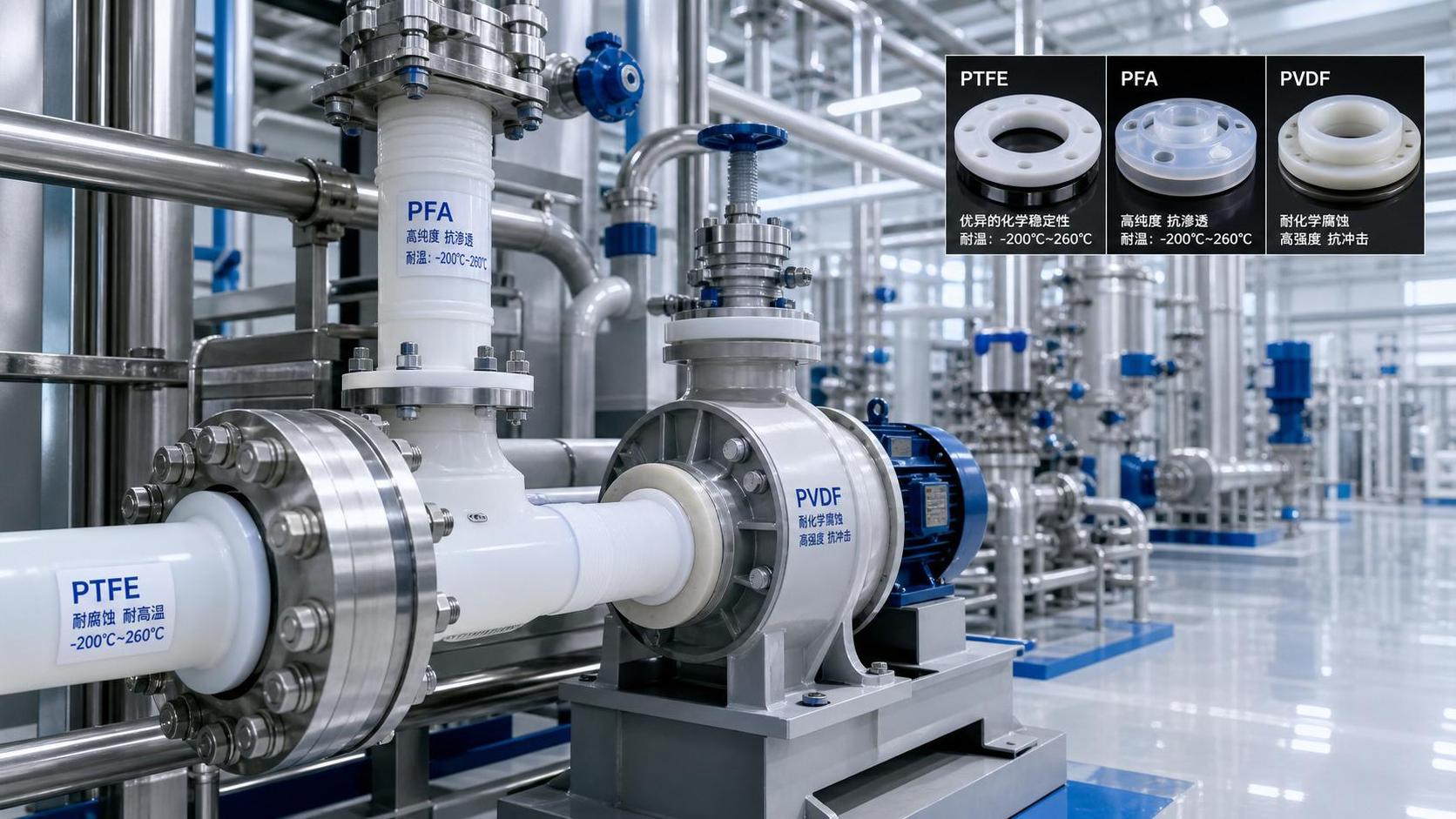
Common examples include PTFE, PFA, PVDF, PEEK, PPS, UHMW-PE, and selected fluoropolymers or filled high-performance compounds. Each has a distinct balance of resistance and mechanical behavior.
From a selection standpoint, chemical resistance alone is not enough. The best material is the one that keeps function stable across the real operating envelope.
Core performance attributes to compare
- Resistance to acids, alkalis, solvents, oxidizers, and mixed media.
- Temperature capability in continuous and peak conditions.
- Compressive strength and creep resistance under sustained load.
- Dimensional stability and coefficient of thermal expansion.
- Permeation behavior and extractables profile.
- Machinability, weldability, and fabrication consistency.
Material Comparison for Harsh Media Applications
No single polymer dominates every harsh media line. Selection depends on which failure mode matters most in the target process.
This comparison shows why chemical resistant engineered polymers must be matched to service conditions, not selected by reputation alone.
Key Evaluation Criteria Beyond Chemical Compatibility Charts
Compatibility charts are useful, but they are only a starting point. Most charts describe static chemical contact, not the complexity of a live process line.
Actual performance depends on concentration, impurities, flow velocity, pressure cycling, temperature spikes, cleaning chemistry, and exposure duration. Small changes can shift material behavior significantly.
This is especially true for chemical resistant engineered polymers used in ultrapure, high-pressure, or thermally variable systems. A material that passes a lab screen may still fail in field service.
Questions worth asking during evaluation
- What is the worst-case chemical concentration, not just the nominal one?
- Are there steam, CIP, or purge steps that alter exposure conditions?
- Does the part carry load while exposed to the media?
- What purity, outgassing, or extractables limits apply?
- Which standards govern traceability, testing, and qualification?
In recent projects, the stronger signal is lifecycle behavior. Teams are moving away from pass-fail chemistry checks toward total performance verification.
Standards, Compliance, and Documentation Expectations
For critical lines, material choice must align with documentation discipline. The polymer itself may be suitable, but missing compliance evidence can still block approval.
Depending on the application, relevant references may include ISO, ASTM, SEMI, FDA, USP, API, or customer-specific qualification protocols. Aerospace and defense lines may add MIL-SPEC requirements.
This also means chemical resistant engineered polymers should be reviewed as controlled materials, not generic substitutions. Grade changes, filler changes, or process changes may affect validation status.
- Request lot traceability and material certification.
- Check test methods behind compatibility claims.
- Confirm cleanroom, purity, or biocompatibility requirements.
- Review dimensional inspection and process control records.
Where systems support sensitive flow and containment, paperwork is not secondary. It is part of the risk control model.
Common Failure Modes in Chemical Resistant Engineered Polymers
Even advanced materials fail when the selection logic is incomplete. Most field issues come from combined stresses that were reviewed separately during design.
A typical example is seal relaxation after thermal cycling. Another is solvent-driven swelling that reduces dimensional tolerance in precision valve components.
Permeation is another underestimated risk. In purity-sensitive environments, a polymer may remain intact while still allowing gradual transfer of gases or chemicals.
Filled grades add another layer. They can improve wear, stiffness, and creep resistance, yet may alter chemical resistance or particle-shedding performance.
Frequent root causes
- Overreliance on generic compatibility tables.
- Ignoring load-bearing behavior during chemical exposure.
- Assuming one grade equals another.
- Missing transient cleaning or upset conditions.
- Underestimating tolerance sensitivity in precision assemblies.
A Practical Selection Workflow
A workable evaluation process should be structured, fast, and evidence-based. It should also connect design intent with sourcing and maintenance realities.
- Define the full media profile, including contaminants and cleaning chemistry.
- Map pressure, temperature, duty cycle, and peak excursions.
- Rank failure consequences: leakage, contamination, deformation, or downtime.
- Shortlist chemical resistant engineered polymers by function, not brand familiarity.
- Review standards, certifications, and traceability needs early.
- Validate with application-specific tests and dimensional checks.
- Feed field data back into the approved material list.
This workflow helps avoid false confidence. It also improves procurement alignment, because equivalent-looking materials often behave very differently in service.
Final Takeaway for Critical Media Line Decisions
Chemical resistant engineered polymers are essential for modern harsh media lines, but the best choice depends on the full operating context.
The most reliable decisions come from balancing chemistry, mechanics, purity, standards, and lifecycle evidence. That is where long-term containment performance is really won.
When evaluating options, focus on verified application fit rather than broad material reputation. In high-consequence systems, disciplined selection is usually cheaper than corrective replacement.
Use that as the operating principle: qualify chemical resistant engineered polymers against the real line, the real media, and the real failure cost.
Industry Briefing
Get the top 5 industry headlines delivered to your inbox every morning.