Thermal Conductivity of Seal Rings Compared by Material
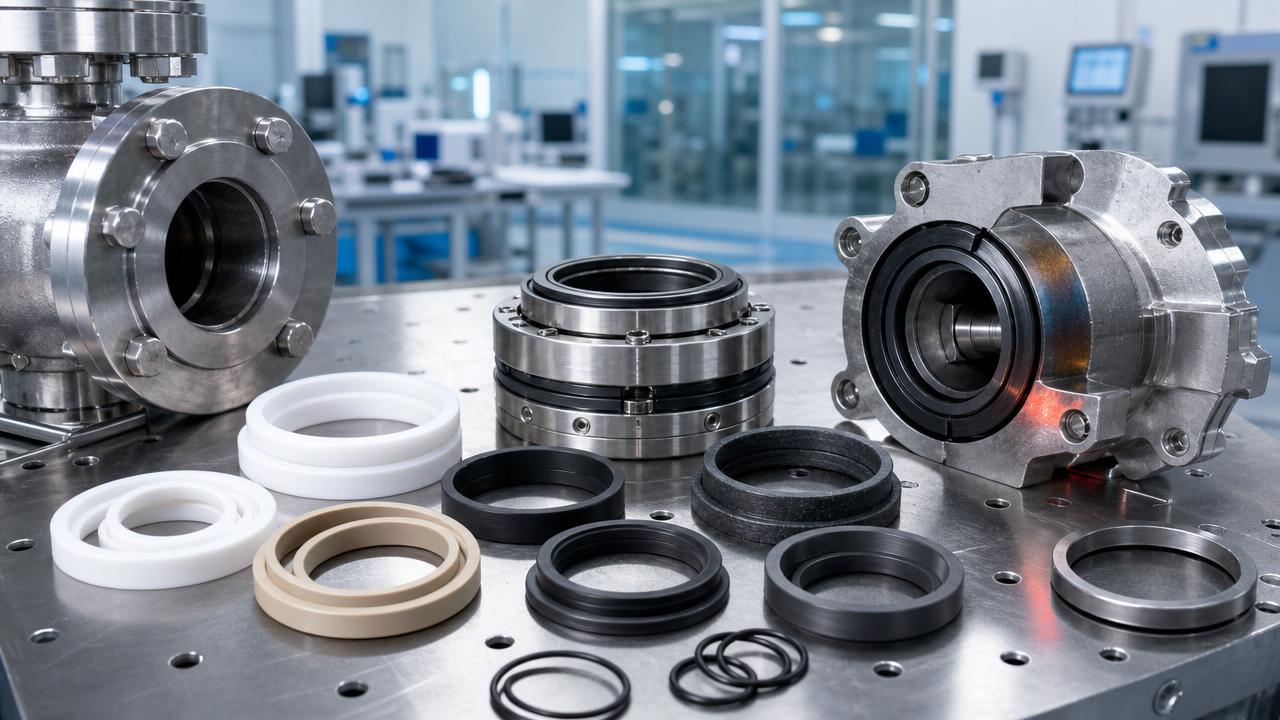
For technical evaluators selecting sealing materials for demanding systems, understanding the thermal conductivity of seal rings is essential to balancing heat transfer, chemical resistance, and long-term reliability.
Different materials behave very differently under pressure, friction, thermal cycling, and media exposure. A seal ring that insulates well may protect adjacent parts, yet also trap heat and accelerate wear.
In precision valves, RF systems, compressors, vacuum tools, and extreme-environment assemblies, the thermal conductivity of seal rings directly affects sealing stability, leakage risk, and service life.
This comparison focuses on practical application judgment. It helps align material choice with heat flow, operating temperature, chemical duty, and motion pattern.
Why thermal conductivity matters in real sealing scenarios
Seal rings do more than block leakage. They also influence how heat leaves contact surfaces, shafts, grooves, and nearby housings.
When conductivity is too low, frictional heat can remain concentrated at the sealing interface. That often causes hardening, thermal expansion mismatch, extrusion, or rapid property drift.
When conductivity is higher, heat can disperse faster. This may reduce local hot spots, but it can also transfer thermal load into surrounding sensitive components.
Therefore, the best thermal conductivity of seal rings is not always the highest value. The correct target depends on system architecture and failure mode.
Core judgment points before comparing materials
- Is heat generated mainly by friction, external process temperature, or both?
- Does the seal need to dissipate heat or isolate heat?
- Is the duty static, reciprocating, or rotary?
- Will pressure spikes and thermal cycling occur together?
- How critical are chemical resistance, cleanability, and outgassing?
Material comparison for high-temperature and friction-driven systems
In dynamic systems, friction-generated heat often dominates selection. Here, the thermal conductivity of seal rings becomes a wear-control parameter rather than a simple material property.
PTFE and filled PTFE seal rings
Virgin PTFE offers low friction and broad chemical resistance. Its thermal conductivity is generally low, around 0.25 W/m·K, so heat dissipation is limited.
Filled PTFE grades improve this behavior slightly. Glass-filled, carbon-filled, or graphite-filled PTFE can provide better dimensional stability and somewhat improved heat transfer.
For valve seats, piston seals, and dry-running interfaces, filled PTFE often performs better than virgin PTFE because it manages creep and frictional heat more effectively.
PEEK seal rings
PEEK usually shows thermal conductivity near 0.25 W/m·K, similar to PTFE in magnitude, but with much higher mechanical strength and temperature capability.
This makes PEEK useful where pressure, abrasion, and shape retention matter more than very low friction. It is common in backup rings, high-load seats, and aggressive process equipment.
Carbon-filled PEEK variants can improve wear and heat spreading. In rapid cycling equipment, that may help reduce localized thermal stress.
Carbon graphite seal rings
Carbon graphite has much higher thermal conductivity than most polymers, though exact values vary widely by grade and orientation.
This material is effective where dry running, high sliding speed, or elevated temperatures create persistent heat. It also offers good self-lubricating behavior.
However, brittleness and media compatibility must be checked carefully. It is not a universal replacement for engineered polymers.
Material comparison for chemically aggressive and clean-process environments
In semiconductor, analytical, pharmaceutical, and specialty chemical systems, chemical stability may outweigh raw conductivity. Still, the thermal conductivity of seal rings remains important during sterilization and thermal swings.
FFKM and other high-performance elastomers
FFKM typically has very low thermal conductivity, often around 0.2 W/m·K or below. It resists aggressive chemicals extremely well, but it is not efficient at moving heat away.
This can be acceptable in static seals exposed to corrosive media. It becomes more challenging in dynamic contact zones or where fast temperature transitions are routine.
FKM, EPDM, and HNBR follow a similar pattern. They are useful when flexibility and chemical suitability are needed, yet they should not be expected to solve thermal build-up.
UHMWPE and specialty fluoropolymers
UHMWPE offers low friction and good wear resistance, with modest thermal conductivity. It can work in specific sliding applications, especially where impact resistance matters.
Other fluoropolymers may improve chemical performance, but many still remain thermally insulating. Selection should consider whether the process benefits from heat containment or heat release.
Typical application scenarios and the best-fit material logic
Scenario 1: High-pressure valves with rapid opening cycles
Pressure spikes, seat impact, and repeated cycling create localized thermal stress. Filled PTFE or PEEK often fit better than soft elastomers.
The preferred thermal conductivity of seal rings here is moderate, paired with strong creep resistance and dimensional stability.
Scenario 2: Dry-running mechanical interfaces
When lubrication is limited, frictional heat becomes the main threat. Carbon graphite or advanced filled polymers can better control surface temperature.
Low-conductivity elastomers are rarely ideal in this case unless contact stress is very low and motion is minimal.
Scenario 3: Corrosive media with static sealing duty
Chemical resistance dominates. FFKM, PTFE, or specific fluoropolymer solutions are often chosen, even though the thermal conductivity of seal rings remains relatively low.
The key judgment point is whether thermal cycling is slow enough to avoid repeated expansion mismatch and stress cracking.
Scenario 4: Vacuum, RF, or precision energy systems
Outgassing, contamination control, and thermal stability become critical. Material purity may limit options before conductivity is even compared.
PTFE, PEEK, and engineered composites are commonly reviewed. Final choice depends on whether the seal should shield adjacent assemblies from heat or conduct it away.
How different scenarios change material requirements
Practical recommendations for selecting seal ring conductivity
- Use conductivity together with PV limits, friction coefficient, and compression set.
- Review filled grades, because additives can change the thermal conductivity of seal rings meaningfully.
- Check contact geometry, since thin sections can overheat even with better materials.
- Model thermal expansion mismatch between ring, gland, and mating hardware.
- Test under actual cycling speed, media, and temperature ramp rate.
Common selection mistakes when comparing seal ring materials
One frequent mistake is choosing only by maximum temperature rating. A material may survive high temperature briefly, yet still fail because it cannot move heat away from the contact zone.
Another mistake is comparing base polymer values only. The actual thermal conductivity of seal rings may shift significantly with fillers, porosity, fiber orientation, or processing route.
A third error is ignoring the surrounding metal path. Seal performance depends on the whole heat-transfer system, not the ring alone.
Finally, low friction should not be confused with low heat risk. Some low-friction materials still accumulate heat because conductivity remains poor.
Next-step evaluation path for material screening
Start with the operating scenario, not the catalog. Define whether the seal must dissipate heat, block heat, resist chemicals, or survive pressure-driven distortion.
Then shortlist two to four candidates by combining conductivity, wear behavior, chemical resistance, and mechanical retention. This narrows risk faster than single-property selection.
For critical systems, request grade-specific data and validate the thermal conductivity of seal rings under representative conditions. Lab values alone rarely capture real interface behavior.
A disciplined comparison of PTFE, filled PTFE, PEEK, elastomers, and carbon graphite can reveal the most reliable fit for advanced containment and flow applications.
Industry Briefing
Get the top 5 industry headlines delivered to your inbox every morning.