How to Choose PTFE Gaskets for Chemical Processing
How to Choose PTFE Gaskets for Chemical Processing
Choosing the right PTFE gaskets for chemical processing is critical to sealing reliability, media compatibility, and long-term system safety.
The decision rarely stops at corrosion resistance alone.
Temperature cycling, bolt load retention, creep, pressure variation, flange finish, and compliance requirements all shape real-world performance.
In chemical service, a gasket that looks chemically compatible on paper can still fail early.
That usually happens when mechanical demands were underestimated during selection.
This guide explains how to choose PTFE gaskets for chemical processing with a practical, evaluation-driven approach.
Why PTFE Gaskets Are Widely Used in Chemical Processing
PTFE offers broad chemical resistance, low surface energy, and strong suitability for aggressive media.
That makes PTFE gaskets for chemical processing common in acids, caustics, oxidizers, and mixed solvents.
They are also valued where cleanliness matters, including pharmaceutical, semiconductor, and high-purity chemical lines.
Another advantage is material stability across a broad temperature range.
Still, PTFE is not a universal answer.
Its tendency to creep under sustained load means selection must balance chemistry and mechanics together.
Start with the Process Media, Not the Material Name
A common mistake is choosing PTFE gaskets for chemical processing only because the chemical list says “resistant.”
That is only the first filter.
Review the actual media profile in detail:
- Primary chemical and concentration range
- Trace contaminants or cleaning residues
- Operating and upset temperatures
- Pressure profile, including spikes and vacuum phases
- Whether service is continuous, batch, or cyclic
- Potential permeation or absorption concerns
In actual plants, the media is often less stable than the line diagram suggests.
Cleaning chemicals, startup solvents, and washdown steps can expose the gasket to short-term extremes.
For that reason, PTFE gasket selection should reflect the harshest credible condition, not the average condition.
Understand the Main PTFE Gasket Types
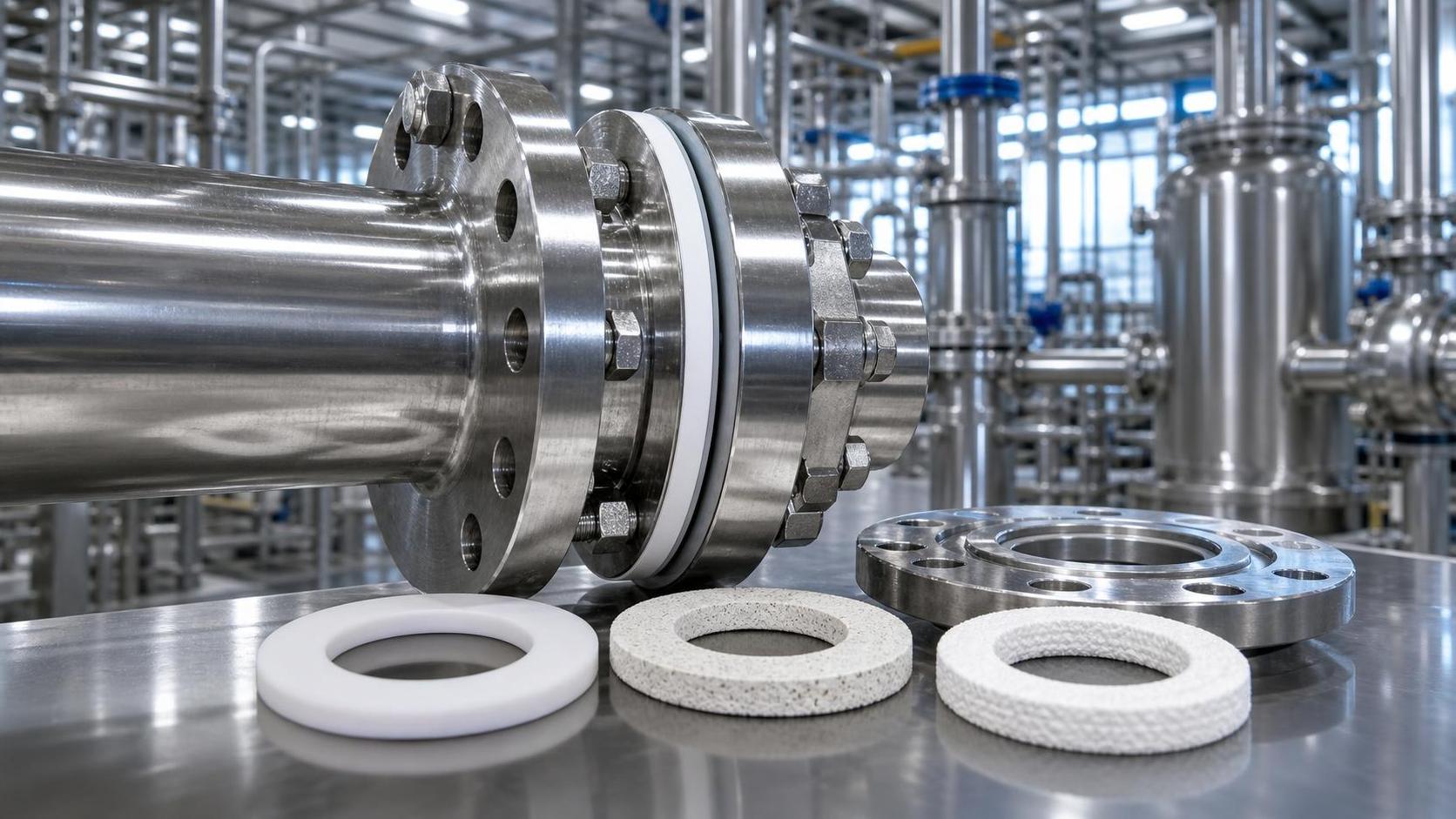
Not all PTFE gaskets for chemical processing behave the same way.
The material form directly affects sealability, creep resistance, and flange load requirements.
Virgin PTFE
Virgin PTFE provides excellent chemical purity and wide compatibility.
It is often preferred for highly aggressive or contamination-sensitive service.
Its weakness is higher creep and cold flow under long-term compression.
Filled PTFE
Filled PTFE includes additives such as glass, carbon, graphite, or mineral fillers.
These formulations improve compressive strength, dimensional stability, and creep resistance.
However, filler choice can affect chemical resistance and purity, so compatibility must be reviewed carefully.
Expanded PTFE
Expanded PTFE is softer and more conformable than standard sheet PTFE.
It seals well on irregular flange surfaces and under relatively low bolt loads.
For aging equipment or glass-lined flanges, this can be a strong advantage.
Match Temperature and Pressure to Real Sealing Conditions
PTFE gaskets for chemical processing must be evaluated against combined temperature and pressure, not isolated values.
A gasket may tolerate the temperature alone and the pressure alone, yet struggle when both peak together.
Check these conditions before final approval:
- Normal operating range and design maximum
- Transient startup and shutdown conditions
- Thermal cycling frequency
- Vacuum or reverse-pressure events
- Pressure pulsation from pumps or valves
Recent selection trends show a stronger focus on upset conditions.
That shift makes sense.
Leaks often begin during transitions, when bolts, flanges, and gasket material respond at different rates.
Creep and Cold Flow Often Decide Service Life
When evaluating PTFE gaskets for chemical processing, creep deserves special attention.
PTFE can deform gradually under compression, especially at elevated temperature.
As gasket stress relaxes, leakage risk rises.
This is more likely in these cases:
- Large-diameter flanges
- Thin or flexible flange assemblies
- High-temperature batch reactors
- Frequent thermal cycling service
- Low bolt-load applications
If creep is the dominant risk, filled or expanded PTFE may outperform virgin PTFE.
This is one reason material grade matters as much as material family.
Check Flange Design, Surface Finish, and Installation Load
Even well-chosen PTFE gaskets for chemical processing can fail on poorly matched hardware.
The gasket must suit the flange style, facing condition, and available bolt stress.
Review these mechanical details:
In practice, installation quality matters more than many specifications suggest.
Controlled torque, correct tightening sequence, and clean flange surfaces should be treated as part of gasket selection.
Do Not Ignore Standards, Test Data, and Documentation
For critical chemical lines, PTFE gaskets for chemical processing should be backed by traceable technical data.
Supplier claims are useful, but validated performance data is better.
Key items to request include:
- Chemical compatibility charts with temperature notes
- Compression, recovery, and creep relaxation data
- Pressure-temperature limits
- Standards alignment, such as ASTM, ASME, FDA, or USP where relevant
- Lot traceability and material certification
This matters even more for regulated industries and top-tier procurement frameworks.
A gasket that fits mechanically but lacks documentation can still fail the approval process.
A Practical Selection Path for PTFE Gaskets for Chemical Processing
A structured review reduces selection risk and shortens qualification time.
- Define the full media envelope, including cleaning and upset conditions.
- Confirm pressure, temperature, cycling, and flange details.
- Choose between virgin, filled, or expanded PTFE based on mechanical risk.
- Check required bolt load against actual assembly capability.
- Review technical data, standards, and traceability records.
- Validate on the most failure-sensitive service first.
This process keeps the choice grounded in operating reality.
It also helps separate nominal compatibility from durable sealing performance.
Final Decision Criteria
The best PTFE gaskets for chemical processing are not simply the most chemically resistant option.
They are the option that remains stable under the actual mechanical and thermal demands of the line.
When comparing candidates, focus on three questions.
Will the material handle the harshest media exposure?
Will it maintain sealing stress through temperature and pressure variation?
Can the selected grade be installed and documented with confidence?
If those answers are clear, the selection is usually on the right track.
For complex lines, a short validation trial often saves far more than it costs.
That is the most reliable way to choose PTFE gaskets for chemical processing with fewer leaks, fewer changeouts, and stronger long-term control.
Industry Briefing
Get the top 5 industry headlines delivered to your inbox every morning.