Compliance-Focused Component Selection for Electronics: Common Mistakes
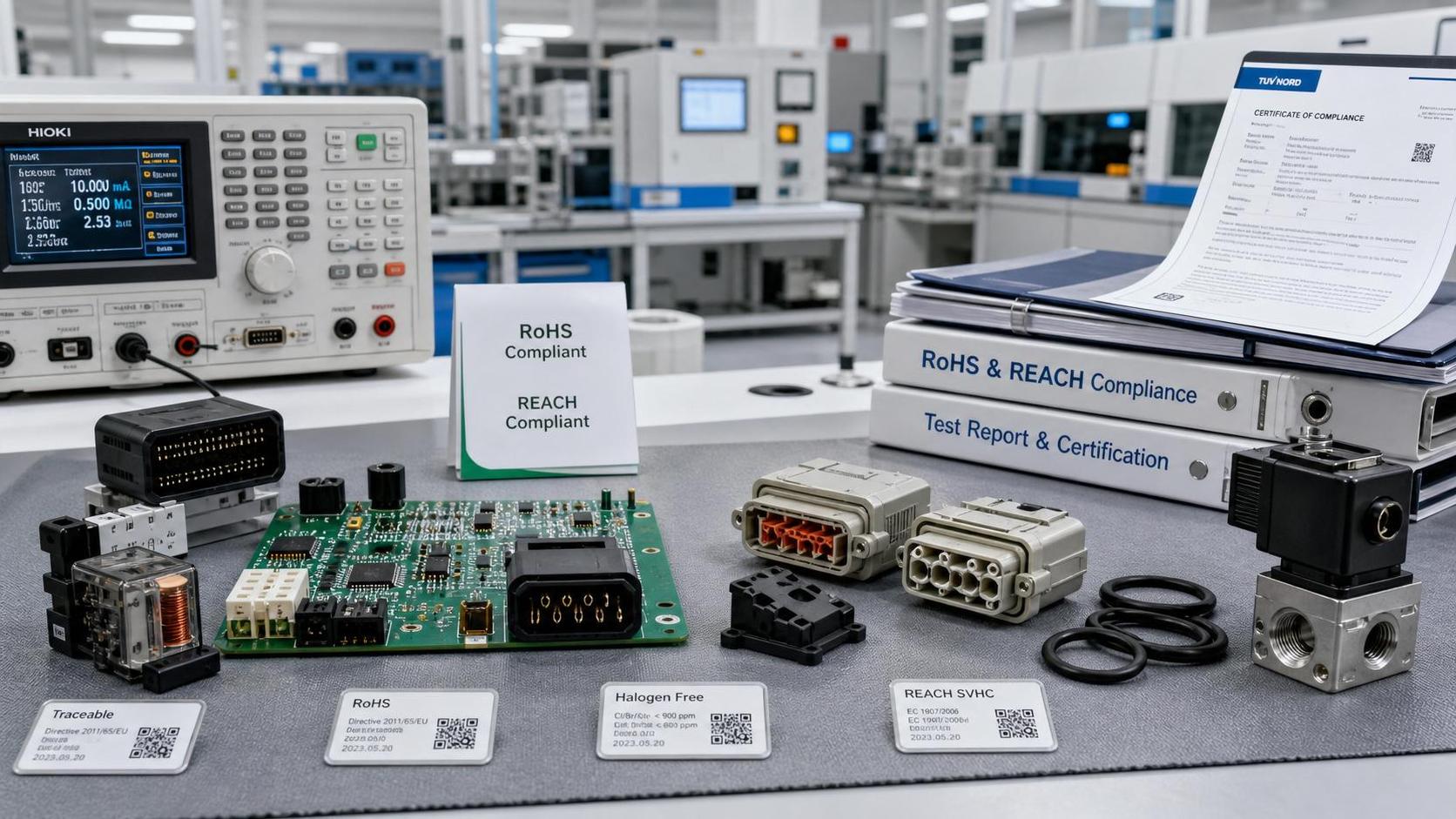
In electronics production, compliance-focused component selection for electronics is not a paperwork exercise. It shapes product safety, certification outcomes, field reliability, and the speed of market entry.
A single unsuitable relay, seal, connector, actuator, or polymer part can trigger audit findings, thermal failure, contamination risk, or redesign costs that spread across the entire build.
That pressure is sharper in systems exposed to high voltage, aggressive media, vacuum conditions, RF energy, or extreme temperatures, where compliance and performance are tightly linked.
Why selection errors remain common
Many errors begin when teams treat compliance as a final checkpoint rather than a design input. By then, the approved bill of materials may already contain hidden conflicts.
Another problem is fragmented responsibility. Engineering checks electrical fit, sourcing checks price and lead time, and quality reviews certificates later, often without a unified acceptance logic.
In cross-industry environments, that gap widens. Electronics now intersects with fluid control, motion systems, microwave energy, sealing materials, and environmental containment requirements.
This is where a reference framework matters. G-PCS approaches component decisions through the “Logic of Containment and Flow,” connecting engineering performance with ISO, SEMI, API, and MIL-SPEC expectations.
What compliance-focused component selection for electronics really means
Compliance-focused component selection for electronics means choosing parts that satisfy function, safety, traceability, material restrictions, environmental limits, and documentation requirements at the same time.
That includes familiar electronics rules such as RoHS, REACH, UL recognition, CE-related evidence, and sector-specific standards. It also includes application-driven requirements often missed in early sourcing.
For example, a valve coil in an electronics assembly may meet voltage requirements but fail on outgassing, media compatibility, or insulation behavior in a high-frequency environment.
In practice, compliance is less about one certificate and more about system fit under real operating conditions.
The most common mistakes
Choosing by datasheet headline only
Headline values often reflect ideal test conditions. Rated pressure, switching speed, temperature range, or dielectric strength may not represent the actual duty cycle in the final product.
This is especially risky with actuators, seals, RF components, and pressure-control devices, where transient behavior matters as much as nominal performance.
Assuming material compliance equals assembly compliance
A compliant resin, elastomer, or plating does not automatically make the finished component acceptable. Adhesives, fillers, coatings, and manufacturing residues can change the regulatory picture.
This mistake appears often in gaskets, cable assemblies, connectors, and sealed modules.
Ignoring the operating environment
Moisture, vacuum, hydrogen exposure, thermal cycling, vibration, aggressive cleaning agents, and RF leakage can turn a nominally acceptable part into a failure point.
Compliance-focused component selection for electronics should always connect the part to the environment, not just the schematic.
Overlooking traceability depth
Certificates without lot traceability, revision control, or manufacturing origin create audit exposure. When a field issue appears, weak traceability slows containment and increases recall scope.
Accepting legacy parts without requalification
A part used safely in a previous platform may become noncompliant after a design shift, supplier change, or new market entry. Legacy acceptance is not evidence.
Treating supplier declarations as the final proof
Declarations are useful, but they are not always complete, current, or specific to the purchased configuration. Supporting test data and revision-linked documentation are often necessary.
Where these mistakes create the most damage
The impact is rarely limited to component replacement. The real cost appears in delayed approvals, revalidation work, warranty claims, and uncertainty during customer or regulatory review.
These examples show why compliance-focused component selection for electronics should be handled as a system-level risk discipline.
A better way to evaluate parts
A practical review starts with the operating profile. Electrical load, pressure, media, temperature, frequency exposure, cleanliness targets, and lifetime expectations should be defined before supplier comparison.
The next step is document alignment. Part numbers, revisions, declarations, and test references must point to the same configuration. Mismatched records are a common source of hidden nonconformity.
Then the material stack needs attention. Base materials, coatings, fillers, lubricants, and sealing compounds should be reviewed together, especially in contained-flow or high-energy applications.
- Check application conditions before checking price ranking.
- Confirm whether certifications apply to the exact purchased variant.
- Review lifecycle behavior, not only initial pass data.
- Require traceability that supports root-cause work later.
- Flag parts crossing multiple regulatory domains.
Why cross-disciplinary intelligence matters
Electronics compliance rarely stays inside electronics. A microwave source interacts with seals and cooling paths. A piezoelectric actuator depends on materials stability. A pressure valve affects enclosure safety and contamination control.
That is why benchmark-driven resources such as G-PCS are useful in complex reviews. They connect component behavior across UHP control, RF energy systems, mechanical sealing, precision actuation, and advanced gasket materials.
For compliance-focused component selection for electronics, this broader lens helps uncover failure modes that are easy to miss when each part is reviewed in isolation.
Signals worth watching in current projects
Several trends are making selection discipline more important. Miniaturization reduces thermal margin. Global sourcing complicates document consistency. New energy systems introduce unfamiliar pressure and chemical conditions.
At the same time, audit expectations are becoming more evidence-based. It is no longer enough to say a component is standard. Teams increasingly need proof tied to the exact use case.
In other words, compliance-focused component selection for electronics is moving closer to reliability engineering and supply chain governance.
What to do next
A useful next step is to review high-risk components through a stricter filter: operating environment, regulatory fit, material stack, traceability, and configuration control.
It also helps to separate approved parts into categories. Some are electrically suitable, some are commercially available, and a smaller group is truly compliance-ready for the intended system.
When the application involves containment, extreme media, RF energy, or precision motion, deeper benchmark comparison is worth the effort. That is often where the most expensive mistakes first become visible.
The strongest decisions come from combining component data with real-use conditions and current standards evidence. That is the practical core of compliance-focused component selection for electronics.
Industry Briefing
Get the top 5 industry headlines delivered to your inbox every morning.