Industrial Seal Solutions for Low-Leakage Flow Systems
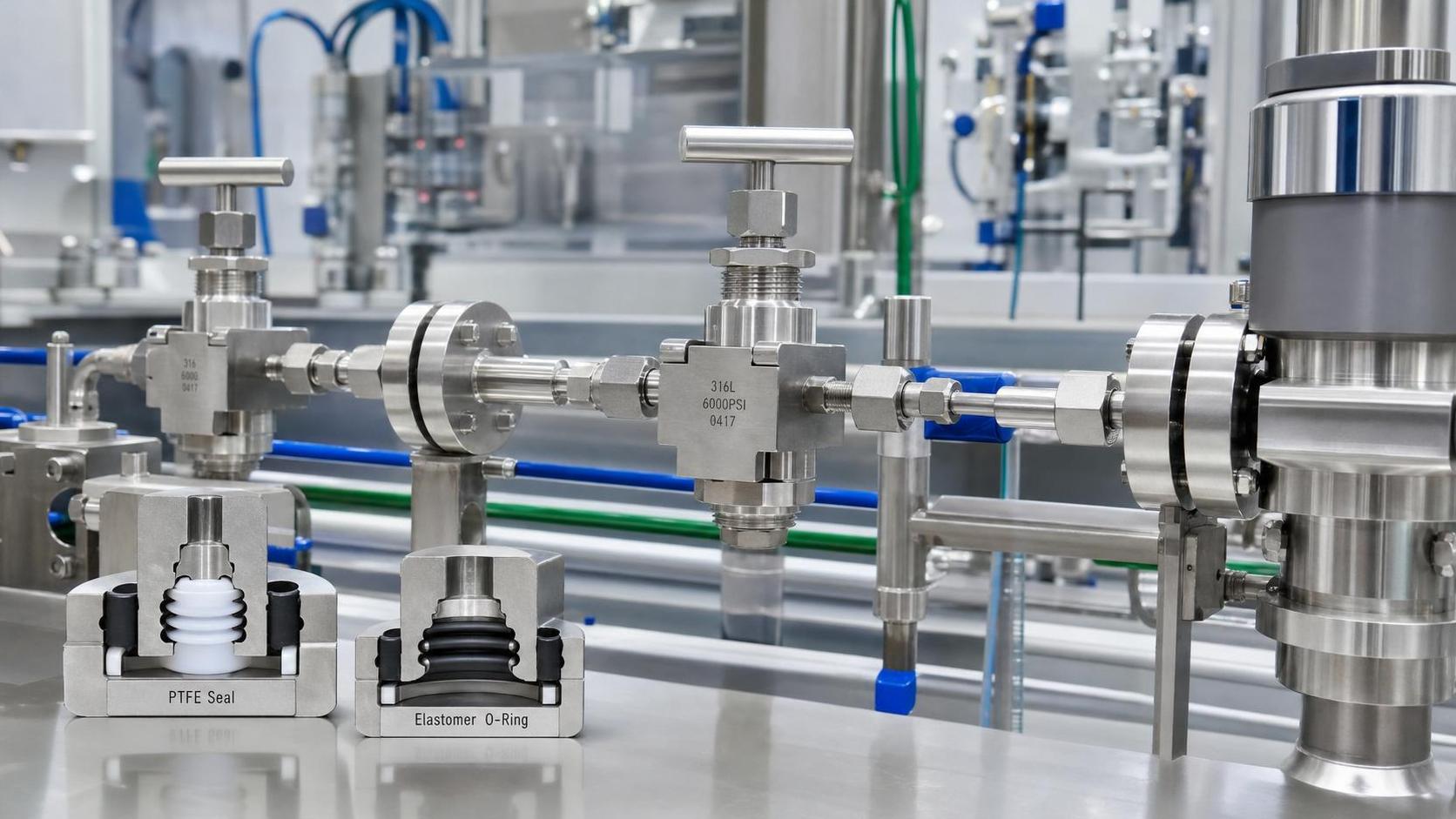
Where Low-Leakage Performance Becomes a System-Level Decision
Low leakage is rarely solved by choosing a seal from a catalog.
In practice, industrial seal solutions sit between fluid behavior, hardware tolerances, duty cycles, and compliance requirements.
That is why similar-looking systems often demand very different sealing strategies.
A hydrogen valve, an RF cooling loop, and a clean process gas module may all target low leakage.
Yet their failure modes are not the same.
Some lose performance through permeation.
Others fail because thermal cycling changes compression set, surface finish response, or actuator timing.
In high-integrity flow systems, industrial seal solutions affect uptime, contamination control, maintenance intervals, and audit readiness.
This is the logic behind the G-PCS view of containment and flow.
Sealing is not an isolated part selection exercise.
It is a reliability decision tied to pressure, media, energy exposure, and standards such as ISO, API, SEMI, and MIL-SPEC.
Actual Use Conditions Change What “Best” Means
The same leakage target can produce different material and geometry choices once site conditions are known.
Pressure range is only one factor.
Response speed, cleaning chemistry, particle sensitivity, and restart frequency often matter just as much.
In one installation, a softer elastomer improves conformity at low torque.
In another, that same material shortens life because pressure pulses and heat drive permanent deformation.
Industrial seal solutions therefore need to be judged by leakage behavior over time, not only by initial bench performance.
A useful starting point is to compare scenario variables before comparing part numbers.
High-Pressure Gas Systems Need More Than Strength
In high-pressure flow systems, leakage control is closely tied to media behavior.
Hydrogen, helium, and mixed industrial gases expose weak assumptions quickly.
Industrial seal solutions for these environments must address permeation, rapid decompression risk, and gland stability under load.
A common misread is to prioritize hardness alone.
Higher hardness may resist extrusion, but it can also reduce sealing conformity on imperfect surfaces.
Where pressure ramps are aggressive, the better choice may be a composite approach.
That can mean energizers, back-up rings, or engineered polymers matched to the pressure profile.
For 700 bar class valve systems, low-leakage flow performance also depends on machining discipline.
Surface finish variation, edge condition, and assembly force often decide whether a qualified seal remains qualified in the field.
Clean, Corrosive, and Sensitive Lines Follow a Different Logic
In cleaner process environments, the sealing question shifts from gross leakage to invisible contamination pathways.
Chemical resistance matters, but extractables, particle generation, and post-cleaning stability matter just as much.
This is where industrial seal solutions based on FFKM, PTFE blends, or specialty composites are often evaluated.
Still, material prestige alone does not guarantee fit.
A highly resistant polymer can become the wrong option if cycling frequency, clamp load, or vacuum exposure falls outside its stable window.
In semiconductor-adjacent or precision analytical lines, one practical rule stands out.
Validate the seal with the cleaning process, not only with the media list.
Many low-leakage failures begin after solvent wash, plasma exposure, or repeated sterilization, not during nominal production flow.
What usually deserves closer review
- Compression set after thermal and chemical cycling
- Surface finish compatibility at the mating interface
- Permeation versus actual leak path behavior
- Particle or outgassing limits tied to process cleanliness
- Batch consistency when qualification must be repeatable
Fast Actuation and RF Equipment Change the Sealing Priorities
Some low-leakage systems are mechanically stable but dynamically demanding.
Piezoelectric positioners, pneumatic modules, and microwave energy systems often place seals near fast response hardware.
Here, industrial seal solutions must support motion accuracy as much as containment.
Too much friction slows actuation and changes repeatability.
Too little preload can reduce leakage margin after wear begins.
RF and microwave systems add another layer.
Localized heating and material aging may distort what looks acceptable in general industrial service.
That is why a dynamic sealing review should include stroke count, response window, energy exposure, and maintenance accessibility together.
Separating those checks often leads to leakage drift that appears only after commissioning.
The Most Common Misjudgments Appear Before Installation
Field issues are often created during specification.
One repeated mistake is treating similar media as identical applications.
Another is comparing industrial seal solutions on unit price while ignoring replacement labor, shutdown cost, and qualification delay.
Short-term savings disappear quickly in systems with strict restart protocols.
There is also a persistent tendency to rely on headline data.
Pressure rating, temperature limit, and nominal compatibility are necessary, but they do not reveal installation sensitivity or cycle-life behavior.
In critical assets, the better question is whether the seal remains predictable after real operating variation.
That includes upset conditions, maintenance intervals, and tolerance drift across production batches.
A Practical Way to Match Industrial Seal Solutions to the Job
A useful selection path starts with the leak consequence, not the component family.
If failure threatens safety, contamination, or calibration stability, the screening criteria should become narrower immediately.
Then compare the application through four filters.
- Media behavior: gas size, chemical activity, purity sensitivity, and decompression risk
- Mechanical reality: pressure cycling, motion profile, mating surface quality, and gland design
- Environmental load: heat, RF exposure, vacuum, washdown, and particulate control
- Governance: ISO, API, SEMI, MIL-SPEC, traceability, and validation records
This is also where a technical repository such as G-PCS becomes useful.
Cross-referencing sealing data with valve behavior, actuator dynamics, and standards context gives a more realistic basis for selection.
That matters most when industrial seal solutions sit inside systems that cannot tolerate hidden leakage growth.
Before Final Selection, Confirm What the Application Will Actually Demand
Low-leakage flow systems reward careful front-end judgment.
The right industrial seal solutions are usually the ones matched to operating behavior, not the ones with the broadest data sheet.
Before locking a specification, map the real duty cycle, confirm media and cleaning conditions, review tolerance control, and test against the relevant compliance path.
Where applications span UHP valves, specialized gaskets, RF energy systems, or precision actuation, keep the sealing decision connected to the entire containment chain.
That approach usually does more for leakage control and service stability than changing materials late in the project.
Industry Briefing
Get the top 5 industry headlines delivered to your inbox every morning.