Industrial Seal Investment Insights: Cost, Risk, and Payback
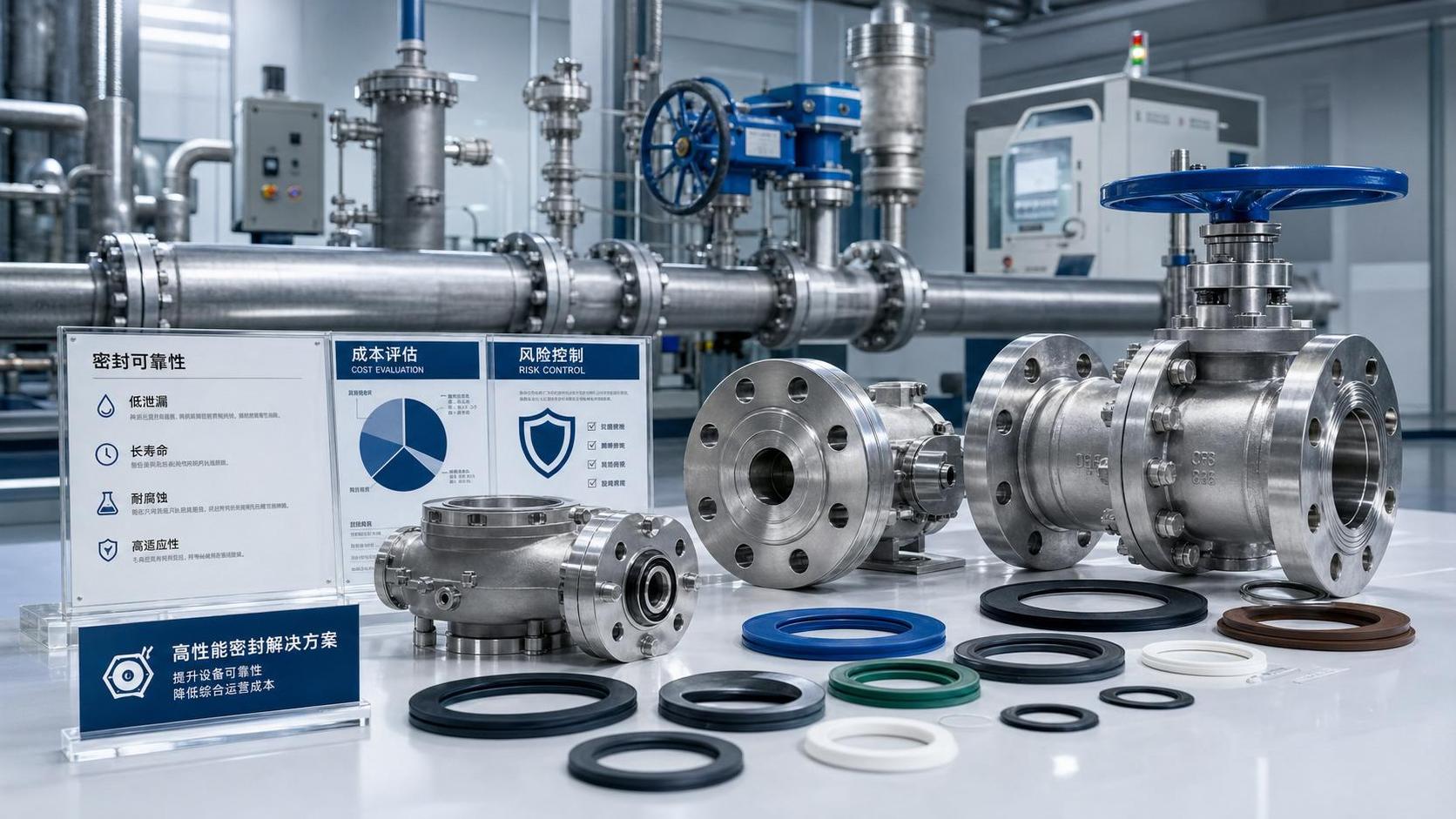
Why do industrial seal investment insights matter more than unit price?
Industrial seal investment insights begin with a basic correction. A seal is rarely a low-value part once system consequences are counted.
In practical terms, the invoice shows one number, but the operating balance sheet absorbs many others. Leakage, contamination, unplanned shutdowns, scrap, and emergency labor usually sit outside the purchase order.
That is why better industrial seal investment insights focus on total exposure, not only acquisition cost. The real question is whether a cheaper seal transfers hidden risk into operations.
This issue becomes sharper in systems handling pressure, aggressive chemistry, thermal cycling, RF energy, vacuum integrity, or precision motion.
In those environments, seal performance affects output stability and compliance status. It also shapes maintenance intervals and the predictability of asset life.
A useful way to read industrial seal investment insights is to treat seals as containment controls. They protect uptime, process quality, safety margins, and audit readiness.
That perspective aligns with the G-PCS view of the “Logic of Containment and Flow.” In advanced supply chains, sealing choices support system reliability frameworks, not just spare-parts inventory.
When does a higher upfront seal cost actually make financial sense?
A premium seal makes sense when failure costs are nonlinear. One small loss event can erase years of savings created by buying lower-grade parts.
This is common in semiconductor tools, hydrogen systems, specialty chemical processing, aerospace support equipment, industrial microwave assemblies, and critical valve platforms.
For example, an FFKM seal may cost several times more than a standard elastomer. That premium looks large until solvent attack, outgassing, or thermal degradation triggers a line stop.
More often, the financial logic rests on four conditions.
- Downtime carries high hourly loss, including delayed shipment and restart waste.
- Seal replacement requires difficult access, specialist labor, or production isolation.
- The process is sensitive to contamination, moisture ingress, or pressure drift.
- Compliance evidence depends on stable material behavior and documented standards alignment.
In actual approvals, industrial seal investment insights become stronger when teams compare annualized failure cost against annualized premium spend.
If the premium prevents even one major interruption, payback can be immediate. If the process is forgiving, the higher specification may not be justified.
What costs are usually missed in seal budgeting?
The most common mistake is narrow budgeting. Many evaluations include purchase price and ignore downstream cost layers.
A better model captures direct and indirect effects. That is where industrial seal investment insights become useful for approval decisions.
Needless overspecification is also a hidden cost. Buying the highest-grade seal without verifying temperature, media, pressure, and duty cycle can waste capital.
The better approach is evidence-based matching. G-PCS-style benchmarking is helpful here because it compares material and sealing behavior against ISO, API, SEMI, and MIL-SPEC expectations.
How should payback be judged when seal failure risk is uncertain?
Uncertainty does not remove the need for a business case. It changes the method.
Instead of asking for perfect prediction, estimate three scenarios: normal operation, stressed operation, and upset condition. This reveals whether the seal decision is robust.
A practical payback review often includes these inputs.
- Expected service life under real duty cycle, not catalog conditions.
- Historical failure frequency for the current seal or equivalent material family.
- Cost per shutdown hour, including restart instability.
- Probability of quality loss, contamination, or emissions event.
- Time and cost to validate a replacement after failure.
When exact data is limited, relative ranking still works. If one option reduces maintenance frequency, broadens chemical compatibility, and lowers leakage probability, its payback case strengthens even before full field data arrives.
Industrial seal investment insights are especially valuable in mixed-technology environments. UHP valves, RF chambers, mechanical seals, piezo assemblies, and composite gasket systems each fail differently.
So payback should be linked to the dominant loss mode. In one system that may be leakage. In another, it may be particle generation or pressure response drift.
Where do buyers misread seal risk most often?
The biggest error is assuming material name equals performance certainty. Two seals labeled similarly may behave very differently because compound formulation, surface finish, tolerances, and application stress are not the same.
Another frequent issue is relying on static specifications for dynamic service. Pressure cycling, rapid decompression, shaft speed, plasma exposure, and cleaning chemistry can change failure patterns quickly.
A shorter checklist helps reduce misreading.
- Confirm the real medium, including trace additives and cleaning agents.
- Review temperature peaks, not only nominal operating temperature.
- Check whether the sealing point is static, reciprocating, rotary, or pulsed.
- Ask whether failure creates visible leakage or silent performance drift.
- Verify standards relevance instead of accepting generic compliance language.
This is where industrial seal investment insights support risk-adjusted approvals. The question is not only “Will it seal?” but “What happens if it degrades earlier than expected?”
For critical assets, silent degradation can be more expensive than obvious failure because it spreads cost into yield, calibration, and investigative labor.
What does a strong approval framework look like before spending is committed?
Good industrial seal investment insights eventually need a repeatable approval framework. That prevents decisions from drifting between emergency replacement logic and long-term asset logic.
A useful framework usually asks five questions.
In real operations, this framework often leads to a tiered strategy. Standard seals fit noncritical loops. Premium seals are reserved for containment-critical or precision-critical points.
That balance usually protects capital discipline better than universal overspecification or aggressive cost cutting.
So what should be done next if the seal budget is under review?
Start by separating commodity replacements from mission-critical sealing points. Not every location deserves the same approval logic.
Then build a short comparison using actual service conditions, expected life, replacement effort, and failure consequence. That creates a clearer payback view than unit price alone.
If data gaps remain, use external benchmarks and standards-based references to narrow uncertainty. That is where sources modeled on G-PCS add value, especially in advanced, mixed-discipline systems.
The best industrial seal investment insights do not promise zero risk. They make cost, risk, and payback visible enough for disciplined decisions.
A sensible next step is to rank seal applications by consequence, compare lifecycle cost scenarios, and confirm which specifications truly reduce operational exposure.
Industry Briefing
Get the top 5 industry headlines delivered to your inbox every morning.