High Speed Seal Stability Benchmarks That Actually Matter
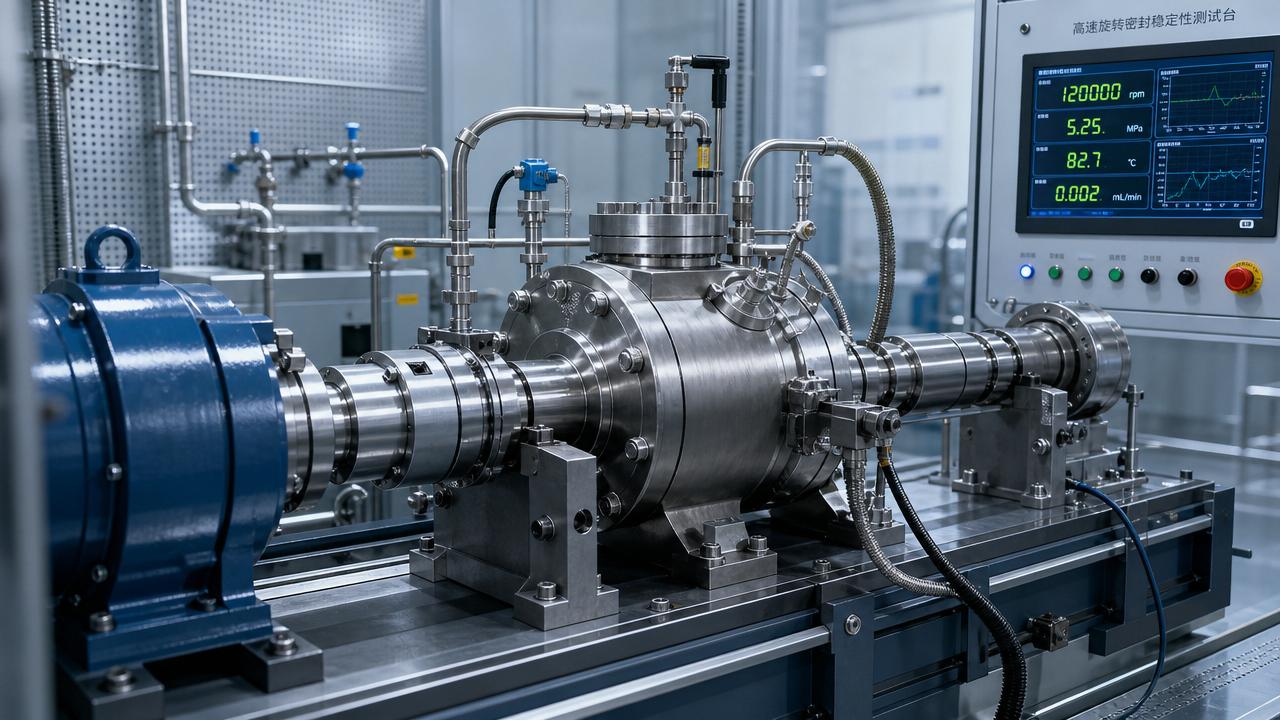
For extreme-speed systems, headline numbers often hide the real sealing risk. The most useful high speed seal stability benchmarks are the ones that predict leakage, heat growth, wear acceleration, and control loss.
In integrated industrial environments, those benchmarks shape uptime, compliance, and lifecycle cost. They also determine whether a seal remains stable during rapid starts, pressure pulses, dry-running moments, and thermal shock.
This guide explains which high speed seal stability benchmarks deserve attention, how application context changes benchmark priorities, and what evaluation steps produce more reliable decisions.
Why application context changes which high speed seal stability benchmarks matter
A benchmark that looks excellent in a steady laboratory loop may fail to predict field behavior. High speed seal stability benchmarks only become meaningful when tied to speed profile, media chemistry, pressure cycling, and thermal loading.
For example, a seal used in RF cooling equipment faces different risks than one inside a high-speed compressor. One sees chemical attack and micro-leak sensitivity. The other sees frictional heating and shaft motion instability.
That is why benchmark selection should begin with operating reality. Speed alone never defines seal stability. Dynamic eccentricity, lubrication regime, pressure reversals, and stop-start frequency usually matter just as much.
Start by separating cosmetic metrics from predictive metrics
Cosmetic metrics include single-point leak values, short-duration pass results, and room-temperature friction readings. Predictive metrics capture trend behavior under time, heat, motion, contamination, and transient stress.
- Leakage drift over time, not just initial leakage
- Thermal rise at peak speed and after repeated cycles
- Wear rate under misalignment and pressure fluctuation
- Recovery after rapid deceleration or dry contact events
- Dimensional stability after media exposure
When rotating equipment runs near its thermal limit
In turbines, compressors, pumps, and motor-driven spindles, heat is the first warning sign. The most important high speed seal stability benchmarks here are thermal rise rate, contact temperature distribution, and leakage stability after heat soak.
A seal can pass a speed test and still fail in service if frictional heat reshapes the sealing lip, hardens the elastomer, or reduces lubricant film thickness. Stability means maintaining function after heat accumulation, not before it.
Core judgment points for thermal-speed scenarios
- Temperature rise per 1,000 rpm increase
- Leakage change between ambient and stabilized operating temperature
- Seal face or lip distortion after continuous high-speed exposure
- Friction coefficient trend during startup and full-load operation
- Wear scar pattern after repeated thermal cycles
Useful test design should include dwell time at top speed, controlled cooling, and restart behavior. Without those steps, high speed seal stability benchmarks may underestimate thermal fatigue and material relaxation.
When pressure pulses and fast cycling dominate the sealing challenge
In UHP valves, pneumatic actuators, and pulsed flow systems, dynamic pressure reversals can destroy apparent stability. Here, high speed seal stability benchmarks must reveal how quickly the seal responds without extrusion, flutter, or pressure lag.
A static pressure rating says little about high-frequency operation. What matters is whether the sealing geometry remains controlled during repeated impulse loading and whether leakage remains low after thousands or millions of cycles.
Core judgment points for pulse-driven systems
- Leakage stability across pressure ramps and reversals
- Compression set after high-cycle testing
- Extrusion resistance at pressure spikes
- Response consistency under micro-second or millisecond actuation
- Seal recovery after sudden decompression
In these scenarios, benchmark reports should also include groove design, clearance range, and backup element behavior. Material strength alone does not guarantee cycle stability.
When chemical media and contamination risk define failure consequences
Semiconductor, vacuum-adjacent, clean process, and specialty chemical systems require more than mechanical endurance. High speed seal stability benchmarks must address permeation, outgassing, particle generation, and dimensional change after chemical exposure.
A seal may remain mechanically intact while becoming unacceptable for purity control. In these applications, leak tightness, media compatibility, and cleanliness retention matter as much as rotational or reciprocating speed.
Core judgment points for chemically sensitive environments
- Volume swell and hardness shift after exposure
- Outgassing profile under heat and vacuum transition
- Particle shedding after dynamic cycling
- Permeation behavior for small molecules and reactive gases
- Leak rate drift after chemical soak and speed restart
For these cases, standards alignment matters. Benchmarking against ISO, SEMI, API, or MIL-SPEC frameworks improves comparability and reduces the chance of approving unsuitable data.
How benchmark priorities differ across common industrial scenarios
This comparison shows why no single benchmark ranks first everywhere. The right high speed seal stability benchmarks depend on what type of instability causes the greatest operational damage.
Practical benchmark selection for better seal evaluation
A useful evaluation plan combines material data, dynamic testing, and system-level interpretation. It should also connect raw benchmark values to failure modes that actually matter in service.
Recommended evaluation sequence
- Define the dominant stress: speed, pressure pulse, chemistry, or precision motion.
- Match test conditions to real duty cycle, including starts, stops, and overloads.
- Request trend data, not only pass or fail summaries.
- Check whether benchmark methods align with relevant standards.
- Review failure analysis from post-test inspection.
- Compare benchmark stability over time, not just best-case peak values.
This approach makes high speed seal stability benchmarks more actionable. It also helps distinguish robust sealing systems from samples optimized only for a narrow demonstration window.
Common mistakes that distort high speed seal stability benchmarks
Several errors repeatedly lead to poor decisions. The first is treating nominal speed capability as proof of stability. A seal may survive speed briefly while becoming unstable in leakage, friction, or geometry.
Another mistake is ignoring shaft runout, alignment error, or housing tolerance. These variables can dominate real sealing behavior, yet many reports test under nearly ideal mechanical conditions.
A third mistake is relying on average temperature instead of local hot-spot behavior. Local overheating often triggers the earliest damage, especially in polymer-based or composite sealing structures.
- Do not rank seals by one short test only.
- Do not ignore transient events between stable operating states.
- Do not separate material compatibility from dynamic benchmark review.
- Do not accept benchmark data without method transparency.
What to do next with high speed seal stability benchmarks
Use benchmark data to build a decision matrix around your operating scenario. Rank leakage stability, thermal resilience, cycle durability, and chemical integrity by actual failure consequence.
Then compare candidate sealing options using the same duty profile and reporting method. That step turns high speed seal stability benchmarks into a practical selection tool rather than a marketing claim.
In advanced industrial systems, the best benchmark is the one that predicts field reliability before installation. When evaluation stays scenario-specific, the data becomes clearer, decisions become faster, and sealing performance becomes far more dependable.
Industry Briefing
Get the top 5 industry headlines delivered to your inbox every morning.