Wholesale Mechanical Seals: How to Compare Price vs Reliability
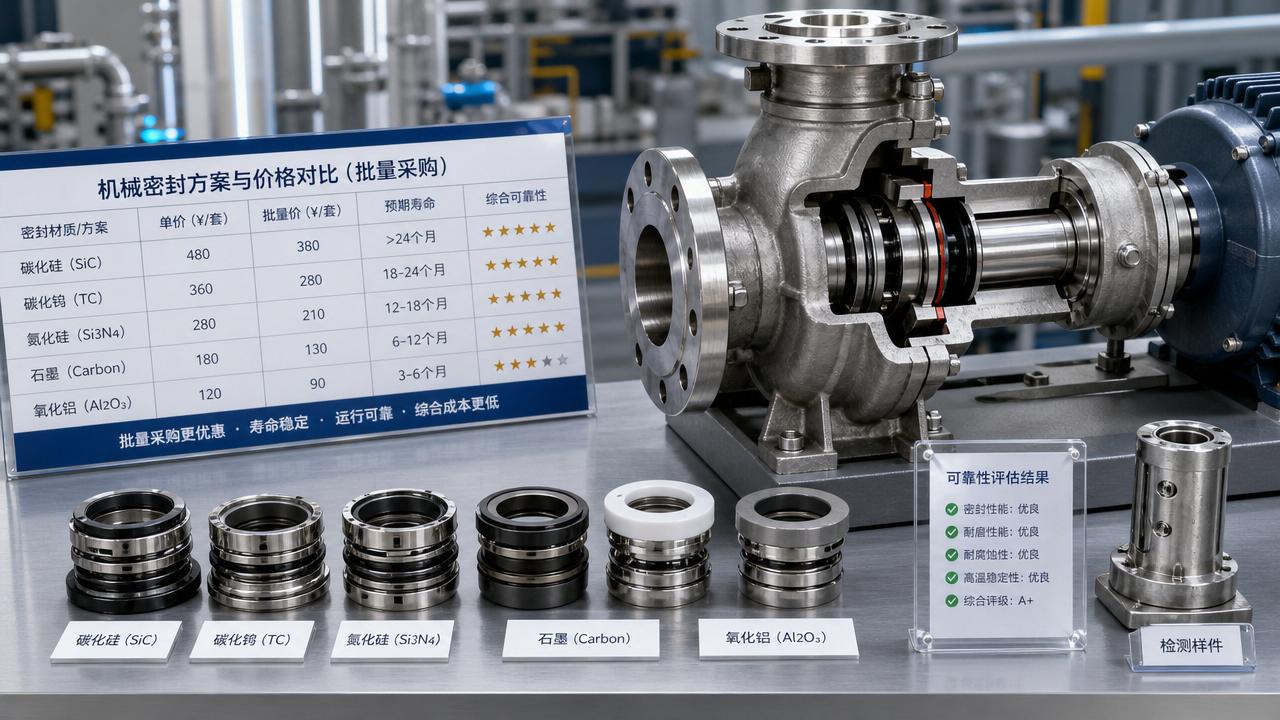
When evaluating wholesale mechanical seals, finance approvers need more than the lowest unit price—they need predictable lifecycle cost, reduced downtime risk, and supplier accountability. This guide explains how to compare upfront pricing with reliability factors such as material grade, certification, operating conditions, and failure rates, helping decision-makers protect both budget efficiency and long-term operational stability.
In high-value industrial environments, a seal that costs 8% less at purchase can create 3 to 10 times more cost if it fails early, leaks under thermal cycling, or forces an unplanned shutdown. For finance teams approving bulk orders, the key question is not simply “What is the unit price?” but “What is the cost of failure over 12 to 36 months?”
This is especially true in sectors where containment, cleanliness, pressure stability, and uptime are directly tied to production yield and regulatory exposure. In those settings, wholesale mechanical seals should be assessed as a risk-managed operating asset, not just a line-item commodity. A disciplined comparison method helps align procurement, engineering, maintenance, and finance around measurable value.
Why Finance Should Evaluate Mechanical Seals Beyond Unit Price
For financial approvers, seal procurement often sits inside a broader spare-parts or MRO budget, where pressure to reduce purchase cost is constant. Yet mechanical seals influence at least 4 major cost buckets: equipment uptime, maintenance labor, product loss, and compliance risk. A lower quote only improves total cost if service life and operating fit remain stable.
A practical review should compare wholesale mechanical seals across a 5-point framework: acquisition cost, expected operating life, failure probability, replacement cycle, and supplier support responsiveness. In many industrial systems, even a 2-hour downtime event can exceed the savings from a 500-piece low-cost order, particularly when the seal protects pumps, mixers, compressors, vacuum systems, or process vessels.
Direct Cost vs Hidden Cost
The invoice price is visible; the downstream cost is often not. Hidden expenses usually appear in 6 forms: emergency maintenance, overtime labor, inventory write-off, leakage cleanup, accelerated shaft wear, and expedited freight for replacement parts. When finance teams model these variables, the cheapest wholesale mechanical seals frequently stop being the lowest-cost option.
Typical hidden-cost triggers
- Seal face incompatibility with media or temperature swings of 20°C to 80°C
- Elastomer degradation under aggressive chemicals or dry-running events
- Dimension inconsistency that increases installation error rates
- Weak traceability for batch quality, making root-cause analysis slow
- Long lead times of 4 to 8 weeks when urgent replacements are needed
The table below shows how finance teams can distinguish visible purchase cost from broader commercial exposure when comparing suppliers of wholesale mechanical seals.
The core financial insight is simple: price variance at purchase is usually measured in percentages, while failure cost is measured in multiples. That is why wholesale mechanical seals should be reviewed using lifecycle assumptions rather than quote sheets alone.
The Reliability Factors That Most Affect Commercial Value
Not all reliability variables carry the same financial weight. For bulk purchasing, 4 factors usually drive most of the long-term cost difference: material selection, operating-condition fit, manufacturing consistency, and certification or documentation level. Finance approvers do not need to become seal design specialists, but they do need a clear framework for identifying where a lower bid may hide future cost exposure.
1. Material Grade and Face Pairing
Mechanical seal performance depends heavily on seal faces, secondary sealing materials, springs, and metal hardware. Common face combinations such as carbon vs silicon carbide or silicon carbide vs tungsten carbide vary significantly in wear resistance, thermal shock tolerance, and suitability for abrasive or clean fluids. A lower-cost configuration may be acceptable for water service, but not for corrosive media, vacuum duty, or pressure cycling above 20 bar.
2. Real Operating Conditions
A seal should be matched to actual conditions, not nominal nameplate conditions. Procurement files often list only pump model and size, but missing details such as dry-running risk, slurry content, shaft speed, pressure spikes, or temperature fluctuation can make side-by-side pricing misleading. In many cases, a seal quoted for 10 bar steady pressure performs poorly if the system sees repeated spikes to 14 or 16 bar.
3. Manufacturing Consistency
Wholesale mechanical seals bought in larger volumes require strong batch repeatability. If face flatness, surface finish, or elastomer dimensions vary from lot to lot, even a technically correct design can generate field failures. Finance leaders should ask whether the supplier can provide incoming material control, production inspection routines, and batch-level traceability for orders of 100, 500, or 1,000 units.
4. Certification and Documentation
Documentation is not just a quality formality. It reduces commercial uncertainty during audits, warranty claims, and root-cause investigations. Depending on the application, useful documentation may include material declarations, dimensional inspection reports, pressure test records, and compliance references aligned with ISO, API, SEMI, or customer-specific validation standards.
The comparison table below translates key reliability variables into procurement and finance language.
These factors matter because finance approval is ultimately a decision about risk-adjusted cost. A supplier with slightly higher pricing but stronger process control can materially reduce volatility in maintenance spending and production interruption.
How to Compare Wholesale Quotes in a Financially Useful Way
A common mistake in industrial buying is comparing quotes that are not technically equivalent. Two offers may describe the same seal size, yet differ in face grade, elastomer type, spring alloy, balancing design, or test level. For finance teams, this means a like-for-like comparison sheet is essential before approving volume purchases.
Build a 6-point quote review checklist
- Confirm part equivalency, including materials and seal configuration.
- Check expected service interval under your real operating conditions.
- Review failure history from the last 12 to 24 months if available.
- Compare warranty scope, not just warranty duration.
- Assess lead time, emergency support, and reorder responsiveness.
- Calculate cost per operating month, not cost per unit only.
Use cost-per-service-cycle as a common metric
If Seal A costs $42 and lasts 4 months, while Seal B costs $55 and lasts 10 months, the monthly operating cost is $10.50 for Seal A and $5.50 for Seal B before labor and downtime are added. Once maintenance hours and process interruption are included, the better-performing option often becomes financially superior even if its purchase price is 20% to 30% higher.
For finance approvers reviewing wholesale mechanical seals, the following matrix helps standardize quote evaluation across technical and commercial criteria.
This method gives finance teams a defensible basis for approval. Instead of challenging engineering with generic cost pressure, approvers can ask targeted questions that improve both budget control and operating resilience.
Common Procurement Risks in Bulk Seal Buying
Bulk purchasing can lower unit cost, but it can also magnify a bad decision. If a single specification error affects 300 units, the organization may carry excess inventory, rework expense, and avoidable downtime for months. The financial impact becomes larger when seals support critical systems in semiconductor tools, high-pressure process lines, RF systems, chemical transfer equipment, or precision vacuum assemblies.
Risk 1: Overstandardizing across different duty cycles
A seal chosen for one process line may not perform equally well in another. Combining light-duty and severe-duty applications under a single low-cost SKU may simplify purchasing but increase failure rates. Segmenting demand into 2 or 3 operating categories often delivers better financial results than forcing one universal part.
Risk 2: Approving based on sample performance only
Prototype or first-batch performance does not always predict mass-order consistency. Before approving wholesale mechanical seals for larger volumes, finance should support a staged validation model such as 30-unit pilot, 100-unit monitored release, then full-scale order. This reduces the chance of paying for bulk inventory that performs inconsistently in field service.
Risk 3: Ignoring supplier response capability
Supplier reliability includes communication speed and corrective-action discipline. If a failure occurs, can the supplier respond within 24 hours, review returned parts within 5 business days, and issue a clear corrective plan? Delayed response increases internal troubleshooting cost and often leaves operations teams carrying the burden alone.
What finance should request before approval
- A written material and configuration specification for the approved part
- Lead-time commitment for standard and urgent replenishment
- Batch traceability and non-conformance handling process
- Clear terms for replacement, analysis, or credit in case of verified defect
A Practical Approval Model for Finance, Procurement, and Engineering
The strongest decisions happen when finance, sourcing, and technical teams use one approval model. For wholesale mechanical seals, a balanced process can usually be completed in 3 stages over 2 to 6 weeks, depending on application criticality and data availability.
Stage 1: Technical-commercial alignment
Define the operating envelope, acceptable material range, documentation requirement, and target service interval. This step prevents quote comparison errors and reduces internal debate after bids arrive.
Stage 2: Controlled supplier comparison
Score suppliers across price, expected life, lead time, support quality, and process control. A simple weighted model such as 30% price, 30% reliability evidence, 20% supply continuity, and 20% service support can help translate technical differences into approval-ready business logic.
Stage 3: Pilot and scale
Start with a monitored release where installation outcomes, leakage events, and replacement intervals are tracked. If field performance meets expectations over one or two maintenance cycles, then move to the larger wholesale commitment. This approach protects working capital and limits exposure to unverified quality assumptions.
Final Buying Guidance for Cost-Conscious Decision-Makers
The best wholesale mechanical seals are not necessarily the lowest-priced units; they are the options that keep cost predictable across procurement, maintenance, and production. Finance approvers should look for pricing that is supported by material clarity, operating-fit evidence, batch consistency, and responsive supplier accountability. Those factors determine whether a quote protects margin or simply postpones expense.
For organizations managing critical containment and flow systems, a disciplined seal evaluation process reduces budget volatility and strengthens operational continuity. If you need support comparing wholesale mechanical seals for demanding industrial environments, G-PCS can help you assess technical risk, sourcing fit, and lifecycle value with greater precision. Contact us to discuss your application, request a tailored evaluation framework, or explore more specialized sealing solutions.
Industry Briefing
Get the top 5 industry headlines delivered to your inbox every morning.