Cartridge Seal OEM Supplier Review: What to Check First
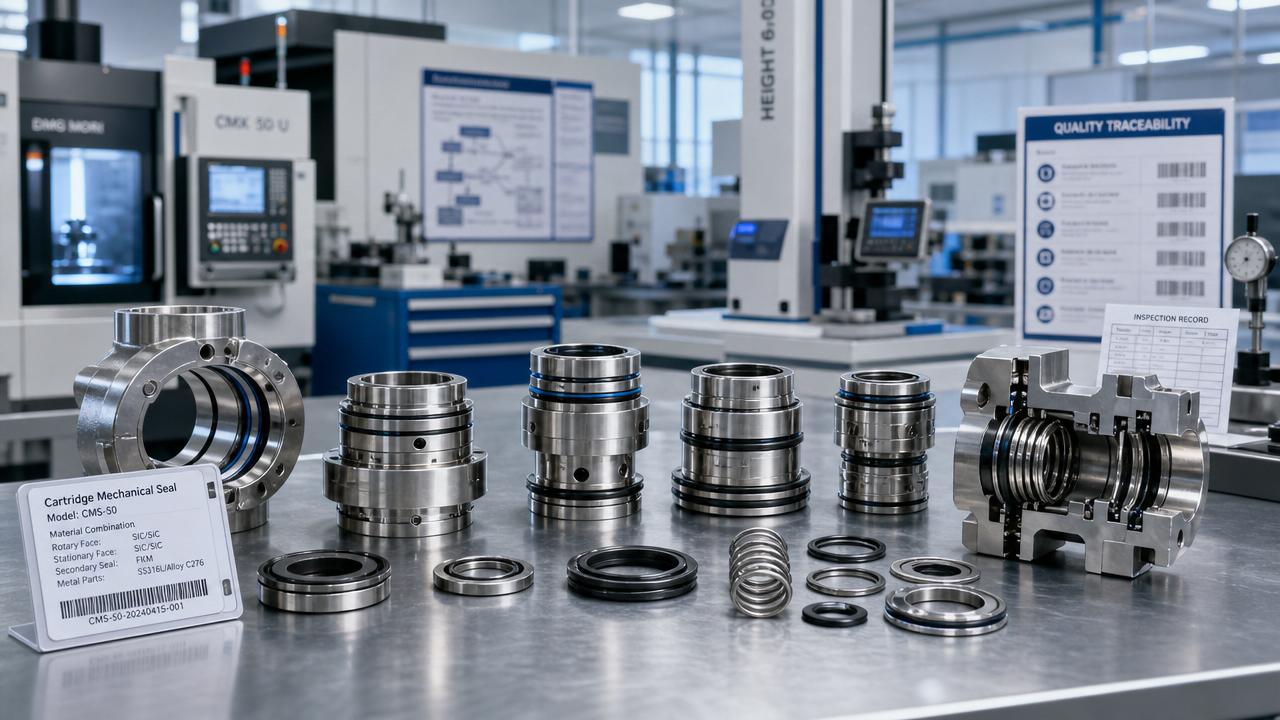
Choosing the right cartridge seal OEM supplier can directly affect equipment uptime, maintenance costs, and long-term procurement stability. For buyers, the first review should go beyond price and focus on manufacturing capability, material compliance, quality systems, and application support. This guide outlines the key checkpoints that help procurement teams reduce risk and select a supplier with confidence.
Why application scenario matters before comparing any cartridge seal OEM supplier
Procurement teams often start supplier screening with quotations, delivery promises, and catalog coverage. That may work for low-risk replacement parts, but cartridge seals are not generic items in many industrial environments. A supplier that performs well in water pumps for municipal utilities may not be the right fit for abrasive slurry, pharmaceutical sanitation, thermal cycling, or high-speed petrochemical rotating equipment. The first review should therefore begin with scenario alignment, not with a price sheet.
For buyers in complex supply chains, the phrase cartridge seal OEM supplier can include very different business models: true design-and-manufacture partners, drawing-based contract producers, regional assemblers, or traders with limited engineering control. Each may appear competitive on paper. However, the risk level changes sharply depending on the operating media, pressure range, temperature profile, shaft movement, maintenance practices, and documentation requirements.
This is why first-stage evaluation should ask a practical question: In which application scenario will this seal be used, and does the supplier have proven capability in that exact environment? Once this is clear, procurement can assess fit more accurately across quality, compliance, lifecycle cost, and supply continuity.
Typical buying scenarios and what changes in the review process
Different business scenarios create different priorities when reviewing a cartridge seal OEM supplier. A shutdown-driven replacement project is not evaluated the same way as a new equipment platform, and a global framework agreement is different from a local emergency purchase. Buyers should classify the sourcing situation early.
Using a scenario lens helps procurement avoid a common error: approving a supplier because it looks strong in a general brochure, while missing the fact that its real strengths belong to a different application category.
Scenario 1: Replacement purchases where downtime is the biggest cost
In many factories, cartridge seal buying starts when a pump or mixer is already down, leaking, or showing unstable performance. In this scenario, the best cartridge seal OEM supplier is not simply the lowest bidder. The key question is whether the supplier can restore operation quickly without creating a second failure after installation.
For urgent replacement orders, buyers should first verify dimensional interchangeability, shaft and sleeve tolerances, seal chamber constraints, and installation method. A supplier with strong emergency support should be able to confirm these points from drawings, equipment nameplates, and field photos. If the response is limited to “same size available,” that is a warning sign.
Material fit is also critical. A seal that physically fits may still fail if the elastomer is incompatible with solvents, if the face material cannot tolerate dry running, or if the secondary sealing elements degrade under heat. In downtime-sensitive situations, buyers should request a short but clear suitability statement covering media, pressure, temperature, speed, and likely failure mode. This is often more useful than a long catalog excerpt.
What to check first in urgent replacement cases
- Can the supplier validate dimensions against an actual drawing or used seal sample?
- Does it have retrofit experience for discontinued or non-standard assemblies?
- Can it provide material traceability even for fast-turn orders?
- Is there technical support for installation errors, flush plans, and startup conditions?
Scenario 2: New equipment projects where lifecycle performance matters more than unit price
When seals are sourced for new pumps, compressors, reactors, or special rotating systems, procurement must evaluate a cartridge seal OEM supplier as part of a broader equipment reliability decision. In this scenario, a low initial quote can become expensive if seal life is short, utility consumption is high, or maintenance intervals remain unpredictable.
The first review should focus on engineering depth. Can the supplier recommend face combinations for the real duty cycle? Does it understand start-stop frequency, cavitation risk, shaft deflection, barrier fluid conditions, and possible upset events? Does it propose a standard cartridge seal because it is what it sells most, or because it truly matches the application?
This is also the stage where buyers should examine design verification. A capable cartridge seal OEM supplier should be able to explain how it validates sealing performance, dimensional consistency, spring balance, and material selection. In high-value systems, reference cases in similar duty are extremely important. Procurement should not hesitate to ask for application history by industry segment, operating envelope, and mean time between failures.
Best fit indicators for project-based sourcing
A supplier is generally more suitable when it can participate early with engineering input, provide clear drawings and bill of materials, support test or pilot stages, and discuss total cost of ownership rather than only unit pricing. This matters especially in systems where leakage risk affects environmental compliance, product purity, or operator safety.
Scenario 3: High-compliance industries where documentation is part of the product
In industries such as pharmaceuticals, specialty chemicals, semiconductors, advanced energy, and sensitive process manufacturing, buyers often need more than a functioning seal. They need auditable evidence. In these environments, documentation quality is not an administrative extra; it is part of supplier capability.
The first check here is whether the cartridge seal OEM supplier can maintain traceability for critical materials and process steps. That may include elastomer batch identification, face material origin, metal grade certificates, surface finish records, pressure test results, and nonconformance handling. If the supplier outsources key parts without robust control, risk increases even if the finished product looks acceptable.
Buyers should also review quality system maturity. ISO certification alone is helpful but not sufficient. Ask how engineering changes are approved, how incoming materials are verified, how final inspections are recorded, and how customer-specific requirements are flowed down into production. For regulated or highly sensitive applications, the difference between “certified” and “controlled” can be significant.
Scenario 4: Multi-site or long-term sourcing where consistency becomes the priority
For procurement directors managing multiple plants or cross-border supply programs, the right cartridge seal OEM supplier must deliver repeatability over time. A strong prototype or first order is not enough. The supplier should be stable in capacity, documentation discipline, and after-sales support.
In these cases, first-stage review should include manufacturing footprint, capacity planning, approved subcontractors, lead-time control, and regional service capability. Buyers should assess whether the supplier can support standardized part numbering, controlled revisions, and coordinated service across maintenance teams. This reduces hidden costs caused by local substitutions, inconsistent installation practices, or batch-to-batch variation.
If the supplier serves global customers, ask for examples of long-term agreements, obsolescence management procedures, and KPI reporting. A professional cartridge seal OEM supplier should be able to discuss on-time delivery, rejection rates, warranty claims, and root-cause trends with real data.
Core checkpoints every buyer should review first
Regardless of scenario, several checkpoints should come before commercial negotiation. These items help procurement quickly separate capable manufacturers from low-visibility sellers.
1. Real manufacturing capability
Confirm whether the supplier actually machines, laps, assembles, and tests cartridge seals, or mainly sources them externally. OEM capability matters because process control influences face flatness, assembly accuracy, and repeatability.
2. Material and application matching
Ask how the supplier selects face materials, elastomers, and metal components for the target media and operating profile. The review should connect materials to real duty conditions, not just list available options.
3. Quality system and traceability
Review certifications, inspection plans, lot traceability, and failure reporting discipline. A dependable cartridge seal OEM supplier should provide confidence that the shipped part will match the approved specification every time.
4. Engineering support before and after sale
Buyers should value technical responsiveness. Good support includes application review, dimensional confirmation, seal plan advice, installation guidance, and root-cause analysis if problems appear in the field.
5. Commercial reliability
Stable lead times, clear revision control, transparent warranty terms, and disciplined communication all affect procurement risk. A low quote from an unstable supplier often creates much higher total cost later.
Common misjudgments buyers make when screening a cartridge seal OEM supplier
One common mistake is assuming that all cartridge seals with similar dimensions are functionally equivalent. In reality, face combination, spring arrangement, balance design, secondary sealing material, and hardware tolerances can change performance significantly.
Another misjudgment is overvaluing catalog breadth. A supplier may list many models but still have weak application engineering or little control over critical components. Buyers should test depth, not just range.
A third issue is ignoring service behavior during quotation stage. Slow, vague, or generic responses before the order often predict weak support after installation. Procurement teams should treat pre-sales technical clarity as an early indicator of future reliability.
How procurement teams can turn review findings into a practical sourcing decision
The best approach is to build a scenario-based scorecard. Weight criteria differently for each purchase type. For example, emergency replacement projects may prioritize compatibility and lead time, while regulated production lines may give higher weight to traceability and change control. New equipment programs may emphasize engineering support and lifecycle validation.
This method helps buyers compare each cartridge seal OEM supplier against the real operating need instead of using a generic checklist. It also improves internal alignment between procurement, maintenance, engineering, and quality teams.
FAQ for buyers reviewing a cartridge seal OEM supplier
Is the lowest-price supplier ever the right choice?
Yes, but mainly in low-risk, well-defined, repeat applications where design, materials, and quality controls are already verified. In critical systems, the lowest price should only be considered after technical fit is proven.
What documents should be requested first?
Start with drawings, material details, quality certificates, test records if applicable, and a clear statement of application suitability. For regulated sectors, request traceability and change-control information early.
How can buyers verify true OEM capability?
Review manufacturing process ownership, inspection methods, sample documentation, and technical response quality. A factory audit or remote process review is often worthwhile for strategic suppliers.
Final decision guidance
Selecting a cartridge seal OEM supplier should begin with the operating scenario, because the correct first checkpoint changes with the application. In urgent replacement cases, confirm fit and speed. In new equipment projects, test engineering depth and lifecycle logic. In high-compliance environments, verify traceability and change control. In multi-site programs, prioritize consistency and supply stability.
If your team is comparing suppliers now, organize the review around your real application conditions, not generic marketing claims. The more precisely you define media, temperature, pressure, shaft conditions, compliance needs, and service expectations, the easier it becomes to identify a cartridge seal OEM supplier that can support both operational reliability and long-term procurement confidence.
Industry Briefing
Get the top 5 industry headlines delivered to your inbox every morning.