Carbon Graphite Pump Seal Selection: Key Performance Checks
Carbon Graphite Pump Seal Selection: Key Performance Checks
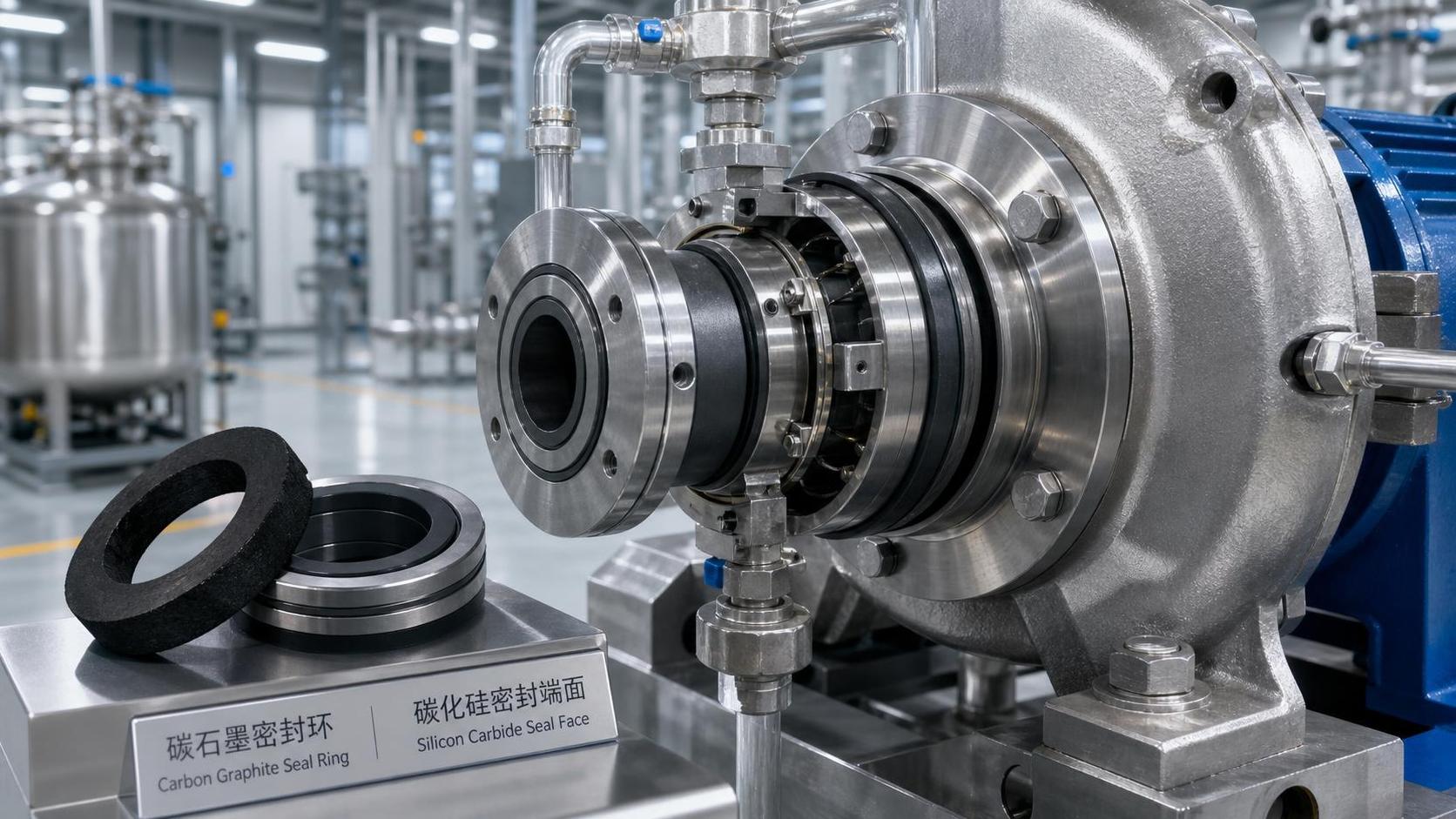
Selecting a carbon graphite pump seal often goes wrong at the point where buyers treat “carbon graphite” as a single material answer. It is not. In sealing work, the term usually refers to a family of engineered carbon and graphite grades used in seal faces, secondary sealing interfaces, or dry-running contact surfaces because they combine self-lubricating behavior, dimensional stability, and broad chemical resistance. The selection problem is less about whether carbon graphite is a good material in general and more about whether a specific grade, mating face, operating envelope, and failure mode fit the pump duty.
That distinction matters in technical evaluation. A seal that performs well in a water service centrifugal pump may fail quickly in a light hydrocarbon system, a hot condensate loop, or a process stream with abrasive fines. Carbon graphite can tolerate difficult conditions, but it is not immune to thermal shock, poor flush design, misalignment, cavitation-induced vibration, or chemical attack on the binder system. When evaluators review a carbon graphite pump seal, they are really checking whether the material system can maintain a controlled sealing interface without excessive wear, distortion, blistering, leakage, or face instability.
What Needs to Be Verified Before Material Preference
A common mistake is to begin with catalog names rather than service conditions. The better sequence is to define the real duty first: fluid composition, temperature range, pressure, shaft speed, pressure fluctuations, solids content, vapor pressure, start-stop frequency, dry-run exposure, and available flush or barrier support. These factors determine whether carbon graphite is being asked to solve a friction problem, a compatibility problem, or a transient upset problem. Those are not the same thing, and one seal design rarely addresses all three equally well.
For pumps used in critical containment systems, the seal should be reviewed as part of the full reliability framework, not as an isolated component. API 682 is often part of that discussion in refinery and petrochemical contexts because it defines arrangements, support plans, and qualification expectations for mechanical seals in centrifugal and rotary pumps. Even where API 682 is not contractually required, its logic is useful: leakage control depends on the seal support environment as much as on the face material itself. A well-chosen carbon graphite face can still underperform if the piping plan allows flashing, contamination, or heat accumulation at the faces.
Thermal Stability Is Usually the First Hard Check
Carbon graphite is frequently selected because it handles sliding contact better than many alternatives, especially where lubrication is marginal. But heat generation at the seal face remains the central risk. Frictional heat, interrupted cooling, and poor face tracking can shift a stable interface into rapid wear or distortion. In real pump service, that transition may happen during startup, upset, low-flow operation, or temporary loss of flush rather than at normal design point.
This is why evaluators should look beyond bulk temperature rating. The practical question is whether the seal face pair can reject heat fast enough to avoid local hot spots. Carbon graphite generally has favorable thermal shock resistance compared with some harder ceramics, but performance still depends on grade formulation and the counterface material. Silicon carbide, tungsten carbide, and carbon combinations behave differently under changing lubrication regimes. A carbon-vs-silicon-carbide pairing may offer one balance of friction and wear, while carbon-vs-tungsten-carbide may be preferred in another service because of toughness or solids handling. There is no universal “best pair” outside the duty profile.
If the pump sees frequent thermal cycling, ask a more pointed question: what fails first when temperature excursions occur? It may be the carbon face, but just as often it is face distortion, elastomer hardening, loss of closing force, or deposits that disrupt the fluid film. A technically sound review treats carbon graphite as one part of a thermal system.
Chemical Compatibility Is More Nuanced Than “Carbon Is Resistant”
Another shortcut in seal selection is the assumption that carbon graphite is broadly inert and therefore low risk. The statement is partly true, but incomplete. Many carbon graphite grades include resins, metals, antimony impregnation, or other treatments that affect porosity, strength, and chemical behavior. Compatibility must be checked at the grade level, not only at the family name level.
Oxidizing media, strong acids, hot caustics, solvents, and ultra-pure process streams all deserve closer scrutiny. In some services, the concern is direct chemical degradation. In others, it is contamination: a material that is mechanically acceptable may still be unsuitable if the process cannot tolerate trace leachables or particulate shedding. This is especially relevant in semiconductor-adjacent, pharmaceutical, fine chemical, and high-purity water systems, where seal integrity includes both leakage control and cleanliness control. The right review question is not simply “Will it survive?” but also “What will it release, absorb, or alter over time?”
Wear Behavior Depends on the Entire Running Interface
Carbon graphite is valued because it can run with low friction and, in some conditions, tolerate momentary lubrication deficiency better than harder face materials. That does not mean wear prediction is straightforward. Face loading, surface finish, balance ratio, shaft deflection, vibration, and solids entrainment all influence whether the material wears gradually or fails abruptly.
Abrasive service is where misunderstandings show up quickly. Many teams assume carbon graphite is automatically the weak side of the pair and therefore the predictable sacrificial element. Sometimes that is acceptable. Sometimes it is a bad trade because accelerated wear increases leakage risk, raises maintenance frequency, and destabilizes the whole sealing interface. In slurry-prone or crystal-forming fluids, seal life may be governed less by the nominal hardness of the face and more by how effectively the system excludes solids, controls face lubrication, and prevents deposition at the dynamic interface.
This is also why reported service life from another plant should be treated carefully. A pump seal running in “similar media” can behave very differently when shaft speed, pipe plan, standby cycling, or flush cleanliness changes. Technical evaluators should treat anecdotal life data as directional, not decisive, unless the operating envelope is demonstrably comparable.
Leakage Risk Is a System Question, Not a Face-Material Question
When a selection exercise is framed around leakage reduction, the temptation is to ask which carbon graphite pump seal leaks least. In practice, leakage behavior depends on arrangement, face flatness retention, pressure reversals, vapor formation, support plan reliability, and installation quality. Material choice matters, but it rarely overrides a poor seal environment.
For hazardous, toxic, flammable, or environmentally controlled fluids, the acceptable leakage threshold may be driven by plant policy, emissions control obligations, or process safety analysis rather than by simple maintenance convenience. In these cases, the evaluator should confirm whether a single seal is even appropriate, or whether a dual pressurized or unpressurized arrangement is necessary. Carbon graphite may still be the correct face material within that design, but the decision sits inside a broader containment strategy.
Where Technical Evaluators Usually Misread the Decision
One recurring misunderstanding is treating hardness as the main indicator of seal quality. Harder is not automatically better. A very hard face combination may resist abrasion but become less forgiving under marginal lubrication or transient contact. Carbon graphite is often selected precisely because it introduces a controlled tribological behavior into the pair. Removing that logic in favor of maximum hardness can solve one problem while creating another.
Another mistake is assuming that seal failure proves wrong material choice. Sometimes it does. Just as often, the root cause sits upstream: pump recirculation, inadequate venting, improper commissioning, seal chamber pressure instability, or contamination introduced during maintenance. A disciplined assessment separates material limitation from system-induced distress. Without that distinction, organizations tend to cycle through face grades without fixing the actual driver of leakage or wear.
A Better Selection Frame
A sound carbon graphite pump seal selection should answer four questions clearly. What operating condition defines the worst credible seal duty? What failure mode is least tolerable: leakage, contamination, thermal cracking, rapid wear, or unplanned shutdown? Which standards or plant specifications govern the seal arrangement and support system? And what evidence from testing, supplier qualification, or prior service is actually comparable to this duty?
That approach is more useful than searching for a universally “best” carbon graphite option because it forces the decision back into engineering context. In critical flow-control environments, the right seal is the one that maintains face stability and containment through the real disturbances the pump will see, not the one that looks strongest in a simplified material comparison. For evaluators working across reliability, compliance, and lifecycle cost, that is the practical standard: verify the interface, the environment, and the upset behavior before locking in the material call.
Industry Briefing
Get the top 5 industry headlines delivered to your inbox every morning.